

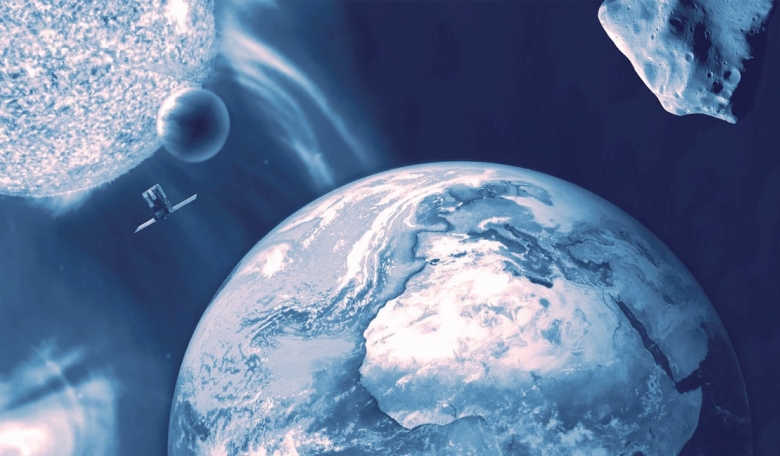
The increasing accessibility of space has made the detection, tracking, and categorisation of the large volume of objects in orbit ever more critical. In this article, Mohammad Dabbah looks at the role artificial intelligence can play in enhancing our capabilities in space situational awareness (SSA) and suggests it is becoming an integral part of the new Space Age.
American philosopher Eric Hoffer’s much-cited quote (below) conveys a very important message: automation, or artificial intelligence (AI), is not as artificial as we think it is.
There have been many exciting developments in the field of autonomy and AI in recent years. Some of these advances can be argued to have been achieved due to the closer approximation of automated systems to nature. Take, for example, deep convolutional neural networks (CNNs) which have proven very effective in areas such as image recognition and classification.
The fact that the machine learning architecture is designed to interface with images directly, without the need for feature extraction, has resulted in a much more powerful tool that mimics the biological process of vision.