

01 February 2016 News

How to Make Intelligent Robots That Understand the World

TEDxESA
TEDxESA

There are some amazing robots roving the surface of Mars. However, they are heavily dependent on their human operators. But what if we could provide them with human-like intelligence so that they could find their own way without assistance? What if we could teach them to autonomously deal with completely novel situations? Danko Nikolić, a neuroscientist at the Max-Planck Institute for Brain Research, has his own vision: a novel approach to Artificial Intelligence (AI) that could give robots the capability to understand the world through a method called “AI-Kindergarten”. So, can we provide for a sufficiently strong artificial intelligence to enable a robot to find its way in an environment as hostile and as unpredictable as space? (TEDxESA)


Popular articles

Popular articles

Space agencies and the armed forces are susceptible to conspiracy theories, largely due to the perceived lack of transparency concerning their activities. Above: Major Jesse A. Marcel holds a piece of foil-lined material related to the Roswell, New Mexico, UFO incident at Fort Worth Army Airfield, 8 July 1947 (Photo: University of Texas at Arlington Libraries Special Collections Division). Astronautics

Winning the Space Race at home

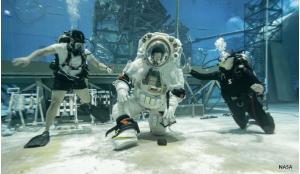
NASA astronaut Loral O’Hara kneels to pick up a rock while testing the mobility of Axiom Space’s lunar spacesuit. NASA and Axiom Space teams held the first dual spacesuit run at the Neutral Buoyancy Laboratory in Houston in September 2025 with astronauts Stan Love and Loral O’Hara. This was the final integration test in the pool, proving both the spacesuit and facility are prepped and ready for Artemis mission training. Astronautics

Who will build humanity’s future in space?