 08 October 2026
Axiom Space outlines plans for its commercial space station, next-generation lunar spacesuits and orbital computing infrastructure at the 77th International Astronautical Congress (IAC) in Türkiye.
 15 September 2026
Space Cargo Unlimited has signed a contract with SpaceX to fly a next-generation one-tonne space factory aboard Starfall, launching on a SpaceX Starship rocket in 2028.
 15 July 2026
As Europe invests billions in sovereign space infrastructure, industry experts warn that achieving long-term autonomy will require Europe to scale optical communications so that its space systems can remain technologically competitive.
 01 July 2026
New portal provides on-demand thermal imagery for critical resource monitoring, risk detection and operational decision-making day or night, worldwide.
 20 May 2026
As Europe works to move beyond congested radio bands in space, Lithuanian space company Astrolight has commissioned a new ESA-backed optical ground station in Greece to support in-orbit testing of high-speed and secure optical links between satellites and Earth. Optical communication enables up to 100 times faster data transmission than traditional radio and is near-immune to electronic warfare attacks like jamming.
Space industry veteran Rick Tumlinson warned at the European Space Economy Summit in Lisbon that Europe risks falling behind in the global space race without bolder ambition and reform. In a keynote address, he argued that while humanity’s expansion into the Solar System is inevitable,
London-based Spaceflux has been selected as the optical systems partner for a multi-million-dollar Canadian military space surveillance programme, in a notable export of UK-developed space domain awareness technology to an allied defence partner.
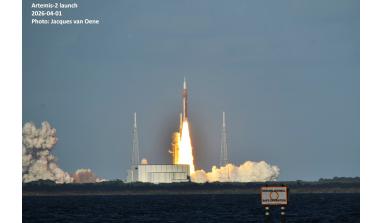
NASA’s SLS (Space Launch System) rocket lifted off from Launch Pad 39B at the agency’s Kennedy Space Center in Florida at 6:35 pm. EDT on 1 April, sending four astronauts aboard the Orion spacecraft on a planned test flight around the Moon and back.
New issue of ROOM Space Journal brings together leading voices from global space sector at a time when the industry itself is entering a decisive new phase.
The European space industry lags behind the US and China due to insufficient and fragmented funding from both public and private sources, a McKinsey report claims. According to the report, the majority of funded European startups are early-stage and not yet ready for commercialisation.