

The launch of the Artemis II lunar mission, planned for early February 2026, marks the long-awaited return of astronauts to the vicinity of the Moon.
It is almost 54 years since the crew of Apollo 17 completed the final mission of the Apollo series, in December 1972, and the space sector has been waiting, since then, for someone to go back.
In fact, the crew of Artemis II will only get within a few thousand kilometres of the lunar surface, as this mission is more concerned with verifying the hardware than exploration. So, in that sense, the mission is closer to Apollo 8, which looped around the Moon in December 1968.
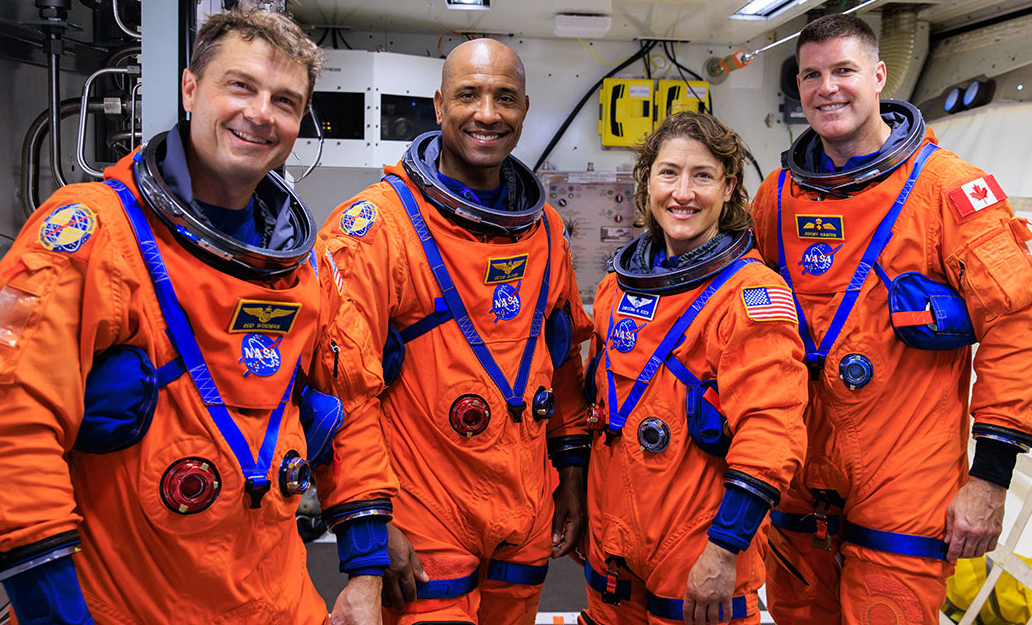
NASA’s Reid Wiseman, Victor Glover and Christina Koch, and CSA (Canadian Space Agency) astronaut Jeremy Hansen are the Artemis II astronauts.
The hardware being tested on this mission includes the Orion capsule - or multi-purpose crew vehicle (MPCV) - supplied by NASA and its Service Module supplied by the European Space Agency (ESA). Apollo, too, had both components, but of course it was an entirely US-funded programme.
In another parallel with Apollo, the launch vehicle designed to deliver Orion to the Moon is also under test, at least in terms of its long-term reliability. NASA’s Space Launch System (SLS) has so far flown only once (without a crew), on the Artemis I mission in November 2022. Clearly, if the Artemis programme as a whole is to be successful, the SLS must continue to perform.
Following the Artemis II launch from Kennedy Space Center, Orion and an upper stage, known as the interim cryogenic propulsion stage (ICPS), will orbit Earth twice to ensure that Orion’s systems are working as expected. After the ICPS delivers Orion to a higher orbit, the capsule will separate and perform a close-proximity manoeuvre test using the upper stage as a target. This is partly in preparation for the docking and undocking operations that will be required in lunar orbit on later missions.
Orion’s service module will then perform a translunar injection burn to place the spacecraft on a free-return trajectory, looping it around the Moon and automatically returning it to Earth. This is much like the figure-of-eight trajectory followed by Apollo 8, except that the latter orbited the Moon 10 times before its return.
During Artemis II’s 10-day mission, Orion will coast somewhere between 6400 and 9600 km above the lunar far side, depending on the precise trajectory, and is thus expected to break the distance record set by Apollo 13 for the furthest humans from Earth.
Meanwhile, NASA and its partners continue to develop the lunar-orbiting Gateway station to support missions between lunar orbit and the surface, and other hardware to support lunar exploration (such as satellite constellations for communications and navigation).
The next named Artemis mission - to land astronauts at the Moon’s south pole - is currently planned for ‘mid-2027’, but there seems very little chance that Artemis III will meet this schedule, not least because of delays in developing the lunar lander. So, for now, Artemis II remains the focus of interest for the lunar exploration community and its next best hope.
# #
Editor’s note:
As of 28 January, the Artemis II launch is planned for 6 February at the earliest, with launch windows spanning 6-8 and 10-11 February; if it misses these windows there are others in March and April but everyone, not least the astronauts in quarantine, hopes for an early lift-off.