 24 March 2017
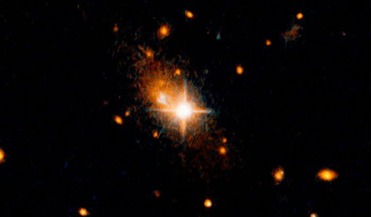
Gravitational waves expel black hole from galaxy centre
... 1 billion suns, that has been kicked out from its parent galaxy by these ripples in space-time. By using the NASA/ESA Hubble Space Telescope, an international team of astronomers have found that a quasar, the tell-tall sign of a supermassive...
 01 September 2017
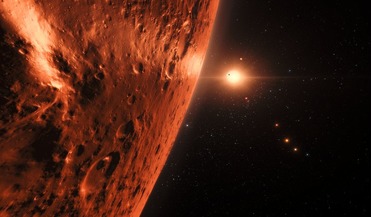
TRAPPIST-1 planets could contain substantial amounts of water
... further weight to the idea that this trio of exoplanets could indeed be habitable. Using the NASA/ESA Hubble Space Telescope, an international team of astronomers followed up the initial discovery, with observations to study that amount the amount...
 07 April 2021
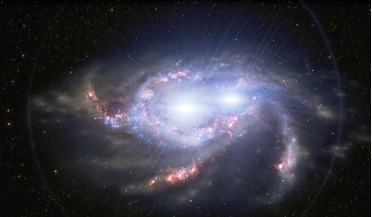
Astronomers find a rare pair of double quasars in the early Universe
... to identify four potential quasar pairs, that were narrowed down to two pairs with the help of the Hubble Space Telescope. Finally, the team used the the Gemini Multi-Object Spectrograph (GMOS) on Gemini North to hone in on the...
 16 May 2018
Astronomers find stars forming just 250 million years after Big Bang
... of Japan, reconstructed the earlier history of MACS1149-JD1 using infrared data taken with the Hubble Space telescope and NASA's Spitzer Space Telescope. After modelling the data, Hashimoto and colleagues found that the observed brightness of the...
 15 April 2020
Scientists discover most brightest and energetic supernova yet
... such energetic explosions occur in nature, NASA's new James Webb Space Telescope will be able to see similar events so far away that... programme. The team also used data from the Hubble Space Telescope, the Keck and Gemini Observatories, in Hawaii, ...
 23 January 2017
New results from HST show relativistic jets on scales rarely seen before
Using the Hubble Space Telescope, which recently celebrated 25 years of operation, a team of astronomers have been able to measure the kiloparsec-scale proper ...