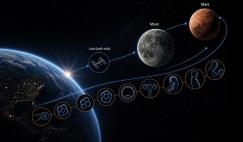


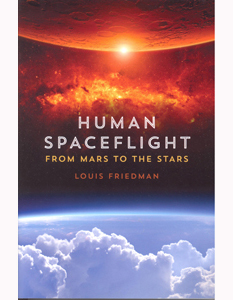
Although progress in the past half-century of human spaceflight would suggest otherwise, most futurists rejoice in the hope that, one day, mankind will explore the solar system and ‘venture forth towards the stars’. By contrast, Louis Friedman, former NASA engineer and co-founder of The Planetary Society, believes that “humans will become a multi-planet species by making it to Mars, but no farther”. Although he realises that some readers will find this to be negative and tantamount to “giving up on the future”, he feels his “job” in this book is “to prove the opposite”.
In the words of a surprisingly brief cover-blurb, the author “lays out a provocative future for human space travel using nanotechnology, space sails, robotics, biomolecular engineering, and artificial intelligence”. In other words, we won’t get beyond Mars, but our technological avatars will!
Friedman says he used to be “disturbed by this” and even “fought against it”, but he is “no longer distressed by the robots winning the ultimate space race”. He even goes as far as to suggest that the experience will be “more satisfying”, because we’ll be able to do so much more. He expands on his thesis in the course of 10 short chapters illustrated with black-and-white photos. There is also a colour photo insert, an appendix on “A Human Mars Mission”, a set of chapter notes and an index.
What the reader takes away from this book will depend to a large extent on where they start: if they believe that human space exploration is too expensive and can be done more efficiently by unmanned probes, they will be cheering the author on; others may find his thesis defeatist and depressing.
Is space exploration to become little more than an expensive multi-player, virtual-reality video game? Personally, I hope not, but only time will tell. Luckily for those who believe in the almost limitless capabilities of technology, most futurists who have predicted that something is impossible have ultimately been proven wrong.
Mark Williamson, Space Technology Consultant