

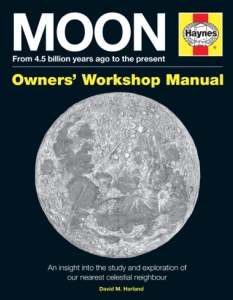
‘Who owns the Moon?’ is a question often heard in space law sessions at international conferences. The short answer is no-one but that hasn’t stopped Haynes producing one of its Owners’ Workshop Manuals on the subject. Subtitled ‘From 4.5 billion years ago to the present’, it offers ‘an insight into the study and exploration of our nearest celestial neighbour’.
In a dozen chapters, it guides us from classical times, via a potted history of famous astronomers, to lunar missions through the Space Age. The book is well illustrated in colour and monochrome which, along with all the charts and diagrams, give the volume a relatively ‘text-light’ appearance. That said, it is well written and informative.
As designed, it is an excellent introductory text on the Moon for students and others who need an overview, while providing sufficient detail and historical background to keep more advanced readers engaged. Many of the images will be familiar, but the colour shots of the Chinese Chang’e lander and its rover Yutu – one of each taken by the other – are far less widely known.
There is very little on future plans though, understandably, these are difficult to predict. In a postscript, the author quotes Arthur C Clarke when asked if there was anything in the preceding 100 years that he could not have anticipated: with typical aplomb he replied “yes”, that “we would have gone to the Moon… and then stopped”.
Mark Williamson