

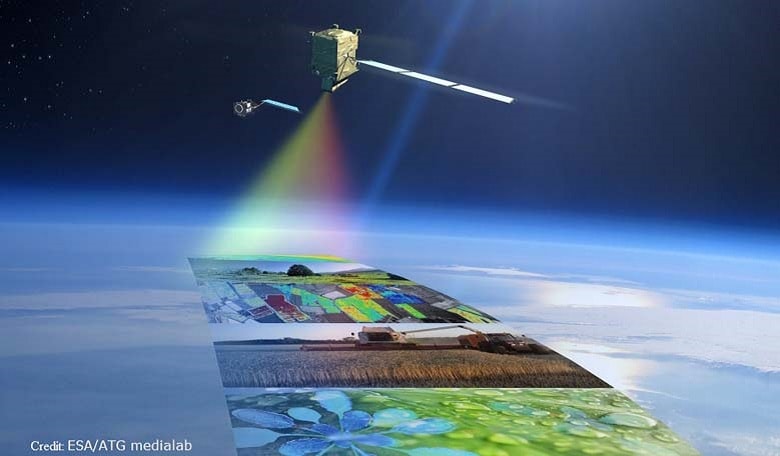
The European Space Agency plans to monitor the health of the Earth's plants by detecting and measuring the faint glow plants produce during photosynthesis.
The satellite chosen by ESA for this mission will be the the eighth Earth Explorer, planned for launch by 2022.
FLEX - the Fluorescence Explorer - will improve our understanding of the effect photosynthesis has on carbon and water cycles on our planet.
Photosynthesis is a fundamental yet extremely complicated process, and a vital one for life on Earth. Every plant has a "solar power" system that collects energy from sunlight and produces chemical energy for photosynthesis and heat. A healthy plant in good environmental conditions will also produce a faint fluorescence during this process. FLEX will be fitted with a novel sensor that will enable it to observe this faint glow, a feat that has never been possible before.
FLEX will orbit in tandem with one of the Copernicus Sentinel-3 satellites, taking advantage of its optical and thermal sensors to provide an integrated package of measurements.
ESA's Earth Explorer missions are meant to utilize new ways of observing Earth from space in order to improve our understanding of the planet.