 01 September 2017
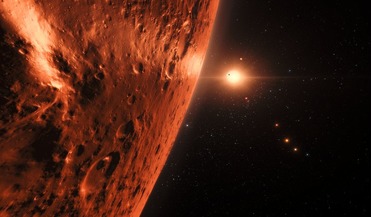
TRAPPIST-1 planets could contain substantial amounts of water
... atoms can escape the exoplanets’ atmosphere. Instruments such as the Space Telescope Imaging Spectrograph (STIS) onboard Hubble can then be used to detect the departing hydrogen. The amount of ultraviolet radiation emitted by TRAPPIST-1, does indeed...
 16 October 2017
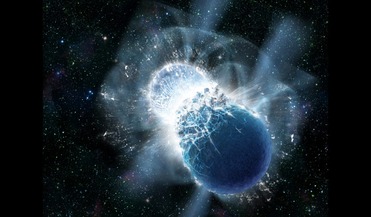
First detected neutron star merger reveals more than gravitational waves
... Constant — a unit of measurement to describe the expansion of the universe, first proposed by Edwin Hubble after he announced in 1929, that galaxies, from all directions, appeared to be moving away from us. GW170817 is the first ...
 03 April 2018
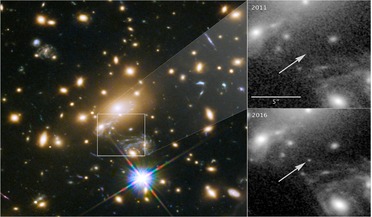
Astronomers unexpectedly find the most distant star ever discovered
... it’s light was magnified 2000 times greater than normal and Hubble just happened to be poking around in the same galaxy ...of this distant star got magnified, making it visible for Hubble,” says Patrick Kelly from the University of Minnesota, USA,...
 03 July 2019
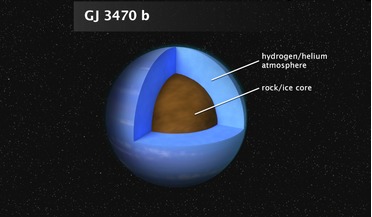
New study reveals detailed exoplanet atmosphere
...study that uses the combined multi-wavelength capabilities of NASA's Hubble snd Spitzer space telescopes to understand its chemical make-up. Gliese ... looked long ago. Observation by NASA's Hubble and Spitzer space telescopes have chemically analyzed ...
 11 September 2019
First detection of atmospheric water vapour on 'super-Earth' in habitable zone
... ‘normal’ star light to ascertain any differences. Although the precise composition of the atmosphere cannot be extracted – Hubble is brilliant, but its not technically capable of determining chemical signatures like other dedicated telescopes – the...
 07 April 2021
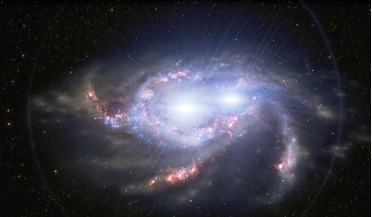
Astronomers find a rare pair of double quasars in the early Universe
... down to two pairs with the help of the Hubble Space Telescope. Finally, the team used the the Gemini...student at John Hopkins University and the principal investigator of the Hubble observations. “It opens a new direction where we can accumulate...