

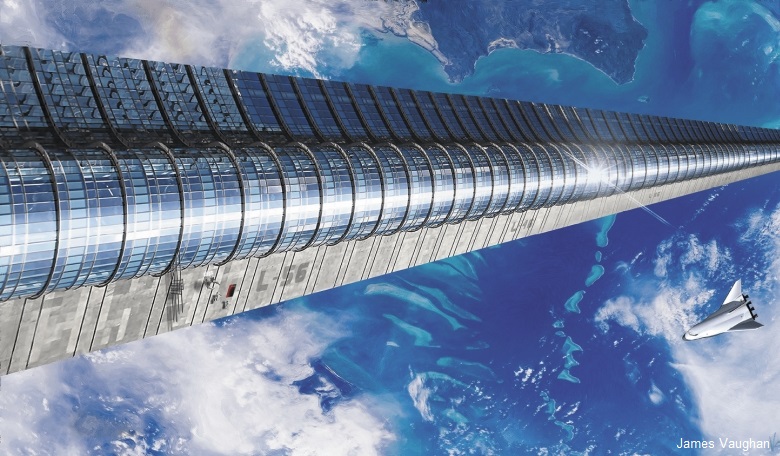
To truly explore the stars, we must develop the capability to lift massive amounts of materials into space, which will require a far more efficient and capacious delivery solution than current launch vehicles, including the SpaceX Starship. Here, the authors describe their concept for a Galactic Harbour as part of a Dual Access to Space Architecture, a far-reaching idea that includes an inter-planetary transportation system or Space Train to ferry people, materials and supplies between the Earth and Mars.
SpaceX CEO, Elon Musk has publicised his intention to create an independent civilisation on Mars of 100,000 or even a million people by 2050… but a major issue for interplanetary travel is the repeated launching of significant amounts of mass from the Earth’s surface onto interplanetary trajectories.
Analysis has shown that it is stretching the imagination to think that one can use rockets with a payload capability of 20 megatons (MT) to move the materials required to support the vision of moving humanity off-planet.
Using current technology, it would take literally tens of thousands of launches and hundreds of years to achieve this goal. To lift enough mass to satisfy Elon Musk’s desired one million people and one million tonnes to the Martian surface, the StarShip would have to be launched roughly 40,000 times.