

Issue #4(22) 2019 Lounge

Apollo girl - camaraderie and discrimination in the Apollo era

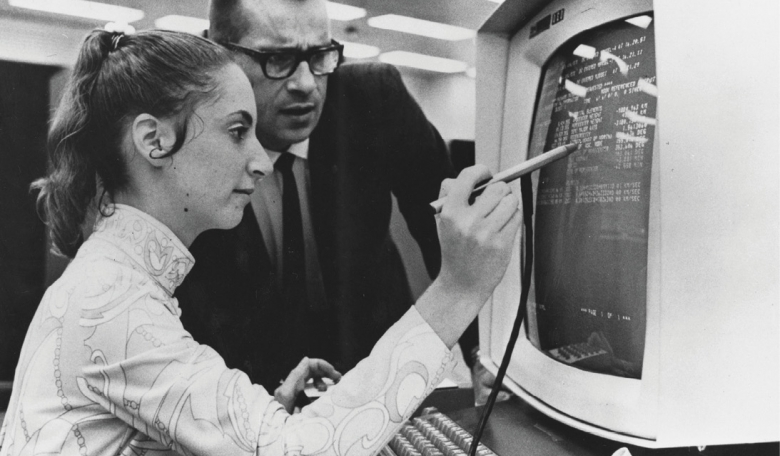
Rhoda Hornstein and colleague Paul Niner prepare for the Apollo 12 mission in October 1969.
Rhoda Shaller Hornstein NASA, USA (retired)

In the summer of 1968, one month after graduating from the University of Maryland, the author reported for duty at the NASA Goddard Space Flight Center as an aerospace technologist in the Data Operations Branch of the Manned Flight Planning and Analysis Division. Here, she reflects on her role in the Apollo 11 mission and other projects in a 46-year career at NASA that encompassed the highs of camaraderie and the lows of discrimination. Among other things, she addresses how a ‘girl’ in a man’s world coped with these conflicting attitudes through the lens of what she defines as the ‘Apollo Mentality’.

I belong to the generation of women whose lives were programmed at birth when the doctor announced: “It’s a girl!” Working for NASA was not part of my programming, but happened quite by chance, and endured for over 46 years. My father was a mechanical engineer and my mother an elementary school teacher. Although my parents, teachers and high school guidance counsellor expected me to graduate from college, they did not expect me to pursue a career that would interfere with marriage and motherhood.

If you already have a login and password to access www.room.eu.com - Please log in to be able to read all the articles of the site.

Popular articles

See also

Specials

Lessons from our first race to the Moon

Astronautics

Promoting growth at geostationary orbit with a one-stop-shop

Astronautics

Innovations in human astronautics

Popular articles

This private sector space race is creating a new ‘Wild West’ in space, the ultimate ‘New Frontier’ of human innovation. An imaginative artistic interpretation of the theme by artist James Vaughan. Opinion

Why the global space sector needs urgent regulation

Data poisoning targets the AI model’s training phase. By surreptitiously injecting corrupted, mislabelled or maliciously crafted data into the training dataset an adversary can compromise the model’s integrity from its inception. Specials

AI cybersecurity - challenges in space