

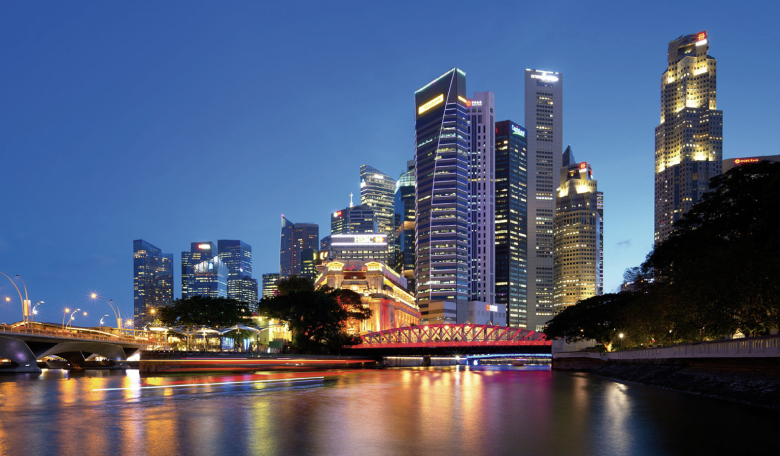
Singapore is known globally as an international centre for finance and hub for global transport, but is arguably less well known for its efforts in space technology. As this south-east Asian republic celebrates the formation of its national space agency, the author describes the nation’s space strategy and its ambitions in the global space market.
Singapore has big ambitions in space technology, carving its own distinctive niche in this rapidly expanding sector. Since 2011, the country has launched more than 30 satellites, drawing on its strengths in advanced manufacturing, aerospace, electronics and R&D. For international companies, this signifies clear opportunities, underlining how the city-state is putting its weight behind space technology development and looking to work with overseas partners.
The Government took a major step forward in April 2026 by launching the National Space Agency of Singapore (NSAS). This has combined activities previously carried out by a range of organisations, signalling a clearer long-term direction. For companies working in satellite data, communications or related services, this is a good time to start paying attention.
 The illuminated Supertree Grove at Gardens by the Bay in Singapore.
More focused approach
Singapore has been building capabilities in space-related technologies for years. Research institutions, startups and government programmes have all contributed, but progress has not always been joined up, making innovations hard to scale. NSAS now helps to consolidate relevant initiatives and gives the sector much greater cohesion.
The Agency’s approach is also deliberately focused. Singapore is not trying to compete with major space powers in launch activity or deep space missions. Instead, it is concentrating on areas where it has a realistic edge, such as satellite data, communications and specialised components.
The global space economy is already worth more than USD600 billion and could reach USD one trillion by the early 2030s. Most of that value comes from downstream activities such as data, communications and space services rather than rocket launches.
There is also a strong link to Singapore’s national priorities. Space technology supports fields including connectivity, environmental monitoring and, by improving shipping-route tracking, supply chain resilience. Importantly, this increases the likelihood that government funding and policy support will follow.
Demand from industry
For companies working in satellite data, commun-ications or related services, this is a good time to start paying attention
The Singapore Government plans to invest in advanced tools for Earth observation, secure communications, satellite image analysis and carbon monitoring, as well as space traffic and debris management.
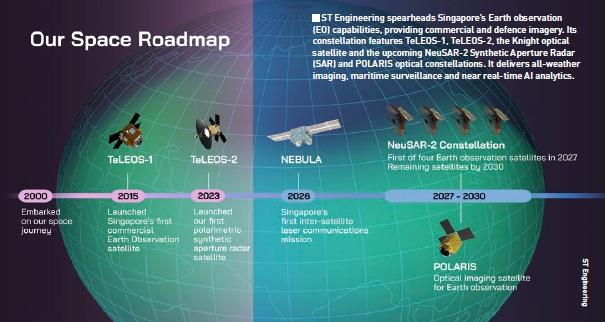
Space technology is already being deployed in Singapore to solve everyday business problems, a good example of which is in the maritime sector. For some time, Singaporean company ST Engineering’s Earth observation satellites have been used to track oil spills and monitor shipping activity in regional waters, providing data to agencies like the state’s Maritime & Port Authority.
In logistics and aviation, for example, satellite-based systems are helping companies to manage transport routes, improve visibility and respond to disruptions faster, which has become more important as supply chains have grown more complex.
Environmental monitoring is another area where the use of space technology is growing. Singapore’s Earth Observation Initiative, for example, is using satellite data to address issues such as food and water quality, disaster response and land management across the Asia Pacific.
Newer technologies are also starting to shape how data are used. For instance, a Singapore-developed nanosatellite is being designed to process and filter data directly in orbit using artificial intelligence (AI), rather than sending everything back to Earth.
Growing ecosystem
The space technology ecosystem in Singapore, although still relatively small, is developing in a steady and focused way. It comprises around 70 companies – ranging from startups to multinationals and research institutions – and employs approximately 2,000 professionals in the sector.
Moreover, several Singaporean companies are already gaining traction internationally. For example, Transcelestial is working on laser communication systems that can transmit data between satellites at high speed, while SpeQtral has launched a quantum secure satellite to enable encrypted communications, which is still a relatively niche capability globally.
Meanwhile, Aliena is developing electric propulsion systems for small satellites and Zero Error Systems is focusing on radiation-resistant electronics for space applications.
On the data side, ST Engineering Geo Insights provides geospatial analytics that turn satellite imagery into valuable intelligence for industries including agriculture and sustainability.
International players, such as San Francisco-headquartered Spire, are also present: it operates a large satellite constellation for weather and maritime data and includes a base in Singapore as part of its global network. In fact, Singapore hosts the regional HQs of most of the world’s top 10 satellite service providers.
For international companies, the opportunity in Singapore is about finding the right commercial fit. Satellite data services form one area where demand in the state is clear, with the emphasis shifting towards analytics and decision support. Companies that can turn data into usable insights stand out beyond those offering raw data alone.
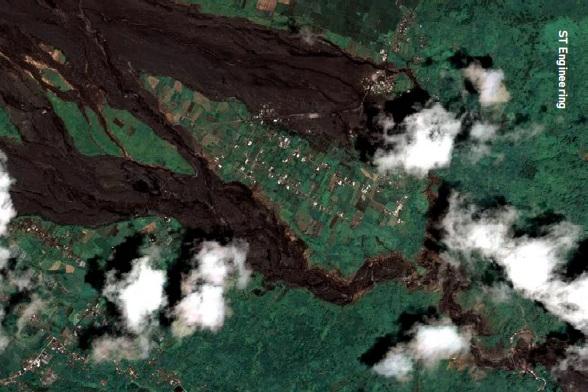 Extensive damage near Sumberwuluh village in Indonesia captured by one of ST Engineering’s EO satellites after Mount Semuru erupted in December 2022.
Space traffic management is another field to watch. As the number of satellites in orbit increases, managing congestion to avoid collisions is becoming vital. Singapore has identified this as a priority focus as it looks to protect its satellite assets and contribute to global standards.
Climate-related applications are also gaining traction. Technologies that support emissions monitoring, disaster response or environmental management align closely with regional needs and the Singapore government’s priorities.
The way companies approach Singapore matters as much as what they offer, and partnerships are often the starting point
More broadly, companies that bring specialised capabilities or experience from other markets have an advantage. Singapore is not trying to build everything domestically: it’s open to working with international companies that complement its capabilities and can help it to accelerate innovations.
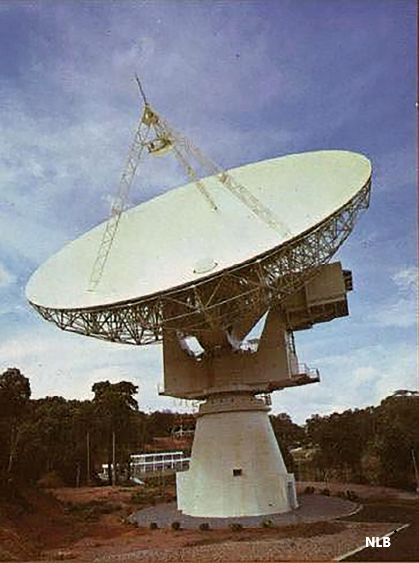 Singapore’s first satellite Earth station on Sentosa Island which was officially opened in October 1971. It enabled Singapore residents to receive direct television broadcasts from Europe and Japan.
Engaging the market
The way companies approach Singapore matters as much as what they offer, and partnerships are often the starting point.
Government agencies and research institutions play a central role in the ecosystem, so working with them can lead to pilot projects or funded programmes. Initiatives such as the Space Technology Development Programme, for example, which has more than USD150 million in funding, provide structured support for research, testing and commercialisation.
Collaboration with Singaporean companies is another important route. Many firms in the state are looking to scale and are open to partnerships which bring new complementary technologies or market access.
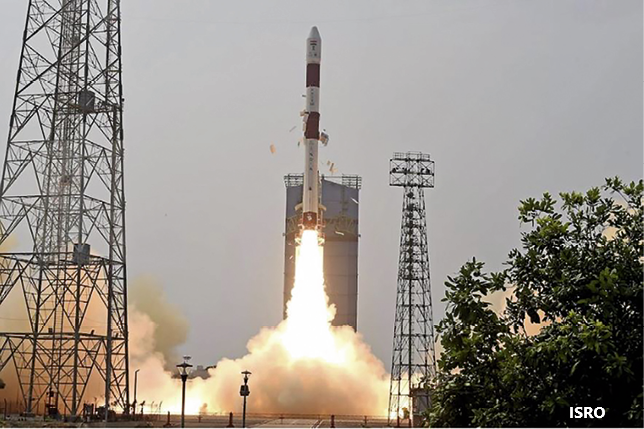 The TeLEOS-2 satellite equipped with an all-weather synthetic aperture radar for surveillance, was launched aboard the ISRO PSLV rocket in April 2023.
For some international companies, setting up a regional base in Singapore is also worth considering. The country often acts as a hub for Southeast Asia, allowing firms to engage locally and access a wider regional market.
In addition, a long-term approach tends to work better than short-termism. The sector is still developing and relationships take time to build. Companies that invest in understanding the ecosystem and aligning with national priorities are more likely to see lasting results.
So, in conclusion, although Singapore is not a large space technology market, its role and influence extend far beyond its size – as underlined by the launch of the National Space Agency of Singapore in April 2026. For international ‘spacetech’ specialists, the state offers a place to develop and test solutions in a stable environment backed by robust infrastructure, while the presence of domestic innovators and international companies makes it easier to form collaborations.
The core opportunity is to build a sustained position in the Singaporean market which can also support wider regional growth. Clearly, companies that enter with a clear focus, realistic expectations and a smart market development strategy are the most likely to succeed.
 NLBISROTeLEOS-2, developed by ST Engineering, provides round-the-clock, all-weather imagery.
About the author
Priyankar Bhunia is Head of Delivery for Southeast Asia at Intralink, a business development consultancy that helps companies to secure customers, partners and investors in overseas markets. Fluent in English, Hindi and Bengali, he specialises in projects focused on advanced technologies including spacetech, aerospace and high-tech manufacturing. Priyankar can be contacted at priyankar.bhunia@intralinkgroup.com and you can see more on Intralink at www.intralinkgroup.com