

Every spacecraft depends on ‘trust’ – in its hardware, its software and the commands it receives. But what if a fault caused by a burst of cosmic radiation is indistinguishable from one introduced by a cyberattack? Burak Oktenli explores why space engineers and cybersecurity specialists must begin treating these seemingly separate threats as a single challenge.
A satellite in orbit has no good way to tell the difference between bad luck and an enemy. When a bit flips inside the computer that flies the spacecraft, the symptom is identical: a register holds the wrong value, a control loop acts on it and the machine does something it was never supposed to do. Whether a cosmic ray struck the memory cell or an adversary corrupted the firmware months earlier on the factory floor, the cause is not immediately clear from the symptom.
That fact, simple as it sounds, is the reason two communities that almost never talk to each other – space and cyber – are guarding the same door from opposite sides, and neither can see the whole threat alone.
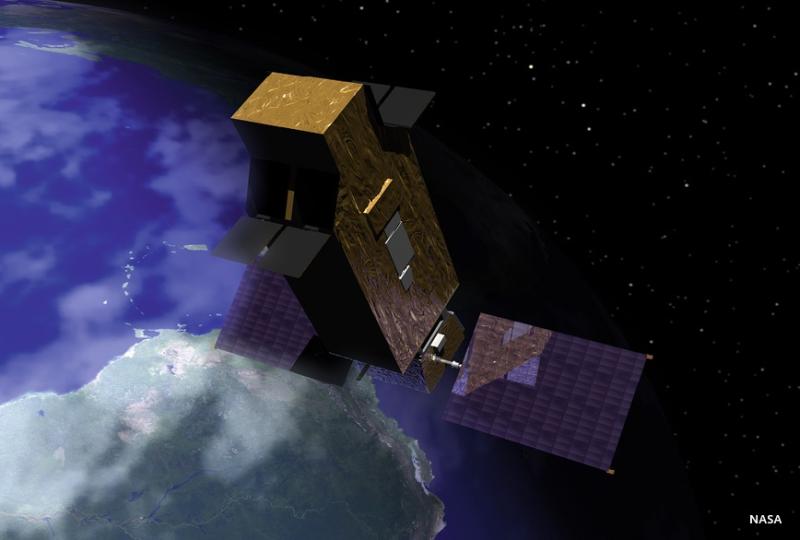 NASA’s Far Ultraviolet Spectroscopic Explorer (FUSE) experienced radiation-induced single-event upsets while passing through the South Atlantic Anomaly, illustrating how energetic particles can disrupt spacecraft electronics. FUSE acquired more than 6000 observations of nearly 3000 separate astronomical targets, including massive stars, supernova remnants and galaxies.
Space radiation
A satellite in orbit has no good way to tell the difference between bad luck and an enemy
The space community studies radiation. For decades its engineers have known that space is full of energetic particles and that when one passes through a chip it can deposit enough charge to flip a stored bit, glitch a logic signal or, at worst case, trigger a destructive latch-up. a sustained high-current state that can permanently damage the device if power is not interrupted
None of this is exotic: an instrument on NASA’s Far Ultraviolet Spectroscopic Explorer (FUSE) logged a detector upset roughly once every three days as it passed through the South Atlantic Anomaly, the region where the radiation belt dips closest to Earth. Because Earth’s magnetic shielding is weaker there, satellites in low Earth orbit (LEO) routinely experience their highest rates of radiation-induced upsets while crossing the region.
Most can be corrected automatically, but FUSE illustrated how even routine radiation events can corrupt software or memory in ways that, if left unchecked, could affect spacecraft operations.
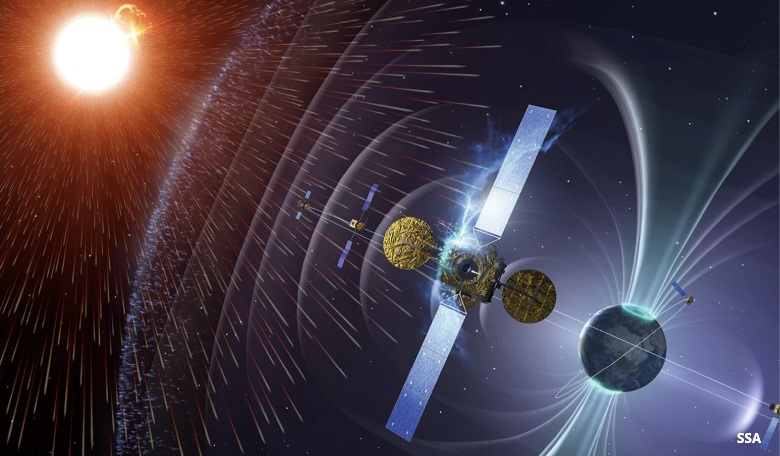
Space weather sharpens the effect and even a relatively modest space weather event can have mission-wide consequences. During disturbed periods the flux of energetic particles increases and the upset rate increases with it. The broader hazard was made vivid in February 2022 when a minor geomagnetic storm thickened the upper atmosphere and increased drag by about 50 percent, dragging 38 newly launched Starlink satellites back into the atmosphere only days after launch.
Radiation-induced faults are a routine and measurable reliability parameter that mission designers budget for, the way a bridge engineer budgets for wind, but the problem is not standing still. As chips shrink, each memory cell holds less charge, so it takes a smaller strike to flip a bit, while the same particle can now corrupt several neighbouring cells at once and defeat the simple error-correction processes that assume faults arrive one at a time.
Physics even affects the most advanced hardware we are starting to field. Controlled experiments show that a single cosmic ray can induce correlated errors across many superconducting qubits at once, creating what researchers have described as ‘catastrophic error bursts’ that standard quantum error correction struggles to absorb because it assumes errors occur independently. Thus the exotic machine inherits the same vulnerability as the ordinary one, because both rest on physical matter that a particle can disturb.
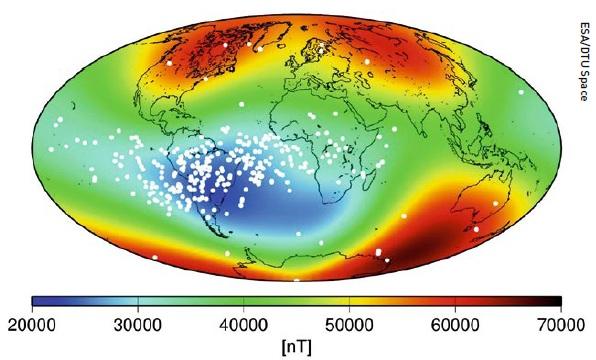 The ‘South Atlantic Anomaly’ refers to an area where our protective shield is weak. The white spots on this map indicate where electronic equipment on a satellite (TOPEX/Poseidon) was affected by radiation as it orbited above.
Cybersecurity
The fix does not require a new theory. It requires treating control-layer integrity as one problem with two sources
Meanwhile, the cyber community studies attackers, and its concern is that the conventional electronics, firmware and software running every spacecraft come from a long, global supply chain, and any link in it can be compromised.
A counterfeit part, a tampered firmware image, an undocumented component buried in a board - each can corrupt the same registers and control values that a cosmic ray corrupts, except that it does so deliberately, persistently and at a time of the attacker’s choosing. Unlike radiation damage, these faults may remain dormant for months or years before being triggered, making them particularly difficult to distinguish from ordinary hardware failures once they appear.
Federal guidance now treats supply-chain and firmware integrity as a first-class concern for space systems precisely because the threat is documented, not hypothetical. The exposure is widened by two facts of the domain. Many spacecraft fly far beyond their original design life and were built before cybersecurity was a design consideration, so the control software running them was never hardened against a deliberate adversary.
Moreover, the ground segment - the stations that command the satellite and receive its data - is itself a control system that can be compromised, which is why federal sector guidance singles out governance and access control at the ground as a primary protection for command and control. An attacker does not need to reach orbit to corrupt what the spacecraft does; the same control values can be poisoned from the ground.
Convergence
Here is what each side tends to miss. Radiation engineers see an upset and reach for the natural explanation, because in their world the environment is the adversary. Security engineers see a fault and suspect malice, because in their world someone always means harm. But the spacecraft cannot consult either worldview. At the level where the damage happens, a corrupted control value carries no label saying whether a particle or a person put it there.
Attributing it to one cause rather than the other requires outside context the system does not have in the moment: a record of the radiation environment during the event, or a trace of anomalous access during manufacture. A single observation cannot tell you which.
This convergence has a useful consequence, and it is the opposite of a counsel of despair. The defences that catch an accidental fault are largely the same ones that catch a deliberate one. Error-correcting codes that fix a radiation-flipped bit also catch corruption from a tampered component. Redundant logic that votes out a particle-induced glitch also votes out a malicious one. Firmware that can detect unauthorised change and restore itself to a known-good state defends against a cosmic ray and a supply-chain implant with the same mechanism.
Protect, detect, recover: the pattern is identical in both domains because the thing being protected is identical. The integrity of the control layer does not care what threatens it, yet we organise our institutions as if the threats were unrelated.
The cosmic ray and the cyberattack are not the same threat. But on the day the bit flips, they leave the same fingerprint
Radiation-hardness assurance and cybersecurity live in separate budgets, separate teams, separate standards documents and separate conferences. A part is qualified against the radiation environment by one group and assessed against supply-chain risk by another, and the two assessments rarely meet, even though they protect the same chip against failures that look the same once they happen. The cost is not merely inefficiency; it is that no one is looking at the full integrity picture of the system, only at two halves that each assume the other does not exist.
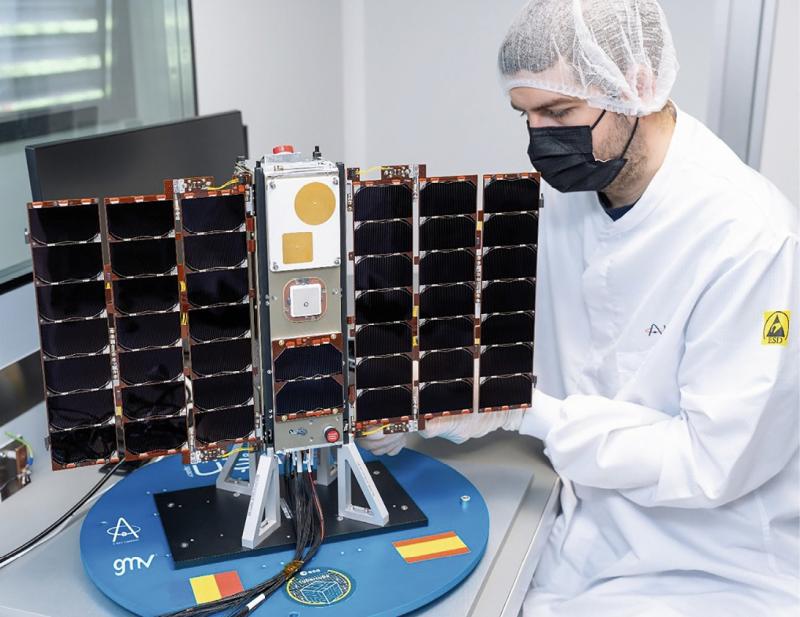 ESA’s CyberCUBE was launched on 7 July 2026 with the objective of validating advanced space cybersecurity technologies.
The fix does not require a new theory. It requires treating control-layer integrity as one problem with two sources. A mission that already models its radiation environment can fold that same awareness into its security monitoring, so that an upset during a quiet space weather period gets a second look rather than an automatic shrug. A programme that already audits its supply chain can recognise that the firmware it is hardening against attackers is the same firmware that must recover from a particle strike, and design one recovery path instead of two.
The resilience frameworks already exist to express this: anticipate the fault, withstand it, recover from it, adapt. They were written for cybersecurity, but they describe radiation reliability just as well, because both are asking a system to maintain its integrity under stress.
None of this is a reason to fear space or to distrust every chip. It is a reason to stop pretending that accidental and adversarial faults are different problems for different people. The most advanced spacecraft we fly, and the most advanced computers we are starting to put near them, all rest on a classical control layer that can be corrupted by nature or by an enemy, often indistinguishably.
A force that defends that layer as a single entity will be harder to surprise than one that splits the job in half and hopes the seam never shows. The cosmic ray and the cyberattack are not the same threat. But on the day the bit flips, they leave the same fingerprint, and the system that survives is the one built to recover no matter which finger made it.
About the author
Burak Oktenli holds a BS in Computer Science Engineering from the University of South Florida and is completing a Master of Professional Studies in Applied Intelligence at Georgetown University. He writes on the governance and integrity of autonomous, computing and space systems, with a focus on where engineering reliability and cybersecurity meet. His commentary has appeared in the Modern War Institute at West Point, the Royal United Services Institute and RealClearDefense. He is based in Washington, DC.