

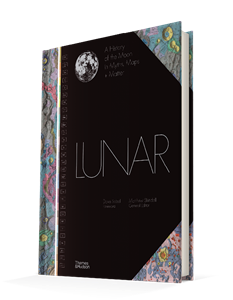
The Artemis missions to return astronauts to the Moon have reminded us that our closest astronomical neighbour is more than a shining disc in the night sky; it’s also a destination. And if you’re going on a trip, you need a map, don’t you?
This book is based on a collection of 44 lunar maps created and adapted throughout the Apollo era (1962-1974) to provide a unique geological reference for the lunar near side. Initially drawn from earthbound telescopic views, the maps were updated as the Lunar Orbiters and Apollo astronauts delivered more precise and ‘ground truth’ data on the geology, or selenology, of the Moon. The result is a cartographic tour de force of colour-coded geological maps showing major features and their material compositions. As ‘Longitude’ author Dava Sobel says in her foreword, “I’ve never seen the Moon quite the way it appears here – a black-and-white world rendered in a riot of gorgeous colours”.
However, if the consultant editor and his publisher had stopped there, they would have limited their market to a few professionals, institutions and libraries. Recognising that the Moon means more to humanity than its geological make-up, they assembled a team of some 20 contributing authors to place the Moon in a historical, sociological and generally more human context. This is reflected in the ‘myths’ and ‘matter’ of the subtitle, where ‘matter’ covers the factual side of eclipses, phases, space exploration, etc.
It is, of course, possible to read a book like this from cover to cover, but it can also be accessed more randomly via the contents list. In a sense, this seems obvious, but its use of a tabular format for the contents allows the reader to prioritise myths, maps or matter, depending on interest or mood, readily identifying groups of pages on a particular subject, relevant dates and so on. This means that summaries of tides, or the Apollo programme, or movies based on the Moon can be found with ease; there is also a decent index for those with more specific interests.
The book is large format (37 x 27 cm) and would make a fine addition to any coffee table. It is colourfully illustrated (even beyond the geological maps) and succinct in its presentation of the diverse subject matter. Perhaps the only criticism is the choice to present facsimile pages of the original maps which include graphics and text that cannot be discerned at the scale of even a book as large as this. No doubt the argument was that they had to be included for completeness, but the counter-argument is ‘why bother?’. The book already includes a double-page spread showing all 44 map-sheets at ‘postage stamp scale’ (and even a spread of their original manilla envelopes!), so the comprehensive angle is covered. It would have been better to simply reproduce the maps themselves as ‘art pieces’ rather than present the reader with thumbnail images and unreadable text.