 17 April 2019
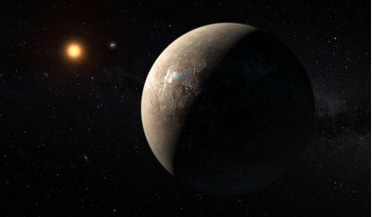
Proxima Centauri may host a second exoplanet, but its first might not be there
17 April 2019
Proxima Centauri may host a second exoplanet, but its first might not be there
... and Anglada-Escude who spotted Proxima b back in 2016, used the radial velocity or “doppler shift" method to detect Proxima c and b respectively. Radial velocity is an indirect method which relies on observing a star’s spectra for signs of a “wobble...
 19 May 2017
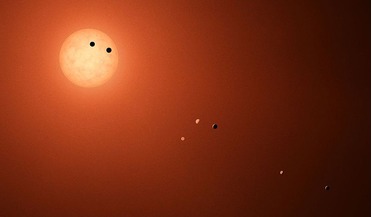
Exoplanets galore and possibly the next Trappist-1 system?
19 May 2017
Exoplanets galore and possibly the next Trappist-1 system?
... Observation list to search for the exoplanets. HARPS itself stands for the High Accuracy Radial Velocity Planet Searcher and it is through the radial velocity method – also known as the watching the wobble method – that these exoplanets were...
 27 October 2021
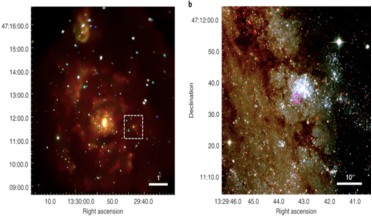
Astronomers may have detected the first planet outside of the Milky Way
27 October 2021
Astronomers may have detected the first planet outside of the Milky Way
...or transit detection techniques, just doesn’t work the same when trying to spot extragalactic exoplanets. The radial-velocity method for finding exoplanets, or wobble method as it is also known by, relies on detecting minute changes in a star’s orbit...
 July 2021
Arecibo - an astounding legacy
July 2021
Arecibo - an astounding legacy
... and its value is crucial to understanding the nature of atomic spectra, which in turn allows astronomers to measure the radial velocity of galaxies from which these spectral lines are observed. Observations have led to the discovery that galaxies...
 07 December 2020
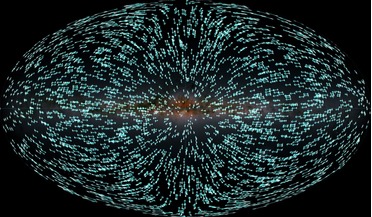
New Gaia data measures Solar System's acceleration
07 December 2020
New Gaia data measures Solar System's acceleration
... the Universe. Launched just under seven years ago, Gaia has been collecting unprecedented positional and radial velocity measurements of an increasing number of stars in our Galaxy to create a 3D map of our galactic neighbourhood; a figure which has...
 19 January 2016
Giant double-planet system around an evolved star detected by astronomers
19 January 2016
Giant double-planet system around an evolved star detected by astronomers
..., as one day our Sun will evolve to be a red giant. The authors of the paper state, that to date, radial-velocity surveys have discovered about 120 substellar companions around such evolved stars and that interestingly, almost...