

Planetary defence is rapidly emerging as one of the defining challenges of the 21st century. While governments continue to devote vast resources to military spending and geopolitical rivalries, the risks posed by asteroid impacts and orbital debris grow more urgent each year. In this powerful essay, Mexican journalist and author Ariadne Gallardo Figueroa calls for a fundamental shift in priorities. Her argument is both ethical and practical: humanity must learn to treat near-Earth space not as an arena for competition but as a fragile, shared environment that demands stewardship and cooperation. From the successes of missions like NASA’s DART and ESA’s Hera, to the looming dangers of Kessler syndrome and unchecked satellite growth, Gallardo highlights the stakes with clarity and urgency. As ROOM editorials have long argued, space security and sustainability are not optional – they are essential for the survival of our species. This article is a timely reminder that planetary defence is not only a scientific endeavour, but also carries with it a profound moral responsibility.
Achieving a true reinvention of space requires a shift in global priorities from militarisation to planetary defence; for unprecedented international collaboration, an ethical reorientation, and recognition of the value of investing in technologies that protect life on Earth.
Governments and international organisations must re-evaluate current approaches, prioritising sustainability and peace over conflict and aggression. Space exploration should inspire nations to work together, driving innovation that benefits humanity and safeguards both our cosmic and terrestrial environments. Only through joint commitment can we ensure a future where technology advances responsibly and space resources are used for all, rather than becoming another arena of rivalry.
One of the most profound uncertainties we face is the threat posed by asteroids. Many remain undetected, and some arrive unexpectedly. The largest – emerging from the Oort Cloud or the asteroid belt – represent dangers capable of uniting humanity under a common cause. Planetary defence must be central to how we understand and explore space.
Militarisation versus planetary defence
Only through joint commitment can we ensure a future where technology advances responsibly and space resources are used for all
Human society has long been dominated by power struggles, with nations competing to control resources, wealth and influence. Economic blocs exert constant pressure on the international system, while conflicts consume energy that could otherwise be directed to safeguarding our shared planet.
Technology, instead of serving equity, is too often harnessed to consolidate national power. The global arms industry continues to expand: in 2025, military spending reached an estimated US$2.7 trillion, with the United States alone accounting for more than a third of this. Yet experts estimate that with just four percent of global defence budgets, world hunger could be eradicated – or planetary defence significantly strengthened.
The question is simple: without a planet, what is left to fight over? Humanity must learn to protect the home that gave us life, progress and the ability to dream of the stars. Our evolutionary leap will not come through conquest but through care, memory and reverence for what sustains us.
 Colour images of sky constructed from the PS1 catalogue using source density and total fluxes in various filters. Pan-STARRS is a system for wide-field astronomical imaging developed and operated by the Institute for Astronomy at the University of Hawaii.PS1SCComet
Cosmic threats
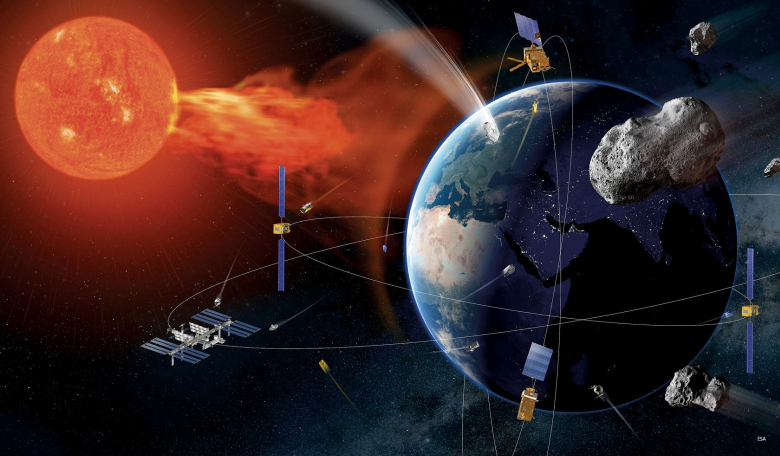
The greatest existential threat may not come from rival nations but from a celestial body capable of reducing civilisation to ashes. Military arsenals cannot defend us from a large asteroid. While small objects can sometimes be deflected, the impact of a large asteroid remains unmanageable with today’s technology.
At the same time, we risk trapping ourselves in a man-made crisis: Kessler syndrome – a cascade of orbital collisions that could render near-Earth space unusable. Despite this, governments continue to prioritise satellite megaconstellations and competitive space deployments over cooperation and sustainability.
Satellites are vital to communications, navigation, and planetary monitoring. But their uncontrolled proliferation, driven by commercial and military interests, poses growing risks. If orbital space becomes unusable, our capacity to track and mitigate asteroid threats will be dangerously compromised.
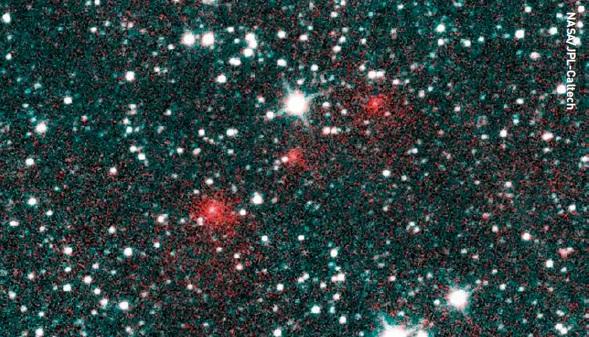 Comet C/2020 F3 NEOWISE appears as a trio of fuzzy red dots in this composite of several infrared images captured by the asteroid and comet-hunting NEOWISE mission on March 27, 2020. These observations helped astronomers determine the comet’s path shortly after its discovery.
Current vision and global cooperation
Fortunately, planetary defence is beginning to emerge as an international priority. Several agencies and networks already play critical roles:
- NASA Planetary Defence Coordination Office (PDCO): Established in 2016, coordinates detection, tracking, and mitigation strategies, including the successful DART (Double Asteroid Redirection Test) mission that altered the orbit of asteroid Dimorphos.
- ESA Planetary Defence Office: Partner in the Hera planetary defence mission, which will study the aftermath of DART’s impact, and the planned Ramses (Rapid Apophis Mission for SEcurity and Safety) mission to study the asteroid Apophis in 2029.
- IAWN (International Asteroid Warning Network): Created by the United Nations (UN) in 2014, facilitates data exchange and global response protocols.
- SMPAG (Space Mission Planning Advisory Group): Also under the UN, evaluates possible missions and promotes international standards.
- JAXA (Japan): Partner in Hera and Ramses, providing advanced technologies.
- CNSA (China): Developing its own asteroid deflection mission, alongside a broader planetary defence strategy.
These efforts underscore an essential point: cosmic threats respect no borders. Planetary defence requires early detection, deflection technology, and - most critically - political coordination.
Obstacles to collaboration
Humanity must learn to protect the home that gave us life, progress, and the ability to dream of the stars
Despite progress, not all space agencies collaborate openly. China and Russia, for example, pursue largely independent programmes, sometimes forming alliances that exclude the West. Geopolitical rivalries hinder trust, limit data sharing, and slow the development of unified protocols.
The Outer Space Treaty (1967) provides a foundation for the peaceful use of space. Its key principles - peaceful purposes, prohibition of military bases, international responsibility, non-appropriation, and cooperation - align naturally with planetary defence. Yet too often, national sovereignty and competition override these commitments.
Healthy examples of cooperation do exist. Mexico’s AztechSat Constellation Project with NASA, the UK’s participation in ESA despite Brexit, and agreements linking the UK with Mexico, France, Canada, and Australia show that even in a fractured world, collaboration is possible. But maintaining these efforts requires political will and shared trust.
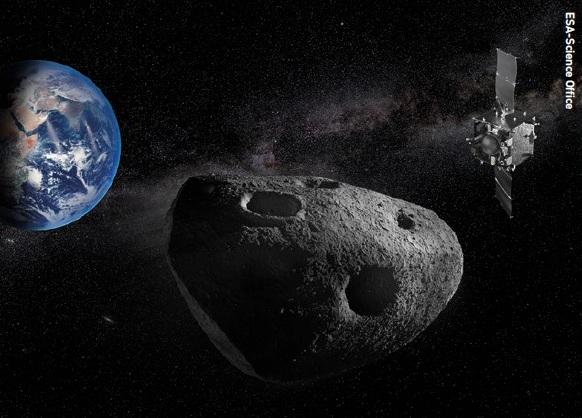 Artist’s impression of ESA’s Rapid Apophis Mission for Space Safety (Ramses). The Ramses spacecraft will rendezvous with Apophis before it passes Earth and accompany the asteroid during the flyby to observe how it is warped and changed by our planet’s gravity.
Technology, resources and ethics
Planetary defence demands constant innovation in detection, monitoring, and mitigation. Technologies like NEOWISE (Near-Earth Objects Wide-field Infrared Survey Explorer), Pan-STARRS (Panoramic Survey Telescope & Rapid Response System) and ATLAS (Atmospheric Laboratory of Applications and Science) provide essential tracking capabilities, while the Center for Near Earth Objects Studies (CNEOS) Sentry system projects impact probabilities over the next century. Yet trust in these systems is just as important as their precision.
Missions like OSIRIS-REx and Hayabusa2 have advanced our ability to sample and understand asteroids, using innovative collection methods rather than deep drilling. Some companies are exploring asteroid mining for metals like platinum and nickel, but these ventures raise complex legal and ethical questions.
The challenge is not just technological but philosophical: will we exploit asteroids as we have Earth, or will we learn to approach space with care and restraint?
Growing threat of space debris
Alongside asteroids, space debris has become an undeniable reality. More than 30,000 tracked objects orbit Earth, with hundreds of breakups and collisions producing further fragments.
Today, the probability of a collision remains low, but projections suggest this could rise to 20 percent by the end of the century. With more than 9000 satellites already in orbit - a figure expected to exceed 60,000 by 2040 - the risks are accelerating.
Recent studies show that satellites burning up in the atmosphere release pollutants that may affect the climate and ozone layer. In this sense, orbital debris is not just an astrophysical issue but an environmental one.
Encouragingly, innovative solutions are emerging: The RemoveDEBRIS mission, led by Surrey Space Centre (University of Surrey) and partially funded by the European Commission, has successfully demonstrated active debris removal and PERSEI Space in Spain is developing electrodynamic tethers for autonomous satellite deorbiting. Proposals for orbital tugs and recycling workshops are also gaining traction.
Yet as CEO and co-founder of PERSEI Space Jesús Manuel Muñoz Tejeda noted, “When satellites are launched, they remain there unless someone goes to pick them up - and nobody wants to pay for that.” Without agreed mechanisms for responsibility and cost-sharing, debris will continue to accumulate.
Towards a planetary ethic
Protecting Earth is not an act of dominance but of survival, and in that shared endeavour lies the possibility of a new planetary ethic
Planetary defence is not only a scientific and technical challenge but an ethical urgency. Humanity must learn to prioritise cooperation over confrontation and stewardship over rivalry.
The path forward requires:
- Rebalancing priorities: Redirecting even a fraction of global defence spending toward planetary defence and space sustainability.
- Strengthening frameworks: Expanding the reach of the UN’s planetary defence mechanisms and updating the Outer Space Treaty with enforceable norms for debris mitigation.
- Investing in innovation: Supporting technologies for detection, deflection, and debris removal.
- Building trust: Encouraging transparency and inclusion, so that all nations – large and small – can participate in safeguarding Earth.
Ultimately, planetary defence offers an opportunity for humanity to demonstrate its capacity for unity and foresight. Protecting Earth is not an act of dominance but of survival, and in that shared endeavour lies the possibility of a new planetary ethic.
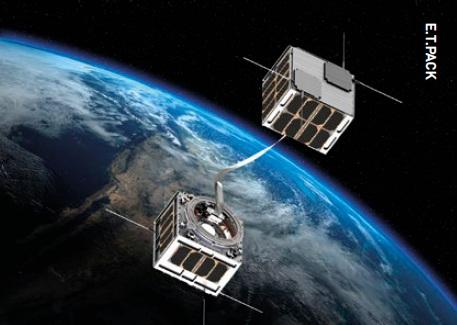 PERSEI Space is preparing its EDT technology for Passive Consumable-less deorbit Kit (E.T. Pack) for demonstration in 2026. The EDT technology offers a propellant-free approach to deorbiting defunct spacecraft and extending the operational life of active satellites.
Shared responsibility
The trajectory of humanity must be guided by unity, learning and the recognition that Earth remains our only home. By finding common ground and pursuing diplomatic, technological, and scientific collaboration, we can build the foundations for a sustainable future.
International coordination already exists – in debris mitigation, collision monitoring and cooperative missions – but must be strengthened and expanded. By working together, we can establish ethical, timely and effective rules for inhabiting the cosmos responsibly.
Planetary defence is more than a technical necessity: it is a profound test of our ability to act as one species in the face of shared threats. The greatest cataclysm may or may not come in our lifetime, but the choice is clear. We can continue to pour resources into weapons that divide us, or invest in defences that protect all of humanity.
If we succeed, we will take an evolutionary step – not as conquerors of space, but as its careful stewards, united by the shared responsibility of preserving life on Earth.
About the author
Ariadne Gallardo Figueroa studied communication sciences and has worked extensively across Mexico’s broadcasting industry. She has also worked in ethno-anthropological research and taught muralist and symbolic art workshops to children and in Indigenous communities. Currently she is dedicated to literary work of various kinds and participation in Asgardia the space nation as a parliamentarian.