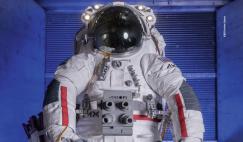


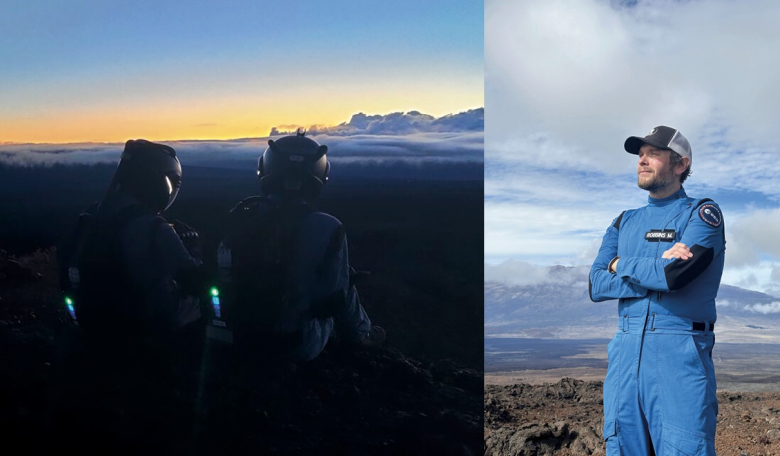
As human spaceflight enters a new phase, one of its most critical technologies remains strangely unchanged. Spacesuits, the fragile boundary between the human body and hostile environments, still rely on design principles rooted in the early days of the Space Age. In Scotland, a small team led by human-performance researcher Mason Robbins is working to challenge that legacy, rethinking spacesuits not as static hardware, but as adaptive biological systems – shaped by human physiology, microbial behaviour and the realities of long-duration use. This work sits at the intersection of craft and science, asking a simple question: what happens when we design for how humans actually live and move beyond Earth, rather than how we imagine they should?
Mason Robbins did not set out to build a spacesuit company. His career unfolded instead across analogue missions, human performance research and extreme environments – places where engineering assumptions are tested through fatigue, failure and adaptation. Over time, those experiences converged on a simple conclusion: the future of human space exploration will depend less on heroic hardware than on how well systems complement and support the human body itself.
That insight underpins Star Helix, the Scotland-based space biotechnology and human-performance company Robbins co-founded. Star Helix concentrates on the most demanding interface in spaceflight: the boundary between human physiology and hostile environments. It is here – inside spacesuits, habitats and life-support systems – that biological reality most often collides with engineering legacy.
As human spaceflight shifts toward longer missions, greater autonomy and renewed lunar ambition, that interface is under growing strain. Spacesuits remain among the most complex life-support systems ever built, but many of their core mechanical principles date back to the 1960s. They function reliably, but often at the cost of mobility, comfort and long-term human performance.
Robbins’ work challenges the assumption that incremental refinement is enough. Drawing on analogue exploration, biotechnology and rapid iteration, Star Helix treats biology as a primary design input. Human movement, microbial behaviour, fatigue and repairability are built into development from the outset, shaping systems intended for sustained use rather than short-duration exposure.
Spacesuits serve as the company’s most visible testbed, revealing with unusual clarity how engineering assumptions perform when subjected to biological reality. That testing has shaped a design philosophy rooted in use, iteration and adaptation – a framework increasingly suited to the demands of long-duration exploration beyond low Earth orbit.
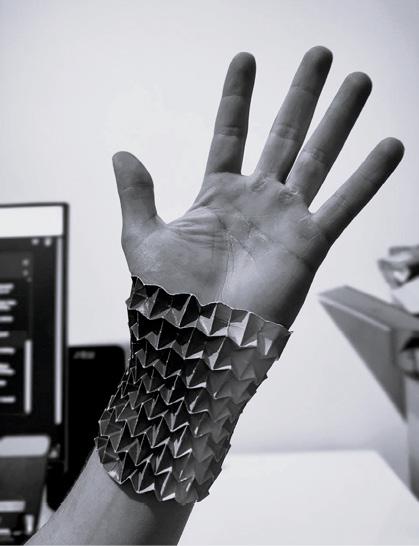 Star Helix explored origami-inspired joint geometries to achieve airtight integrity, structural strength and freedom of movement simultaneously, while reducing parts count and maintenance complexity.
Limits of legacy design
Human movement, microbial behaviour, fatigue and repairability are built into development from the outset
Modern extra vehicular activity (EVA) spacesuits are among the most demanding life-support systems ever built. They maintain pressure in vacuum, regulate temperature across extremes, manage oxygen flow and carbon dioxide removal, and shield astronauts from micrometeoroids and radiation. Yet for all their sophistication, many of their core mechanical principles date back more than half a century.
Joint architectures based on rigid rings and ball bearings remain standard, particularly in gloves and shoulders. These systems are proven and reliable, but they impose real costs: restricted mobility, chronic oxygen leakage, high maintenance demands and cumulative strain on the human musculoskeletal system. Over time, those costs translate into fatigue, injury risk and reduced operational efficiency.
For short-duration EVAs, such trade-offs have been accepted. But as human activity in space shifts toward longer surface operations, autonomous missions and sustained habitation, the tolerances narrow. The question facing engineers is no longer whether these suits work, but whether they work well enough for what comes next.
Robbins’ view is that incremental upgrades alone will not be sufficient. “You can improve materials and electronics indefinitely,” he argues, “but if the underlying interface between the human body and the system remains fundamentally constrained, you’re only postponing the problem.”
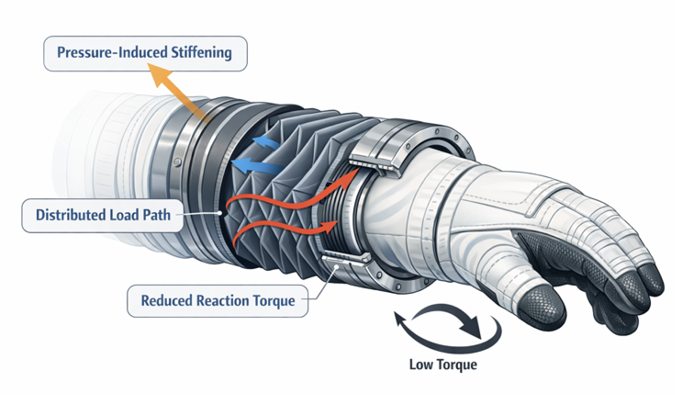 Illustration of an advanced spacesuit wrist joint using origami-inspired folded structures that distribute stress across flexible surfaces rather than relying on discrete mechanical components.
Human-centred, biotech-first approach
Star Helix approaches this challenge from a different starting point, treating biology as a foundational design input across the company’s work. Human performance, microbial behaviour, tissue stress and fatigue are not secondary considerations.
This ‘biotech-first’ philosophy reflects Robbins’ background in analogue exploration and human performance research, where theory is tested quickly against reality. In hostile environments – such as Arctic research stations, volcanic terrain or underwater habitats – design flaws reveal themselves rapidly. “Systems that look elegant on paper can fail in ways that matter deeply to the people inside them,” he says.
Star Helix’s development model mirrors that reality. Concepts move deliberately from laboratory research into analogue testing and flight-like demonstrations, aligned where appropriate with ECSS (European Cooperation for Space Standardisation ) and ISO standards but not constrained by traditional programme timelines. The objective is to learn early, iterate often and build evidence that reflects real use, not idealised conditions – a philosophy evident in the company’s work on pressurised garments.
The suit as a testbed
Robbins’ path toward spacesuit development emerged through a convergence of education, outreach and research. While working on STEM initiatives linked to SaxaVord Spaceport in Shetland, he connected to the University of Arizona’s Center for Human Space Exploration and, through it, to Cameron Smith – an anthropologist, explorer and long-time experimenter in pressurised garment design.
Smith’s work stood apart from institutional suit programmes. Over several decades, he had built and tested pressurised garments for high-altitude ballooning and extreme exploration, developing designs that prioritised simplicity, repairability and rapid iteration. His approach was informed less by procurement logic than by lived experience.
For Robbins, the collaboration was formative. Smith’s latest suit design – later named Grissom, after astronaut Gus Grissom – offered something rare: a fully pressurised garment designed as an experimental platform. Star Helix adopted the Grissom suit as a testbed for human factors engineering and bio-inspired innovation.
Learning from analogue
Simulation allowed weak concepts to be discarded early and promising ones to be refined before fabrication
Testing was not confined to laboratories. Iterations of the Grissom suit have been deployed across a wide range of analogue environments: volcanic landscapes in Hawaii used historically for Apollo testing, Arctic research stations, underwater facilities and confined structures designed to replicate aspects of off-world habitats.
Across these deployments, Star Helix and its collaborators have accumulated hundreds of hours of simulated EVA activity. The data generated is not abstract; it includes measurements of joint strain, oxygen leakage, microbial growth, wear patterns and human fatigue – the kind of detail that determines whether a system remains usable over weeks and months, not just minutes.
In Europe, this work has helped establish one of the few commercially operated full-pressure suit testbeds capable of supporting iterative development outside large agency programmes. For Robbins, that capability functions primarily as an enabler: a way to explore ideas quickly without waiting for institutional validation cycles.
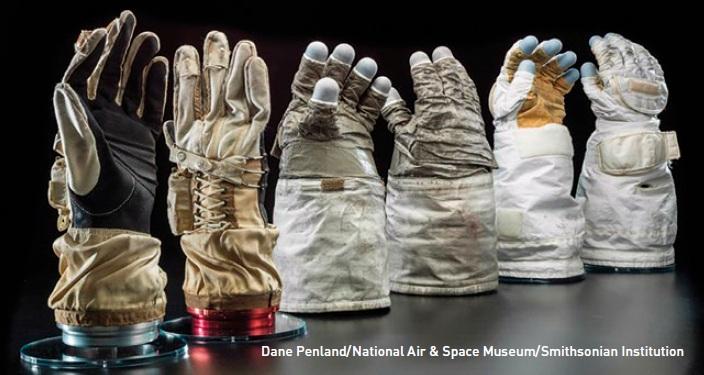 Gloves worn by astronauts Ed White (Gemini IV), Gene Cernan (Apollo 17) and Kathy Sullivan (STS 41-G).
Rethinking the joint
One of the clearest pain points revealed through testing has been joint performance, particularly in gloves and shoulders. Traditional bearing-based joints, while robust, concentrate stress, restrict motion and introduce persistent leakage paths. Over time, they contribute significantly to operator fatigue and injury risk.
Star Helix questioned the necessity of bearing-based joints altogether and the resulting work explored origami-inspired joint geometries – folded structures that distribute stress across flexible surfaces rather than relying on discrete mechanical components. The objective was to achieve airtight integrity, structural strength and freedom of movement simultaneously, while reducing parts count and maintenance complexity.
Such designs lend themselves naturally to additive manufacturing, opening the door to rapid prototyping, field servicing and, in the longer term, in-situ fabrication in extraterrestrial habitats. They also represent a conceptual shift: from joints as mechanical assemblies to joints as structural forms.
Digital engineering as an accelerator
Transforming an unconventional joint concept into a credible engineering solution requires quantitative evidence. To support this, a chance meeting at a space conference led to Star Helix collaborating with TECHNIA, a digital engineering partner experienced in advanced simulation across high-consequence industries from automotive and Formula-1, to nuclear engineering and renewable energy. Leveraging these proven strengths - space organisations (such as satellite manufacturers, launch integrators, space agencies) can accelerate development, de-risk missions and improve lifecycle management of space assets – attractive features for Star Helix’s requirements. TECHNIA is, in fact, well placed to help the space industry move from document-based workflows to digital-first engineering, supporting missions today and enabling the next generation of space systems.
The collaboration focused on translating origami-based concepts into manufacturable geometries and subjecting them to physics-based analysis, using advanced Dassault Systèmes software on a rapid two-week development timeline with geometry modelling in SOLIDWORKS aligned with Star Helix’s existing software capabilities. Advanced analysis setup was then undertaken using SIMULIA, leveraging the powerful Abaqus solver, and multiple origami joint designs were evaluated against a baseline model, allowing trade-offs between rigidity, flexibility and durability to be assessed rapidly. TECHNIA’s collaborative dashboard on the 3DEXPERIENCE platform enabled seamless information sharing.
For Star Helix, the value of this work lay not in replacing physical testing, but leveraging Technia’s design and simulation expertise from multiple sectors, to accelerate it. Simulation allowed weak concepts to be discarded early and promising ones to be refined before fabrication. In a funding and certification landscape that increasingly demands quantitative justification, this combination of analogue testing and digital evidence proved critical.
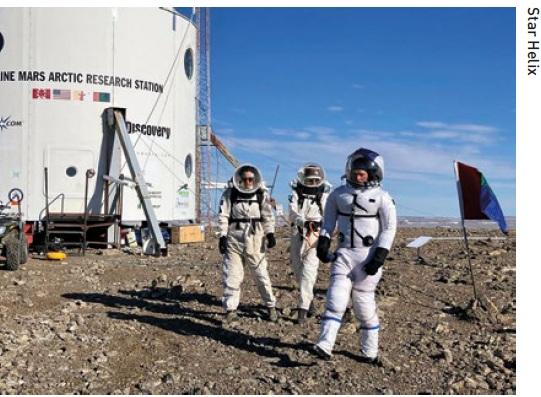 Hostile environments such as the FMARS Arctic Research Station in Nunavut, Canada, quickly test design theory against reality.
Biology as infrastructure
While spacesuits provide a visible focus for Star Helix’s work, they represent one expression of a broader strategy to integrate biology into mission-critical systems.
One of the company’s flagship developments is a bio-derived anti-biofilm platform designed to suppress microbial growth on surfaces in suits, habitats, cleanrooms and water systems. Microbial contamination is a persistent issue in closed environments, contributing to corrosion, health risks and increased maintenance.
Originally developed to address hygiene challenges in pressurised garments, the platform has since demonstrated relevance across terrestrial sectors, including healthcare and industrial hygiene. The principle is consistent: solve for space, and the solution often proves valuable on Earth.
In parallel, Star Helix is exploring melanised mycelia as a lightweight radiation-shielding material, alongside biomimicry-inspired suit components designed for rapid field servicing. While these technologies sit at varying levels of maturity, they share a common thread – treating biological systems as assets rather than liabilities.
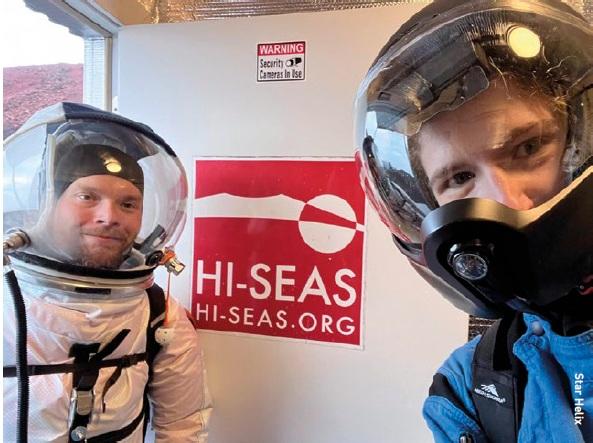 Star Helix directors Mason Robbins and Natasha Nicholson testing heart rate variability in different spacesuits, pressurised (left) and unpressurised (right) at the Hawaii Space Exploration Analog and Simulation (HI-SEAS) facility.
A European contribution
Technologies developed for extreme environments often find application in hazardous industries on Earth, from energy to emergency response
Europe has played a central role in human spaceflight through modules, life-support systems and scientific payloads. Spacesuits themselves, however, have remained largely outside the continent’s industrial base.
By developing full-pressure suit capability and associated technologies within Europe, Star Helix contributes to a more balanced exploration ecosystem. This is not about duplication for its own sake, but about resilience and optionality as international missions and commercial platforms proliferate.
The implications extend beyond space. Technologies developed for extreme environments often find application in hazardous industries on Earth, from energy to emergency response. In this sense, investment in human spaceflight capability reinforces broader societal resilience.
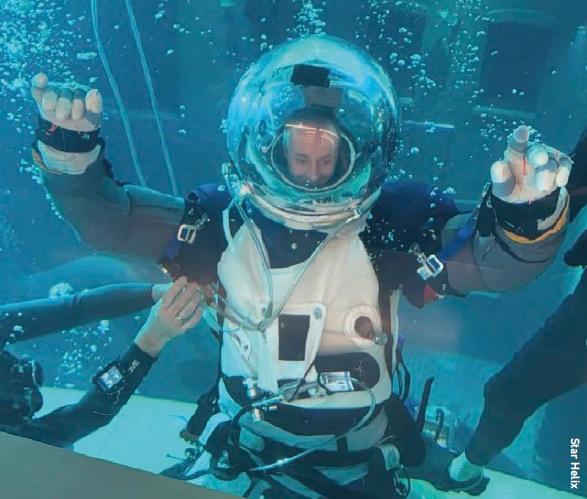 Testing of the Neutral Buoyancy Suit, designed by Cameron Smith, in collaboration with the International Institute for Astronautical Sciences, Blink and Deep Dive Dubai.
Designing for what comes next
Star Helix remains an early-stage company, but its trajectory reflects a wider shift underway in the space sector. As missions become longer and more autonomous, success will depend less on singular engineering feats and more on systems that adapt to human needs over time.
For Robbins, the lesson from analogue exploration is clear: environments change, humans change, and systems must change with them. Spacesuits, perhaps more than any other technology, reveal whether that adaptability has been designed in from the start.
The work underway at Star Helix reframes how the problem of human survival beyond Earth is approached. It replaces static solutions with iterative systems grounded in biological reality.
If humanity is to establish a sustained presence on the Moon, Mars and beyond, the technologies that support us will need to evolve continuously. That evolution, increasingly, is being shaped not only in large programmes and agencies, but in smaller teams willing to test ideas at the edge of human performance. 
About the author
Richard Osborne is AstroAgency’s Chief Technology Officer, and a launch systems/strategic foresight expert. He previously worked as Programme Manager at orbital launch company Skyrora, and for companies including Reaction Engines and Airborne Engineering, as well as other work on launch systems, spaceports and propulsion consultancy over a number of decades. He specialises in space strategy, launcher and propulsion technology, trajectory and orbital analysis, spaceport analysis, downstream applications and technological & strategic forecasting. A Chartered Physicist, he has degrees in Physics, and Remote Sensing and Planetary Physics, as well as Solar Astrophysics research.