

The exploration of Mars is not just a scientific goal; it’s a dream that humanity has carried since we first looked up and wondered what lay beyond the sky. However, even as technology advances, one challenge remains unchanged: transit time. It still takes more than 200 days to reach Mars, which is not only a problem of convenience, but also of safety, mission cost and human endurance. The author offers a solution.
For thousands of years, stories, scriptures and philosophical texts have echoed our longing to reach the stars. From the ancient epics of the Ramayana, where sage Valmiki wrote of flying vehicles like Ravana’s Pushpaka Vimana, to the science fiction of the 20th century and the reality of satellites orbiting Mars today, the desire to travel beyond Earth is deeply rooted in humanity.
However, reaching Mars has always been more than just ambition. Technically speaking, it comes down to one key metric: delta-V, the total change in velocity a spacecraft must achieve across its mission profile. Unlike cars or aircraft, spacecraft can’t stop to refuel. Every manoeuvre, from launch to orbit insertion to interplanetary transfer must be powered by the propellant carried at launch. And for a round-trip crewed mission to Mars, that delta-V budget climbs quickly to over 20,000 metres per second.
Escaping Earth’s gravity alone requires roughly 9.3 km/s of delta-V. A Hohmann transfer to Mars adds around 3.6 km/s, plus mid-course corrections, Mars orbit insertion and, eventually, a return leg. Every bit of required delta-V increases the fuel mass, which increases the total spacecraft mass, which in turn increases the delta-V required. It’s an exponential feedback loop known in mission design as the tyranny of the rocket equation.
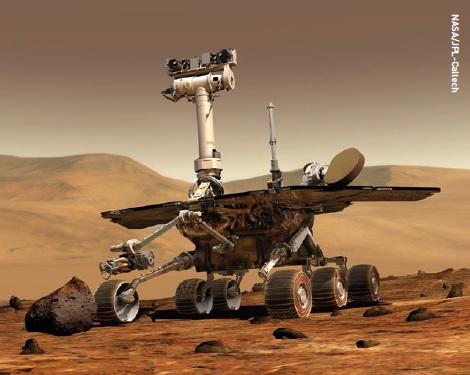 The tyranny of the rocket equation. The Curiosity rover on Mars has a mass of just over 1,980 pounds (900 kg), of which 165 pounds (75 kg) are science instruments. The rover launched on an Atlas V 541 rocket which, when fully fuelled and with the payload attached, weighed 117 million pounds (53,000 kg). So Curiosity required 1,169,835 pounds of additional mass to get it to Mars and to make it all work once on the surface. The ratio of instrument mass to total rocket mass is only a bit more than one one-hundredth of a percent of the total mass (0.014 percent).
Traditional chemical propulsion systems, like the engines used in the Saturn V or Falcon Heavy, offer high thrust in the range of 1000 to 3000 kilonewtons, but at a cost. Their specific impulse (Isp), which measures how efficiently a rocket uses propellant, typically maxes out at around 450 seconds. This means that they consume enormous amounts of propellant in a very short time and, for deep-space missions, they are simply too inefficient.
A potential solution is a hybrid nuclear propulsion concept that aims to break the traditional trade-off between high thrust and high efficiency
On the other hand, electric propulsion systems, such as ion thrusters, offer remarkable efficiency, with specific impulses exceeding 5000 seconds. These engines use electromagnetic fields to accelerate ionised xenon particles to velocities over 30 km/s, making them perfect for conserving propellant. However, they produce astonishingly low thrust. A typical ion thruster operates at around 0.5 to 2 newtons which is equivalent to the force imparted by a piece of paper here on Earth.
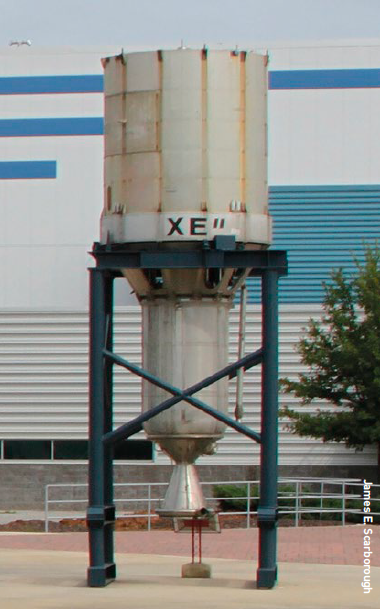 NERVA XE at the Marshall Space Flight Center in Huntsville, Alabama. The objective of the NERVA (Nuclear Engine for Rocket Vehicle Application) programme was to establish a technology base for nuclear rocket engine systems to be utilised in the design and development of propulsion systems for space mission application. The programme ended in 1973 and NASA’s ambitious plans for NERVA, including a visit to Mars by 1978, a permanent lunar base by 1981 and deep space probes to Jupiter, Saturn and the outer planets, were never realised.
Nuclear solution
The issue of the travel time to Mars is not a new problem. Back in the 1960s, when NASA was embarking on the early phases of lunar exploration, American engineers were working on NERVA (Nuclear Engine for Rocket Vehicle Application), which used a nuclear reactor instead of a chemical reaction to provide energy to heat a propellant.
In the MATLAB simulations run for the author’s project, a Nuclear Electric Propulsion system produced an acceleration of just 0.000037 m/s², meaning that it would take over 200 days to reach Mars assuming ideal conditions. That’s fine for cargo or robotic missions, but for humans it’s simply too long. Radiation from cosmic rays and solar storms accumulates. Muscles and bones deteriorate in microgravity. Life-support mass increases with every extra day in space for water, food, oxygen and shielding. Every additional kilogram adds to the fuel burden and every additional day adds to mission risk. It becomes a vicious cycle: the longer you’re in space, the more you require to survive; the more you need, the heavier the spacecraft; the heavier the spacecraft, the more thrust it needs to achieve the same velocity… and we are back to delta-V.
The challenge is clear and the constraints are real. What’s needed is a propulsion system that can deliver the delta-V required for Mars, with sufficient acceleration to reduce mission time and enough efficiency to remain practical.
A potential solution is a hybrid nuclear propulsion concept that aims to break the traditional trade-off between high thrust and high efficiency. The design integrates two propulsion modes: Nuclear Thermal Propulsion (NTP) and Nuclear Electric Propulsion (NEP) powered by a single onboard nuclear reactor.
The system architecture consists of a 124,000 kg spacecraft launched into low Earth orbit (LEO) using a conventional chemical propulsion system. Once in orbit, the chemical stage is jettisoned and the nuclear system takes over. At this point, the propulsion architecture transitions into its hybrid configuration, with a single nuclear reactor responsible for powering both the thermal and electric systems in different stages of the mission.
Stage one: Earth escape via NTP
By adopting this strategy, the total cruise time is reduced from 115 days to just 55 days
The first phase is built around Nuclear Thermal Propulsion, a high-thrust propulsion system that uses the heat from a solid-core nuclear reactor to energise a light propellant, in this case, hydrogen. The concept follows principles long explored in programmes like NERVA, where the propellant is heated to temperatures over 2500K and expanded through a nozzle to generate thrust.
In this design, the NTP engine produces a peak thrust of 334.87 kN with an exhaust velocity of 8829.4 m/s, resulting in a specific impulse of approximately 900 seconds. The hydrogen is expelled at a mass flow rate of 37.48 kg/s, and the system is operated for 13.8-minutes, the time required to add a delta-V of 4640.29 m/s.
Since the spacecraft is already in low Earth orbit with an initial velocity of around 7.8 km per second, this added velocity brings the total above 11.2 km/s, which is used to escape Earth. This phase is critical. Not only does it allow the spacecraft to escape Earth’s gravitational field, but also front-loads a significant portion of the mission’s required delta-V. By decreasing the propellant mass early in the mission, the system allows the subsequent electric propulsion phase to function more efficiently with a reduced burden.
Stage two: deep space cruise via NEP
Once clear of Earth’s gravity, the system transitions into a different mode. The same nuclear reactor now becomes an electrical power plant. Through a closed Brayton cycle, thermal energy from the reactor drives a high-efficiency turbine generator system. In this configuration, 2090.43 kW of thermal power is converted into 731 kW of electrical output, with an overall system efficiency of 35 percent. Of this output, 620 kW is dedicated to powering a pair of ion thrusters, each operating in electrostatic mode. These engines accelerate ionised xenon propellant to extremely high velocities.
The result is a combined thrust of two newtons and an incredibly low propellant mass flow rate of 0.00004 kg/s. While the thrust appears negligible, the key to NEP is not immediate force but constant acceleration over time. The system produces a continuous acceleration of just 0.000037 m/s², but in the vacuum of space, with nothing to hinder progress, this builds steadily into a sizeable velocity.
This makes NEP ideal for the cruise phase of interplanetary travel provided time is not a limiting factor. However, in the case of crewed missions, time is absolutely a constraint. Even after the initial high-thrust phase provided by the NTP system, the low acceleration of the electric thrusters becomes a bottleneck. While the NTP burn adds over 4600 m/s of delta-V and transitions the spacecraft into an interplanetary trajectory, the continuous thrust from the NEP system produces the low acceleration typical of ion thrusters. This means that, despite the initial velocity, the NEP system alone would still require approximately 115 days to reach Mars.
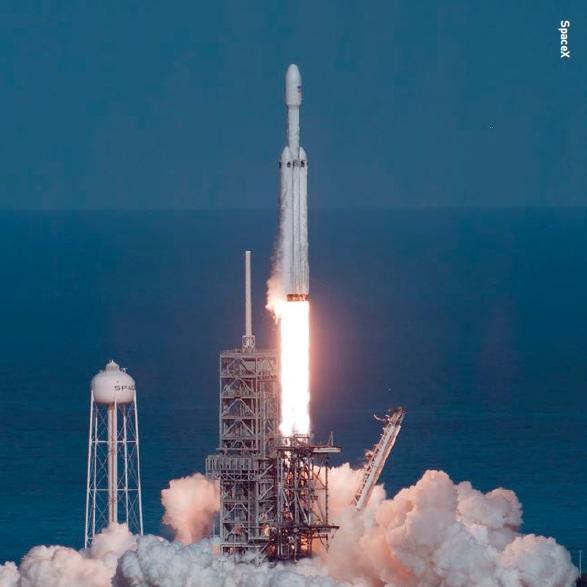 Traditional chemical propulsion systems, like the engines used in the Falcon Heavy offer high thrust, but at a cost. Their specific impulse (Isp), which measures how efficiently a rocket uses propellant, typically maxes out at around 450 seconds. This means they consume enormous amounts of propellant in a very short time and, for deep-space missions, they are simply too inefficient.
Hybrid strategy
The design requires no revolutionary propulsion breakthroughs, only the thoughtful orchestration of known technologies
To overcome this limitation, the hybrid system incorporates a periodic burn model. A short two-minute NTP burn is executed every 10 days during the cruise phase, layered on top of the ongoing electric propulsion. Simulation results show that each NTP burn significantly increases the spacecraft’s velocity by 643.69 m/s to 911.10 m/s at the point of the final burn. In between the NTP burns, the NEP system adds consistent velocity increments of approximately 26-41 m/s every 10 days. This alternating pattern of high and low thrust creates a stepped velocity profile that efficiently builds interplanetary speed.
By adopting this strategy, the total cruise time is reduced from 115 days to just 55 days which is a 52.7 percent reduction, while maintaining manageable propellant use and system simplicity. This method also avoids dependence on experimental technologies such as the wave rotor topping cycle, currently being studied by NASA and the University of Florida. While promising, wave rotors remain complex and new for integration into space-based nuclear propulsion systems. In contrast, the periodic burn model relies on well-understood, flight-proven technologies and offers a far more direct path to feasibility - a critical factor in the design of crewed interplanetary missions.
The complete mission architecture has been modelled and simulated, with dynamic parameters such as thrust, exhaust velocity, fuel mass flow and power conversion efficiencies coded into a system-wide trajectory model. Each subsystem was analysed for its individual performance before being integrated into the full mission profile. Particular attention was paid to energy balance across the Brayton cycle, thermal constraints on reactor operation and propellant utilisation during periodic NTP burns. The final simulation, with two ion thrusters running continuously and NTP burns implemented every 10 days, produced the above 55-day transit time. Moreover, the 52 percent reduction in transit time, compared to an NEP-only model, achieved a lower overall fuel mass fraction than an NTP-only mission.
What is critical here is not just the velocity, but the system balance: propellant mass, reactor load, energy conversion and flight dynamics all operate within stable, realistic limits. The design requires no revolutionary propulsion breakthroughs, only the thoughtful orchestration of known technologies.
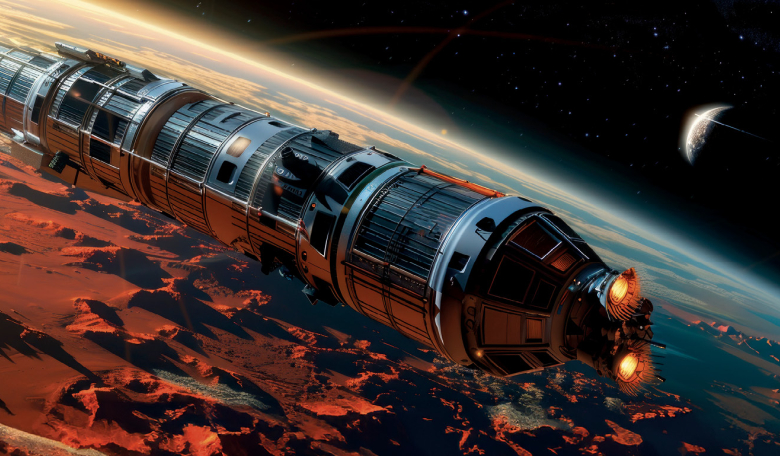
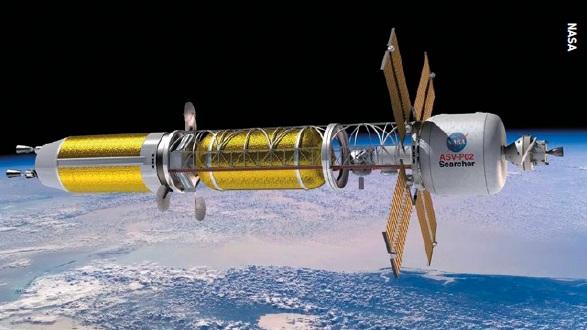 Illustration-of-a-spacecraft-enabled-by-nuclear-thermal-propulsion.
Human spaceflight implications
This hybrid model offers more than just a reduction in transit time; it introduces an unprecedented level of mission flexibility. With adjustable burn frequencies and durations, the propulsion system can adapt to varying launch windows, orbital alignments and even mid-mission contingencies. Such responsiveness opens the door to faster crew transfers, more agile robotic missions, and perhaps even a permanent cadence of interplanetary travel - one no longer constrained by prolonged stasis or inflexible timelines.
While significant engineering challenges remain, particularly in the areas of nuclear safety, in-space reactor deployment and long-duration radiation shielding, the architecture demonstrates a core feasibility: that a 55-day Mars mission is not only possible, but achievable using principles and technologies already within reach.
The broader implications are equally significant. A faster journey reduces crew exposure to radiation, minimises life support demands and enhances mission safety. It increases the feasibility of emergency-return options and improves the agility of both crewed and uncrewed interplanetary logistics.
This is not merely a technical evolution, it is a cultural and philosophical shift in how we think about our role in the Solar System
Moreover, on a policy level, it prompts necessary discussions around the deployment of nuclear systems in space, international regulations and the frameworks required to govern such missions responsibly. And, ethically, it raises important questions about how we approach risk, sustainability and our long-term responsibilities as a species expanding beyond Earth. This is not merely a technical evolution; it is a cultural and philosophical shift in how we think about our role in the Solar System.
In the end, propulsion is more than a matter of engineering; it is a gateway to possibility. The way we choose to move through space shapes the missions we can undertake, the lives we can protect and the future we can build. The hybrid nuclear model may not be the only solution, but it represents a compelling synthesis of known science and forward-thinking strategy. It is, arguably, a bold, practical step toward making crewed Mars exploration not only viable, but sustainable. If our journey to Mars is a test of will, wisdom and ingenuity, then reimagining how we get there may well be the key to unlocking the next chapter in human spaceflight.
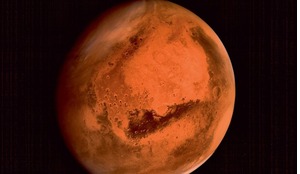
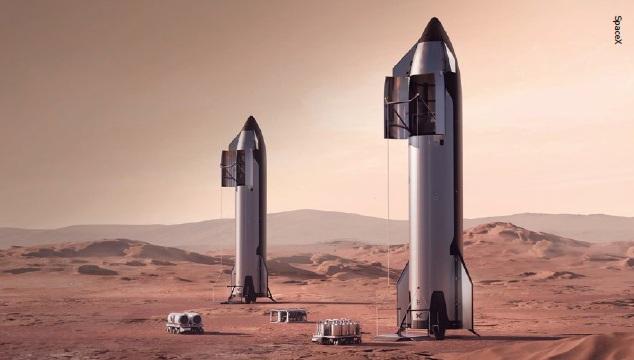 SpaceX plans to send the first unmanned Starship rocket to Mars in 2026.
About the author
Sweta Parmar is Founder & CEO, Agnia Aerospace Ltd, aerospace engineer and propulsion systems researcher, passionate about reshaping the future of in-space mobility through innovative propulsion technologies. Her pioneering undergraduate project introduced a novel hybrid nuclear propulsion architecture using a periodic burn model—an unconventional adaptation that sparked her deeper interest in high-efficiency propulsion systems. This early research became the foundation for her continued work in electric and hybrid propulsion, and ultimately inspired the founding of Agnia Aerospace, a space-tech startup aimed at advancing sustainable, intelligent propulsion for the next generation of spacecraft. Sweta envisions a future where affordable and reliable propulsion can democratise access to space and accelerate global space equity.