

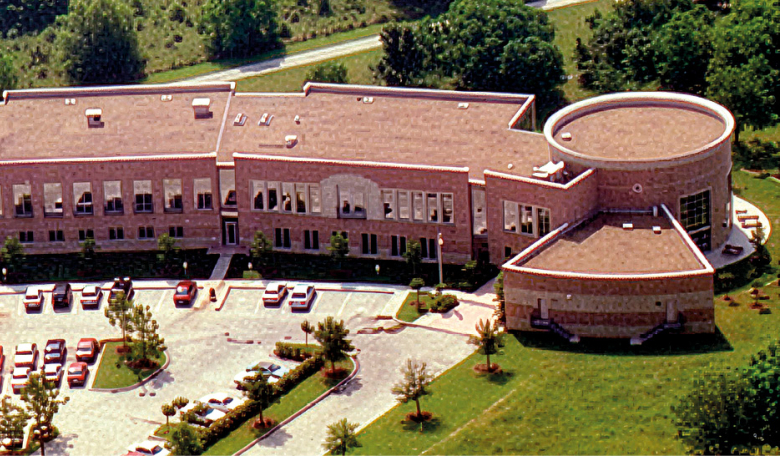
For nearly six decades, the Lunar and Planetary Institute (LPI) has advanced understanding of the solar system by providing exceptional science, service, and inspiration. Formed at the height of the Apollo era, the Institute became a unique bridge between NASA, academia, and the global scientific community. Its success has always rested on the breadth of its activities and the infusion of science into everything it does. Today, as planetary exploration enters a new era of missions and sample returns, LPI’s role remains as vital as ever.
During the mid-1960s, NASA was racing toward President John F. Kennedy’s goal of landing a man on the Moon. Recognising the need for deeper engagement with the academic community, NASA Administrator James Webb commissioned a committee led by Dr Frederick Seitz, President of the National Academy of Sciences. By July 1967, these discussions produced the concept of a Lunar Science Institute (LSI).
A defining moment came on 1 March 1968, when President Lyndon B. Johnson visited NASA’s Manned Spacecraft Center (MSC) in Houston. His speech set out a bold vision: “We must continue to build new strength by using the strength we have. We will establish here in Houston a new Lunar Science Institute… Here will come scientists – and their students – from all over the world.”
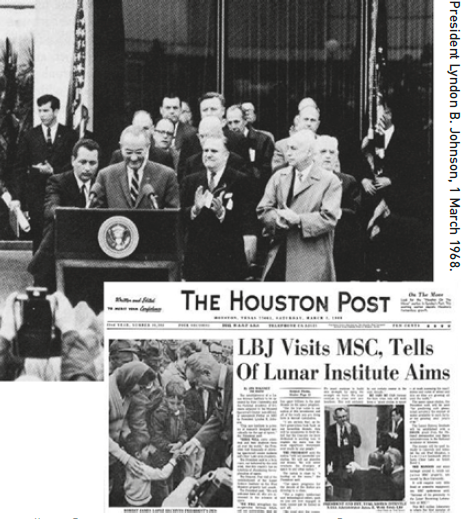 “Let [the new Lunar Science Institute] show the world that we do not build rockets and spacecraft to fly our flag in space, or to plant our banner on the surface on the Moon. We work to give all mankind its last great heritage. We are reaching for the stars.”
Johnson’s call helped anchor the Institute as a central node of global scientific cooperation in the age of space exploration.
LSI was formally created on 1 October 1968 through a NASA contract with the National Academy of Sciences, in cooperation with Rice University. Its early objectives centred on strengthening communication among scientists and organisations, enabling use of the Lunar Receiving Laboratory, supporting postgraduate education and facilitating research on lunar material.
In March 1969, NASA asked the National Academy of Sciences to establish a more permanent management organisation. The result was the Universities Space Research Association (USRA), chartered to foster cooperation among universities, research organisations and the US government. USRA assumed management of the LSI in December 1969.
Six decades after its founding, LPI remains an intellectual leader in lunar and planetary science
Under its first Director, Dr William W. Rubey, operations began in temporary offices at the Manned Spacecraft Center before moving to leased space nearby. A significant turning point came with the renovation of the West Mansion – deeded to Rice University for research purposes – which became LSI’s home in October 1969. Dedication of the West Mansion followed in January 1970, marked by NASA Administrator Thomas Paine’s statement that it was: “Dedicated to the scientists of the Earth who seek to understand the nature, origin and history of our solar system.”
As research expanded to include other planets, satellites, asteroids and meteorites, the Institute was renamed the Lunar and Planetary Institute (LPI) in 1978.
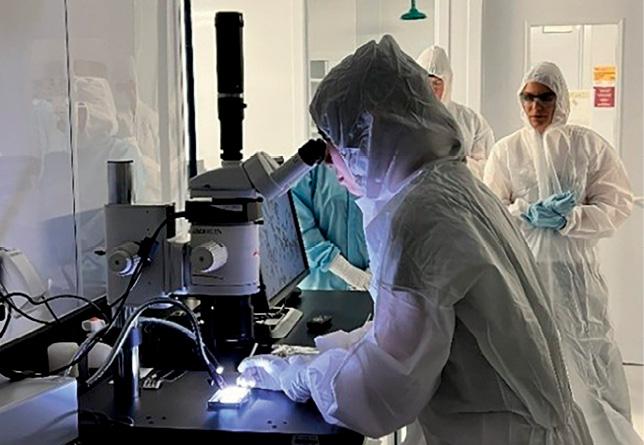 The Lunar and Planetary Institute provides hands-on training in micromanipulation of small-scale astro materials.
From the beginning, LPI’s model centred on a small resident scientific staff, supplemented by a robust community of visiting scientists and postdocs. Early visiting scientists included S. Ross Taylor, Friedrich Hörz, and Nobel laureate Harold Urey, who helped establish the Institute’s scientific culture.
Today, LPI’s scientific capability retains this hybrid structure. Core areas include astromaterials sample science – spanning Apollo samples, meteorites and returned samples from missions such as OSIRIS-REx and Hayabusa2 – and research on the geology and geophysics of Venus, the Moon, Mars and icy satellites. LPI scientists participate in spacecraft missions including Lunar Reconnaissance Orbiter, NASA’s Mars rovers and Europa Clipper and contribute to future missions such as DAVINCI and ESA/NASA’s EnVision.
LPI scientists devote much of their time to community service aligned with Institute goals. Their activities include:
- leading the LPI summer intern programme
- creating and editing science content and displays
- participating in public outreach
- operating laboratory facilities
- organising topical initiatives and workshops
- mentoring students and postdocs
- supporting NASA and the planetary science community through advisory roles and peer review.
This structure enables LPI to respond rapidly and flexibly to emerging scientific and technical needs.
LPI has a long tradition of organising interdisciplinary study projects, from Basaltic Volcanism in the Terrestrial Planets (1976) to New Views of the Moon 2 (2023). These projects have produced influential books and shaped new scientific directions. In response to NASA’s 2004 Vision for Space Exploration, LPI launched the Lunar Science and Exploration Initiative, including the web-based Lunar Science Exploration Portal and leadership roles within NASA’s lunar science institutes from 2009-2026.
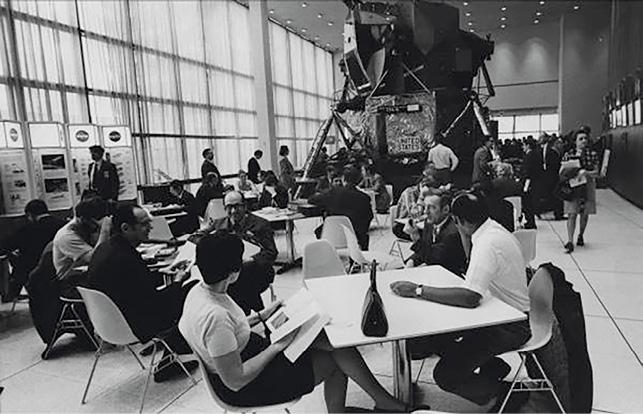 The Institute’s primary activities in the early years included organising and hosting symposia and seminars. When its seminar series began in September 1969, Dutch astronomer and planetary scientist Dr Gerard P. Kuiper was the first speaker.
Training the next generation
The Institute became a unique bridge between NASA, academia, and the global scientific community
Commitment to education and workforce development has been central since 1977, when LPI launched the Summer Undergraduate Intern Program. Many of today’s leaders in planetary science began their careers through this programme.
Now in its 50th year, the programme offers undergraduates hands-on research with leading scientists, supported by lectures, workshops and professional development. Interns gain research skills, networking opportunities and exposure to potential career paths, reinforcing LPI’s role in shaping future generations of planetary scientists.
Origins and evolution
From its earliest days, LPI organised seminars and symposia to foster scientific exchange. Among the first major efforts was co-sponsorship of the Lunar Science Conference (later LPSC), with the Institute assuming administrative duties when the conference moved to MSC.
Since the first LSC in 1971, held during the Apollo era, USRA and LPI have organised every subsequent conference. Attendance has grown steadily, and the conference relocated to The Woodlands, Texas, in 2009 to accommodate its expanding size.
Despite its growth, LPSC remains community-focused, characterised by collegiality and open discussion. With students comprising around 30 percent of attendees, the conference has become a key venue for early-career scientists to present research and engage with senior colleagues.
Expanding ENComPSS programme
For more than 50 years, NASA’s Johnson Space Center has curated samples from the Moon, asteroids, comets, the solar wind and cosmic dust. LPI has long supported community access to these materials and associated instrumentation.
Through NASA’s Support for Planetary Sample Science, LPI now leads the Expanding NASA’s Community of Planetary Sample Scientists (ENComPSS) programme to broaden participation in sample science. This includes curriculum development, workshops, hands-on training, and community-building activities.
In its first two years, ENComPSS delivered training in:
- Micromanipulation and handling of small particles
- Embedding samples and ultramicrotomy
- Scanning Electron Microscopy (SEM) and Energy Dispersive Spectroscopy (EDS) techniques
- Focused Ion Beam Scanning Electron Microscopy
- Tomography of planetary materials.
The programme also organised virtual sessions on accessing NASA’s collections, the Planetary Science Enabling Facilities (PSEF) programme, and proposal processes, along with topical workshops linked to OSIRIS-REx, Hayabusa and other missions.
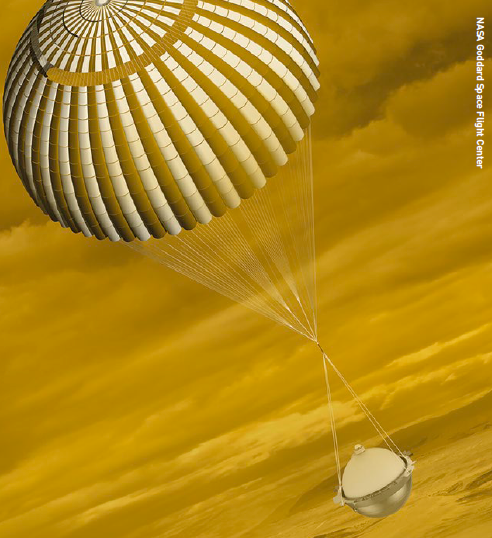 LPI scientists are contributing to NASA’s Deep Atmosphere Venus Investigation of Noble gases, Chemistry, and Imaging (DAVINCI) mission, scheduled to launch in the early 2030s. The DAVINCI spacecraft will study Venus’ clouds and highlands during two flybys and it will also release a spherical probe, about three feet wide, that will plunge through the planet’s thick atmosphere and corrosive clouds, taking measurements and capturing high-resolution images of the Venusian surface.
Legacy of access
LPI scientists devote much of their time to community service aligned with Institute goals
Beginning in 1973, LPI’s role expanded to include lunar data management, including photos, maps, mission documents and geophysical data. The Institute later became an original member of NASA’s Regional Planetary Image Facility (RPIF) network, providing public access to planetary mission archives.
Although NASA concluded the RPIF network in 2020, LPI continues to maintain extensive digital and physical holdings, including:
- data from robotic and crewed lunar missions
- lunar sample information
- Apollo-era documents, mission plans, transcripts, and debriefs
- one of the largest digital repositories of lunar sample data.
The library now includes more than 63,000 catalogued items and provides reference services to scientists, educators, media, students and the public.
Six decades after its founding, LPI remains an intellectual leader in lunar and planetary science. Its mission continues to focus on attracting world-class scientists and students; supporting the research community through meetings, workshops, and services; facilitating access to planetary data and NASA science; and inspiring the public through education and outreach.
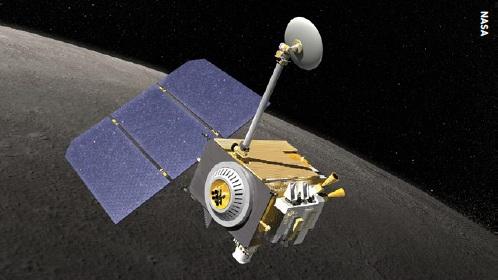 Lunar and Planetary Institute scientists participate in spacecraft missions including the Lunar Orbiter which has been studying the Moon up close since 2009, making it the longest-lived lunar orbiting mission ever. During this time, the orbiter has mapped the Moon’s surface and measured its temperature, composition, and radiation environment in unprecedented detail.
Acknowledgements: The Lunar and Planetary Institute is operated by the Universities Space Research Association and supported by NASA’s Planetary Science Division under Cooperative Agreement 80NSSC24M0008.
About the authors
Walter Kiefer is Director of the Lunar and Planetary Institute (LPI) at USRA, where he has been a research scientist since 1993. His work focuses on the interior structure and evolution of the terrestrial planets and icy satellites. He serves on the science teams for NASA’s Europa Clipper and DAVINCI missions and ESA/NASA’s EnVision mission.
Renee Dotson is the Senior Library and Publications Manager at LPI/USRA. She has served as the Production Editor for the University of Arizona Press’ Space Science Series for over 20 years. She also regularly contributes to the LPI’s summer intern programme and the Lunar and Planetary Science Conference. She was awarded the 2024 Masursky Prize by the American Astronomical Society’s Division for Planetary Sciences (DPS) in recognition of her longstanding exceptional service and dedication to the planetary science community.
Julie Tygielski is the Communications and Media Manager at LPI/USRA where her primary role is to disseminate lunar and planetary science and organisational capabilities to external stakeholders such as NASA, the academic research community, educators, and the public. The LPI Internship Program Team, a cross-functional team of which she is a member, was awarded the Team Excellence Award by the 2025 USRA President’s Awards.
Jamie Shumbera is Senior Operations Manager at LPI/USRA with expertise in programme management and business operations. She previously served as Programme Manager for Internship Programmes. Prior to joining USRA Jamie was with United Space Alliance for 13 years working in project management.