

It’s almost 30 years since NASA and Russia launched the first elements of the International Space Station but the lessons about space travel that came with it have been largely overlooked by the public. Behind the scenes, it’s been a different story. More has been learnt about the perils of long duration spaceflight than ever before and nothing has been starker than the issue of radiation.
Just one day in low Earth orbit (LEO) exposes a person to the same amount of radiation experienced on the surface of the planet Earth in a year. Most astronauts only stay on the International Space Station (ISS) for about six months, although a handful have served for a full year. It is not an easy experience and for some men and women the adverse side-effects of spaceflight are impossible to reverse.
Astronauts are brave individuals and they take risks, but there’s something particularly slow and insidious about death by ionising radiation. An American radiation worker is supposed to receive less than 50 mSVe per year. In contrast, the average radiation on Earth is very low at 3 to 6.2 mSv/year. But people may be far more tolerant of ionising radiation than we once assumed. In some areas of the city of Ramsar, Iran, the radiation level is 260 mSv/year. Thus far, no one has been able to detect an increase in health problems in this population, suggesting that this kind of dose would be safe for one or two years of space travel too.
All the hazards we have endured to date are as nothing compared to the dangers of flying to another planet. Six months on the ISS exposes an astronaut to 72 millisieverts (mSv), but the dose experienced on a mission to Mars would be about 1000 mSv.
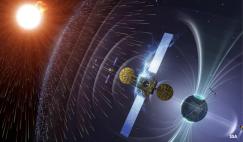
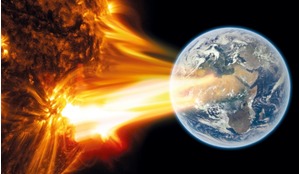
On the journey to Mars, we will experience radiation from two sources: our own Sun and the background intergalactic radiation field. Most of the radiation with a solar origin consists of electrically charged particles that are effectively alpha and beta particles. Part of the reason we don’t notice them on Earth is that electrically charged particles are deviated around the planet by the Earth’s magnetic field, with many being trapped in the Van Allen radiation belts.
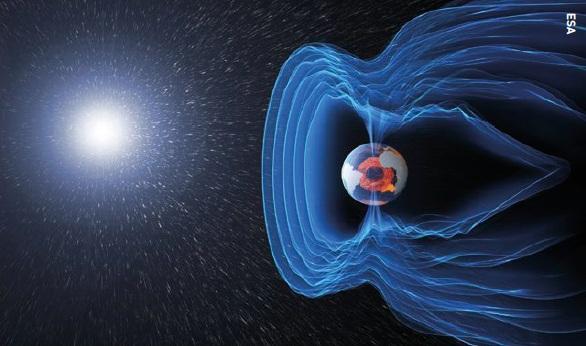 Earth’s magnetic field and atmosphere protect us from the constant bombardment of galactic cosmic rays – energetic particles that travel at close to the speed of light and penetrate the human body. An astronaut on a mission to Mars could receive radiation doses up to 700 times higher than on our planet – a major showstopper for the safe exploration of our Solar System.
If we want to fly to the Moon or another planet, we must pass through the Van Allen belts, beyond which the background dose of ionising radiation increases dramatically. So, to understand the risks involved for the crew, we must also consider the likely duration of the mission.
The Apollo missions to the Moon lasted between one and two weeks and did involve quite a high radiation dose for the crew, but the astronauts survived unscathed, in part because it was all over in a matter of days. Mars will be different, as a mission to Mars is likely to take around six months and the crew would have to wait for a suitable launch window to enable a return journey. This means we’re looking at 18 months to three years of exposure to the deep space environment.
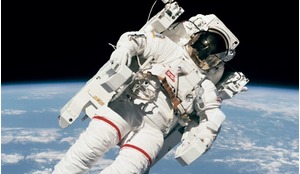
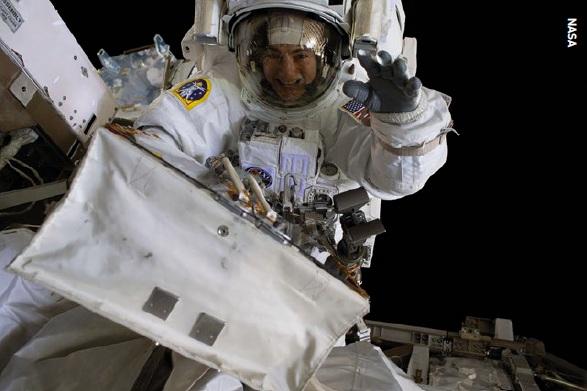 A spacewalk can be fun, as this image of NASA’s Jessica Meir shows, but astronauts who spend six months in space are exposed to roughly the same amount of radiation as 1,000 chest X-rays. Having multiple kinds of radiation bombard their bodies puts them at risk for cancer, central nervous system damage, bone loss and some cardiovascular diseases.
Shielding
Just one day in low Earth orbit (LEO) exposes a person to the same amount of radiation experienced on the surface of the planet Earth in a year
Ideas for shielding our astronauts from radiation have two approaches, active and passive. Proponents of active shielding believe that we can generate a magnetic field around the spacecraft that mimics the effect of the Earth’s magnetic field and deviates the electrically charged particles around the vehicle, thus sparing the crew from the worst of the solar wind. However, the intergalactic radiation field is mostly composed of very high energy neutrons and these particles won’t be influenced by a magnetic field.
Passive shielding requires the wall of the spacecraft to be lined with materials that will block out most or at least some of the ionising radiation and reduce the cumulative dose received by the crew. But how thick should such a layer be?
To answer this question, we must consider another issue first: what is the maximum dose an astronaut can be reasonably expected to endure? Relatively low energy particles from the Sun can be blocked by the shielding in the wall of the spacecraft, but high energy particles will penetrate quite easily, often breaking up like shrapnel that may do more harm to the astronauts than unobstructed cosmic rays.
Polyethylene or other polymers rich in hydrogen are known to be effective in blocking radiation. The thicker the shielding, the lower the dose of radiation, but this kind of safety comes at a price. One of the very few areas of progress in spaceflight over the last few decades is our ability to build spacecraft out of ever more lightweight materials. Even if our rockets haven’t improved, at least the power-to-weight ratio of our spaceships has improved and this ought to lead to a better performance. However, lining the walls of a spacecraft with tonnes of solid lead is not the answer!
Many people will be aware that MRI scanners here on Earth already use superconducting coils to generate high magnetic fields. However, MRI coils in the hospital environment only generate about 3 or 4 Tesla and the requirements of a magnetic shield on a mission to Mars would be several times greater than this, perhaps as much as 20 Tesla. It has also been suggested that a magnetic field as high as 20 Tesla might itself represent a threat to the crew.
Some physicists have suggested that it might be possible to separate the crew and their onboard electronics from the shield by flying the magnetic coil some distance away. The crucial question here is the likely mass of such a system. The use of hot superconductors might well enable us to generate a dramatic field between the spacecraft and the Sun, but this would also require electrical power. And any failure of the system would abruptly increase the radiation dose experienced by the crew.
A recent NASA study looked at the possibility of positioning the magnetic coil some distance from the spacecraft in order to spare the main vehicle from the magnetic field. However, active shielding would require hundreds of megavolts and some engineers have questioned the credibility of such a system using current technology.
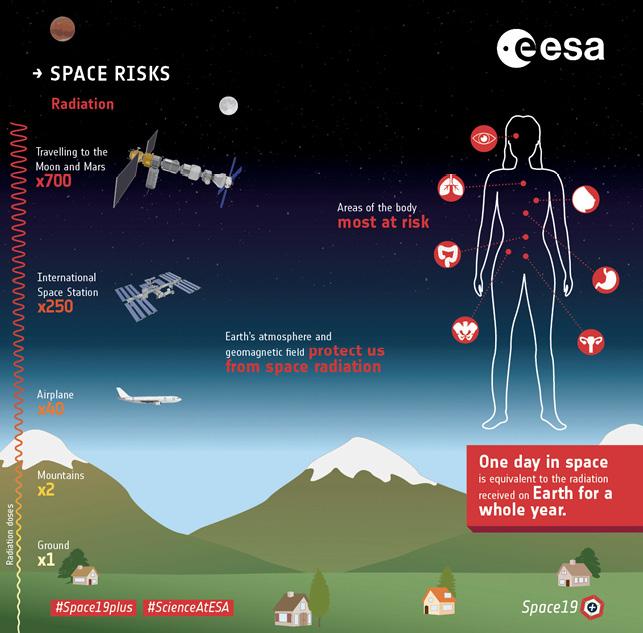 Cosmic radiation could increase cancer risks during long duration missions. Damage to the human body extends to the brain, heart and the central nervous system and sets the stage for degenerative diseases. A higher percentage of early-onset cataracts have been reported in astronauts.
Water wall
A much simpler solution would be to surround the crew compartment with a wall of water one metre thick, so that the crew should be exposed to the same radiation dose that most of us experience here on Earth. In practise, the water would heat up slightly as the high energy cosmic rays collide with the water molecules.
Thus, there is no reason to doubt the ability of human beings to travel into the deep space environment; the only issue is that every precaution comes at a price. One cubic metre of water weighs about a tonne, dependent on temperature and pressure, so if we start with a crew compartment that is ten metres wide and attempt to envelope it in a metre of liquid water, the spacecraft is going to be very, very heavy.
Of course, we don’t necessarily have to surround the entire vessel with water. We could have a small forward compartment, enveloped by liquid water where the astronauts sleep, which would cut the cumulative dose by about a third. Remember the crew will have to take quite a lot of liquid water with them anyway and it wouldn’t make any sense to store such a cargo in the very centre of the ship.
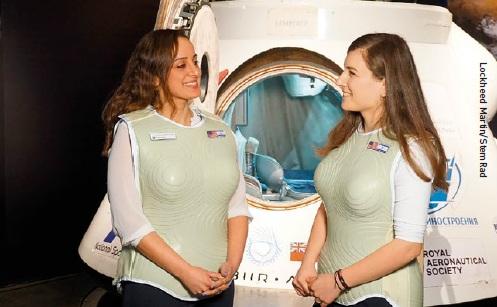
In practise, we’d spread it out in the wall of the crew compartment, possibly putting the sleep chamber in the centre of the water reservoir. Some scientists have explored the possibility of the astronauts wearing special suits that block the radiation just before it enters the body. For example, it’s routine for medical staff to don lead-lined jackets when operating with x-rays. Why not ask future explorers to do this in outer space?
It has long been understood that 7cm of water can block about half of the incident radiation in outer space and water is one of the most attractive materials to use for shielding in manned spaceflight. If we inflated a protective suit with about 7cm of water, the crew might start to look like the Michelin Man, but this would be much easier than surrounding the entire crew compartment with a similar barrier.
Space colony
The nightmarish possibility is that the crew might make it as far as Mars only to go into kidney failure during the voyage home
Even in the 1970s, the conquest of outer space had been researched in some detail. Spurred on by the rapid success of the Apollo programme, American scientists began to envisage a future where millions of people might migrate to manmade colonies in outer space. One of the most iconic designs to emerge from that period is the Stanford Torus, whereby a gigantic space wheel would be constructed halfway between the Earth and the Moon and a self-sustaining human settlement established.
The people designing the Stanford Torus proposed a wheel that was more than two miles in diameter and its design spec demanded a radiation dose of close to that experienced at sea level on Earth. The colony was intended to be placed at a Lagrange Point, far beyond the Van Allen belts, and shielding was to be achieved using just under two metres of rubble from the lunar surface.
But there are other entirely different measures that we might want to consider in our bid to conquer space. Some scientists are looking at nuclear powered rocket engines that could get us there much faster than this. If we could reduce the outward voyage from six months to six weeks, we’d see a 75 percent reduction in radiation exposure straight away.
Similarly, it may be possible to address the adverse consequences of radiation exposure using drugs. A recent study at University College London looked at data from the ISS to assess how dangerous the deep space environment might be for kidney function. The results were far from positive.
The nightmarish possibility is that the crew might make it as far as Mars only to go into kidney failure during the voyage home. Evidence of the impact of radiation on the human kidney is also available from many years of experience using radiotherapy in the treatment of cancer. If we could develop drugs that saved the human kidney from the effects of radiation during spaceflight, there would be an immediate application for these drugs in the treatment of malignancy here on Earth.
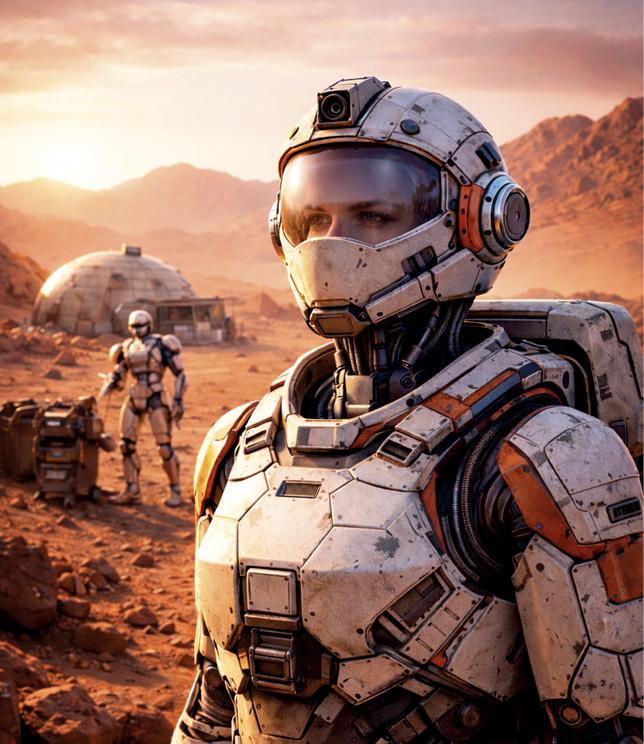 Humanoid robots are advancing at an astonishing pace and, by the time we have routine access to the planets, robots will be replacing human labour at scale.
Robot avatars?
But the real ‘elephant in the room’ here isn’t even organic. Humanoid robots are advancing at an astonishing pace and, by the time we have routine access to the planets, robots will be replacing human labour at scale. Nowhere will this development be more obvious than in the exploration and industrialisation of outer space. Should astronauts be required to perform a spacewalk to repair or maintain their vehicle on the way to Mars, it seems inevitable that a robot will be used. In this case, the robot would be acting as an avatar with the astronaut safely shielded by his own water supply in the centre of the spacecraft.
Of course, the robots’ electronics will have to be shielded from the radiation, but robots don’t get cancer, consume oxygen or tire. The servants of deep space colonisation will be entirely synthetic and it will be the human beings that benefit.
About the author
Steven Cutts is a doctor, film producer and science writer based in Norwich, England. He studied physics at Imperial College and medicine at St Thomas’ Hospital London. His science fiction novel The Village On Mars is available on Amazon. He has previously published in Spaceflight magazine, Esquire and the Birmingham Post and writes regularly for the Independent online newspaper.