


A decade ago, the scientist, businessman and philanthropist Dr Igor Ashurbeyli unveiled an audacious vision for the world’s first Space Nation. Today, as Asgardia marks its tenth anniversary, its founder and Head of Nation reflects on the journey from concept to digital society – and sets out the ambitions that will shape its second decade.
On 12 October 2016 at an international press conference in Paris I announced an idea that many people regarded as improbable, perhaps even impossible.
“Now, we have decided to create the first-ever Space Nation. Is it pioneering, futuristic and visionary – or madness? Call it what you will, and time will tell.”
Ten years have now passed and time has begun to provide an answer.
Asgardia has grown from an idea into a functioning digital nation bringing together more than a million people from more than 200 countries on Earth. We have established a Constitution, Parliament, Government and Supreme Court. We have created national symbols, developed our own digital systems of governance and launched the Asgardia-1 satellite into orbit. We have participated in scientific research directed towards making permanent human life beyond Earth possible.
 In-person meeting of Asgardia executives in Vienna, Austria.
Yet anniversaries should not simply be occasions for listing achievements. They are opportunities to remember why a journey began and to ask where it should lead next.
When Asgardia was conceived, I did not see it simply as just another space project. From the beginning I envisioned it as a global, unifying humanitarian project and its philosophy was founded upon a simple principle: humanity’s future in space should belong to humanity. A true nation without borders remains our purpose today.
Ten years later, whether viewed as a prototype of future space settlements or a transnational digital society, Asgardia has survived and evolved far beyond what many observers expected
Asgardia grew from my conviction that humanity cannot carry all the divisions and conflicts of Earth with it as it expands into space. Our planet is divided by geographical borders, political systems, religions, economic interests and historical disputes. Space gives us an opportunity to think differently.
The essence of Asgardia has always been Peace in Space – and, in particular, preventing the conflicts of Earth from being transferred to a new arena beyond our planet. This is why Asgardia was created without geographical, ethnic or religious boundaries. It is a nation based instead upon the free choice of people who share an idea about humanity’s future.
As I recently stated on Asgardia’s Unity Day, our nation did not originate from a common birthplace, language or family background. It came from the conscious choice of people who united around a common idea: a peaceful future for humanity in space.
That distinction is fundamental because the permanent human settlement of space will eventually require us to address questions that terrestrial political systems were never designed to answer.
 Asgardia at the International Astronauticial Congress (IAC) in Baku in 2024.
 Asgardia residents Ksenia Orlova (left), SIRIUS-23 crew member, with Victoria Kirichenko, SIRIUS-21 crew physician.
 ’Paving the Road to Living in Space’, Asgardia’s first Space Science and Investment Congress (ASIC), was held in 2019.
Who will live in space? Under whose laws? What rights will people have? How will societies be organised? How can access to space be made more equal? And how do we ensure that the political and military conflicts that have shaped so much of Earth’s history are not allowed to determine humanity’s future beyond it?
Asgardia was created to begin addressing those questions before circumstances force us to do so.
One of our first physical milestones came in November 2017 when Asgardia-1 reached orbit, a small satellite that carried digital copies of Asgardia’s Constitution, flag and coat of arms, together with data uploaded by Asgardians. Its physical dimensions were modest but its symbolism was considerable. An idea conceived on Earth had established a physical presence in space.
A central scientific mission
The expansion of human civilisation beyond Earth will require forms of cooperation that traditional political structures often struggle to provide
The greater challenge, however, has always lain ahead - making human life possible beyond Earth. Humanity has been sending people into space for more than six decades. But visiting space is fundamentally different from living there.
If human civilisation is genuinely to expand beyond Earth, we must create conditions in which people can live complete lives – not merely survive for the duration of a mission before returning home. This is why Asgardia’s central scientific mission is so ambitious: to facilitate the birth of the first human child in space.
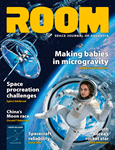
Some may regard that objective in much the same way they regarded the announcement of Asgardia itself in 2016. But childbirth beyond Earth [as the two articles that open this issue demonstrate] represents something much more profound than a single scientific achievement. It would demonstrate that human life can continue from one generation to another beyond our home planet.
Without reproduction there can be no genuinely self-sustaining human civilisation in space but achieving that goal requires answers to scientific and medical questions that remain unresolved. Asgardia has therefore concentrated its research around three fundamental challenges: artificial gravity, protection from space radiation and human embryology.
Our participation in the international SIRIUS isolation programme has been part of this effort. Asgardian female representatives participated in the SIRIUS-21 and SIRIUS-23 crews, spending 240 and 366 days respectively in conditions designed to simulate the psychological and physiological challenges of long-duration missions.
The emphasis on women is deliberate. Women have historically been underrepresented in spaceflight research, yet understanding the effects of prolonged isolation and other spaceflight factors upon the female body will be essential if humanity intends to create communities rather than temporary outposts beyond Earth.
We are also advancing artificial gravity research with the Laboratory for Equilibrium Investigations and Aerospace in Antwerp, Belgium. Artificial gravity and radiation protection will be fundamental to protecting human health during prolonged missions and eventual settlement.

Building a nation for the Space Age
I have sometimes compared the next phase of space exploration with the great sea voyages of earlier centuries. Those sailors set out without the maps, navigation systems or certainty we take for granted today. They did not always know whether they would reach the other shore. Yet humanity continued to explore. Today the new territory of discovery is space.
Our responsibility is to ensure that we undertake that journey with science, foresight and a clear understanding of the society we hope eventually to create there.
Scientific progress alone, however, cannot create a civilisation. Human beings require institutions, laws, economic structures and mechanisms through which they can participate in the societies of which they are part.
Asgardia’s first decade has therefore also been an experiment in developing a new model of statehood and our Constitution established three independent branches of power: Parliament, Government and the Supreme Court.
On 24 June 2018, digitally elected representatives from around the world gathered in Vienna for Asgardia’s first in-person parliamentary session. The 108 Members of Parliament represented 13 language-based electoral districts – deliberately organised according to language rather than terrestrial geography.
Asgardia concentrates its scientific efforts on three key research areas: artificial gravity, protection from space radiation and human embryology
The following day, 25 June, I was inaugurated as the first Head of Nation of Asgardia. Those events were important because they began the process of turning a concept into institutions capable of functioning.
Asgardia’s Parliament has subsequently convened in regular digital sittings with simultaneous interpretation enabling Members from different parts of the world to participate. In 2023 we completed our first five-year constitutional governance cycle, leading to the election of our Second Parliament and formation of the Second Government. Today, 12 ministries oversee the principal areas of the Nation’s development.
Equally important has been the creation of an integrated digital ecosystem. For a conventional country, digital government is an increasingly useful means of delivering services. For Asgardia it is something more fundamental: our citizens and institutions exist across terrestrial borders, making digital infrastructure part of the foundation upon which the Nation itself operates.
Ten years ago, there was no established template for what we were attempting to create and in some ways that is still the case.
I have always believed that if you do things only in the way they have been done before, you will never create anything new. Asgardia is necessarily a work in progress, because it is intended to explore possibilities for which no complete precedent exists.
 Asgardia’s first parliamentary session was held in Vienna, Austria, in 2018.
From digital nation to physical presence
Our second decade must take us further. At the Fourth Executives’ Congress in Dubai in October 2025, I presented plans for Asgardia’s first ground-based experimental complex dedicated to researching the future of human life in space.
The proposed facility is intended to provide a platform for simulated distant space missions involving international mixed-gender crews, supporting research in areas including gravitational physiology, space biomedicine, radiation safety and crew psychology.
The wider concept includes a Research and Education Centre, a Public Outreach Centre and a Technology Transfer Centre, enabling knowledge developed for space to produce benefits on Earth as well.
This is an important principle. Humanity’s expansion into space should not be considered in isolation from the future of our home planet. Technologies developed to protect human health, manage scarce resources or sustain communities in extreme environments can have applications on Earth too.
Our task is not to abandon Earth. It is to expand the possibilities available to humanity while protecting the cradle from which our civilisation emerged.
 Press conference during the 4th Executives’ Congress in Dubai, UAE, in 2025.
The coming decade
Our task is not to abandon Earth. It is to expand the possibilities available to humanity while protecting the cradle from which our civilisation emerged
Ten years is a considerable milestone for Asgardia, but it is a very short period in the history of a nation.
When Asgardia celebrated its fifth anniversary in 2021, I observed that words and ideas had begun to be translated into real life. Five years further on, that process continues. Our population has grown, our institutions have matured and our scientific programme has become increasingly focused upon the practical challenges that must be overcome if people are eventually to live and reproduce beyond Earth.
The next decade must be about turning more of that architecture into reality. We must continue advancing the science required for long-duration human life in space. We must strengthen Asgardia’s institutions and economy. We must develop our international relationships and seek wider recognition in connection with the adoption, on 13 August 2024, of the Decleration of Independence of Asgardia. And we must create physical places where the ideas and technologies necessary for humanity’s future can be researched, tested and demonstrated, for example on land belonging to no state, a part of Antarctica.
We will mark Asgardia’s tenth anniversary in Nice, France. The city already has a place in Asgardia’s history, hosting our first Economic Forum in 2018. It is also intended to become much more important to our future, with plans for the future headquarters of Asgardia to be located there.
The choice of Nice for our tenth-anniversary celebrations therefore connects our past with our future. We return to a city in which an important part of Asgardia’s early development took place but also look ahead to the time when it will provide one of the physical homes for the institutions of a nation whose citizens are distributed throughout the world. That combination of the physical and digital will become increasingly important as Asgardia develops.
Ten years on, I return to the question I posed when I announced Asgardia in Paris in 2016: would this prove to be a pioneering vision or an impossible dream? A decade is not enough to provide the complete answer and the project we began was never intended to be measured against so short a period. But we have demonstrated something important.
People from different nations, cultures, languages and backgrounds can choose to unite around an idea about their common future. Institutions can be created across geographical borders. Scientific research can be directed towards questions that lie beyond the immediate horizon. And an idea that initially appears impossible can begin to acquire practical form.
For me, Asgardia has always been about more than creating another nation. It is about asking what kind of future humanity wishes to build as it moves beyond the planet on which civilisation began.
Our motto is “One Humanity – One Unity” and Asgardia’s first ten years have been about laying the foundations for that idea. Our second decade must be about building upon those foundations. The ultimate destination remains space and the first human child born in it.