

The Artemis II crew returned from a well-publicised lunar flyby mission in mid-April 2026, following a nine-day, one-hour mission. Four astronauts were launched successfully on a free-return trajectory around the Moon and returned safely to a ‘perfect’ splashdown in the Pacific off San Diego. That was good news for the astronauts, for NASA and for the space community in general, but how much did this mission advance the cause of space exploration? Space technologist and author Mark Williamson considers the technology of the recent mission and critiques its presentation by the media. After the emotion of Artemis II comes a more difficult question: what does the mission really mean for the future of human exploration?
Given that no-one has travelled beyond low Earth orbit since December 1972, the Artemis II mission deserves a place in the history books. I grew up in the Apollo era and, it turns out, was sufficiently entranced by the radio and TV coverage to develop a career in the space sector. Since those halcyon days, I have often complained about a lack of action in the space exploration arena, so I should be happy about the Artemis programme… but I can’t quite bring myself to declare a state of nirvana.
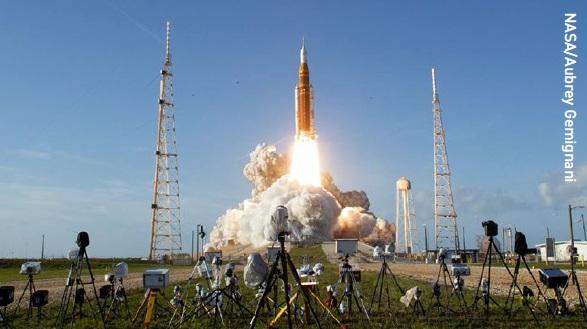 The launch of Artemis II on 1 April 2026 from Kennedy Space Center in Florida.
Technology
From a purely engineering point of view, the Artemis II mission helped to prove the technology of the Space Launch System (SLS), the Orion capsule and the European Service Module, which is encouraging for future missions.
However, as many commentators have pointed out, Artemis II was effectively a repeat of the Apollo 8 mission of December 1968, which sent three astronauts around the Moon (and, incidentally, produced the famous Earthrise photographs). While it makes sense to test systems this way before committing to a lunar landing, the recent mission was essentially a case of relearning techniques that NASA mastered almost six decades ago – so forgive me if I’m not too excited. The truth of the matter is that this mission was necessary because NASA has lost its ‘institutional memory’ of how to do lunar missions, having been stuck in low Earth orbit for more than half a century!
After the emotion of Artemis II comes a more difficult question: what does the mission really mean for the future of human exploration?
Am I impressed with this 21st century technology, as compared with the launch vehicles and spacecraft launched only 10 years after the first Sputnik? Not really. SLS is styled as NASA’s ‘most powerful rocket’, since its first stage engines produce about 15 percent more thrust than the venerable Saturn V, but the payload capability of the Block I variant to TLI (trans-lunar injection) is only about 60 percent that of the Saturn. In practice, this means that a separate vehicle will be required to place a lander in lunar orbit for the landing mission. On top of this, the development of SLS has been prone to greater delays than the Saturn V; again, I suspect a loss of institutional memory, though lack of sufficient funding has an obvious role to play.
What about the Orion capsule? Well, the word ‘capsule’ is the important one here. Having flown a reusable Space Shuttle orbiter for 30 years, NASA returned to the concept of a capsule with an ablative heatshield similar to that of Apollo (which makes the heatshield issues experienced on Artemis I much less forgivable). True, Orion is half as big again as Apollo in terms of volume, but it’s designed to carry an extra astronaut and enable longer missions so the difference is less significant. It is also intended to be reusable, but this capability has yet to be proven. And, yes, it has a toilet, which replaces the need to defecate in a bag, but was it flawless? No.
Anyone who has ever followed a human space mission knows that the media’s focus on the Orion toilet was a given, whether or not it performed to specification, so why was it allowed to become the focus of media jokes? Why did its design allow even the possibility of a frozen urine vent? It reminded me of an issue with the thrusters on Boeing’s Starliner capsule in 2024, which caused a delay in returning a space station crew to Earth. The space industry has designed and built thruster systems, vent valves and even space station toilets for decades, so why are they still as unreliable as a 1970’s jalopy?
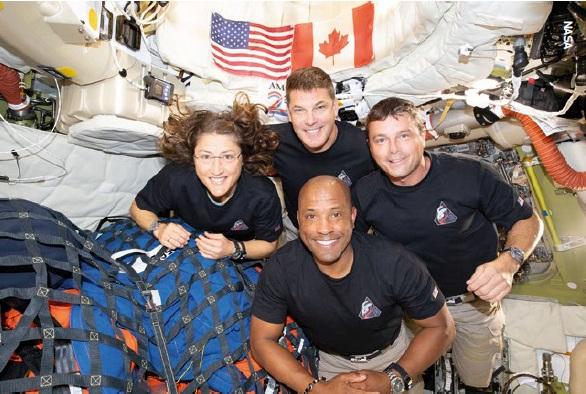 The Artemis II crew (from left) Christina Koch, Jeremy Hansen, Reid Wiseman, and Victor Glover inside the Orion spacecraft.
Media view
Despite all this, the Artemis II mission was probably good for STEM and has hopefully encouraged a large tranche of young people to engage with science, technology, engineering and maths. But the general media can’t take much credit for this. Much of the televised coverage in the UK (I can’t speak for coverage elsewhere) focused on the human aspects of the mission and any science done on the mission was mostly eclipsed.
While I fully appreciate that thrust coefficients and telemetry schedules have no place in public outreach, there is a tried-and-tested way to introduce lay audiences to the challenge and excitement of conducting a mission in an alien environment. In the UK, for Apollo, we were lucky to benefit from the guidance of the BBC’s James Burke, a journalist with no background in space technology but endowed with a professional ethic that demanded attention to detail. It’s clear from the BBC’s Artemis coverage that today’s ‘science correspondents’ lack this ability, or calling, to educate their audience - though, admittedly, they were not helped by NASA’s own public relations output, which concentrated on the human aspects of the mission.
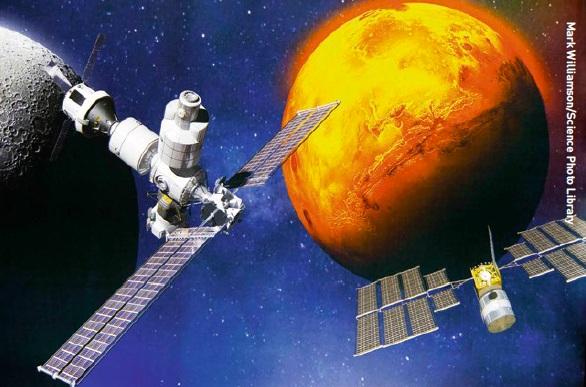 Gateway to nowhere? A model of the Gateway station bridges the conceptual gulf between the Moon and Mars.
A lack of technical appreciation was evident from the very beginning – the coverage of the launch. What I presume was NASA’s official feed, carried live by the TV networks, included moments of complete blackout following ignition and somehow managed to omit key moments, such as the vehicle clearing the tower and jettisoning its solid boosters; instead of the latter, an apparently bored producer showed us views of the crowd. One would think that these launch-sequence events were unpredictable, rather than timed to the second. Again, NASA’s public presentation of launches no longer feels as assured as it once did, while SpaceX in stark contrast, has it pretty much nailed.
Anyone who has ever followed a human space mission knows that the media’s focus on the Orion toilet was a given
Moreover, the NASA-organised ‘welcome home’ event at Houston was a pretty dire affair with its set speeches, read from autocue, overflowing with superlatives and devoid of humanity… that is, until the astronauts finally came on stage. It was only then that the event became bearable, touching, even thought-provoking at times.
Astronauts are famously professional and self-assured, even laid-back and laconic; they are the sort of people you would want with you in a disaster situation. But, watching the event, I felt that this crew had something more; possibly it was the media training they undoubtedly received, but also a personal confidence that allows one to be oneself whatever the pressures to perform.
Mission commander Reid Wiseman, for example, was not afraid to point out the obvious. Everyone in that room and watching remotely knew that these four people had just returned from a mission around the Moon – well, we’d all seen the figure-of-eight graphic a hundred times, hadn’t we? But when Wiseman pointed out, matter-of-factly, that since they’d boarded Orion 10 days earlier they had seen the Earth shrink as they powered towards the Moon, disappear as they orbited behind it and, later, grow larger in the window as they prepared for their fiery re-entry, I was suddenly there beside him.
However much one understands the mission trajectory intellectually, the realisation that the man on the stage was, just a few days earlier, a quarter of a million miles out in space, able to hide the rest of us behind his thumb was arresting, if not shocking.
Later in the show, Christina Koch’s thoughtful definition of a ‘crew’ was a valiant attempt to compare the four Artemis astronauts with the crew of ‘spaceship Earth’, hopeful perhaps that some leading politicians were listening and taking note. It’s often said that sending such politicians into orbit would convince them of the Earth’s fragility, even humanise them sufficiently to reduce global tensions, but perhaps that’s a hope for the future. It’s hard enough getting four career astronauts into orbit under the current regime!
The astronauts of the 1960s were characterised as having ‘the right stuff’ and today’s astronauts have that too, but they also have a different kind of stuff. In common with the modern-day man, male spacefarers are more in touch with their emotions and, thankfully, female astronauts are considered equals, which places 21st century astronauts ahead of their forerunners.
All that said, based on the outreach, I’m left with a feeling of ambivalence about their nine-day excursion. We were informed that the crew bonded well, enhanced their personal friendships and really enjoyed their time together in space, but is that commensurate with the price tag? Space proselytisers have enough trouble convincing naysayers as it is and I don’t believe that Artemis II helped our cause; the mission had the flavour of something between a modern-day reimagining and a makeover.
Politics and money
Clearly, any plans to send astronauts to the surface of the Moon (and later to Mars) will require more, not less, money
Now that the dust has settled on the Artemis II mission, it is time to look forward. Once again, however, I find myself questioning whether the Artemis programme will follow in the footsteps of Apollo, or suffer the same fate as the other failed NASA programmes to get ‘boots on the regolith’.
As usual, it’s all down to politics and money, in particular the current US Administration’s apparent intention to decimate the nation’s research and development efforts across a range of fields. As highlighted by Nature and other highly regarded journals, the plan proposes “cuts to federal agencies that fund or conduct research on health, space and the environment”. For example, the budgets of both the National Science Foundation and the Environmental Protection Agency would suffer reductions of “more than 50 percent” compared with current levels, while that for the National Institutes of Health would decrease by 13 percent.
But it’s the proposal to slash NASA’s budget by a quarter that concerns me here, as it provides limited confidence that later Artemis missions will actually place astronauts on the Moon (let alone on Mars, which is an order of magnitude more difficult). Nor am I encouraged by the NASA Administrator’s apparent acceptance of this cost-cutting stance. Publicly, at least, the agency’s leadership has appeared willing to work within the proposed budgetary constraints.
Clearly, any plans to send astronauts to the surface of the Moon (and later to Mars) will require more, not less, money. Surely, the conclusion of a successful and publicly well-received Artemis II mission is the time to call for a budget increase, or at least stability. Unfortunately, stability is not one of NASA’s core competencies. Following years of hype, the Lunar Gateway station was cancelled in March 2026, allegedly in favour of a permanent surface base. No doubt some of the bean-counters think that money saved on Gateway will fund Artemis, but this is just another example (after decades of cancelled technology developments) of the agency’s lack of resolve and staying power.
Even us armchair space explorers know that space exploration is not really about missions; it’s about providing the infrastructure for missions. While I had no particular feelings for the Gateway programme, the technology of its modules could have provided a stepping stone to the lunar surface and might also have been adapted for those future Mars missions.
Historians often point out that Russia has continually adapted its Soyuz spacecraft, learning and updating as it went, rather than developing entirely new vehicles. Many will remember that, when NASA retired the Space Shuttle fleet, it left itself with no homegrown spacecraft to ferry its astronauts to the International Space Station. Luckily, Soyuz had become part of the infrastructure and stepped into the breach, albeit at a predictably high cost-per-seat.
So why does NASA continually design from scratch and then ditch the technology and the institutional memory embodied in its educated workforce? The phrase “insanity is doing the same thing over and over again and expecting different results” is attributed to Einstein, apparently incorrectly, but it seems apt.
Elastic schedules
The closest parallel with those halcyon days of Apollo is the fear that another nation will get there first
My confidence in America’s ability to return people to the Moon is further diminished by the apparent lack of urgency. The Artemis III mission was to have placed astronauts on the surface, but that goal has slipped to Artemis IV. Instead, Artemis III will show that Orion can dock with one or more lunar landers in Earth orbit, in 2027, followed hopefully by a lunar landing in 2028.
A more charitable commentator might suggest that this was a sensible and safety-conscious correction to an aggressive schedule, but why was this docking phase not built into the programme as it was with Apollo? Probably because the commercially provided landers were ‘over-sold on schedule’ to NASA and are nowhere near ready, obliging the agency to insert a mission into the timeline to at least give the impression of progress.
But a mission a year is hardly aggressive and will do little to encourage either funding continuity or public acceptance. Apart from this, as is widely accepted in the industry, longer timelines mean higher overall mission costs - mostly because the largest cost in a space programme is the salary bill, and folks need paying even if the milestones slip to the right.
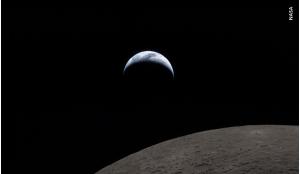
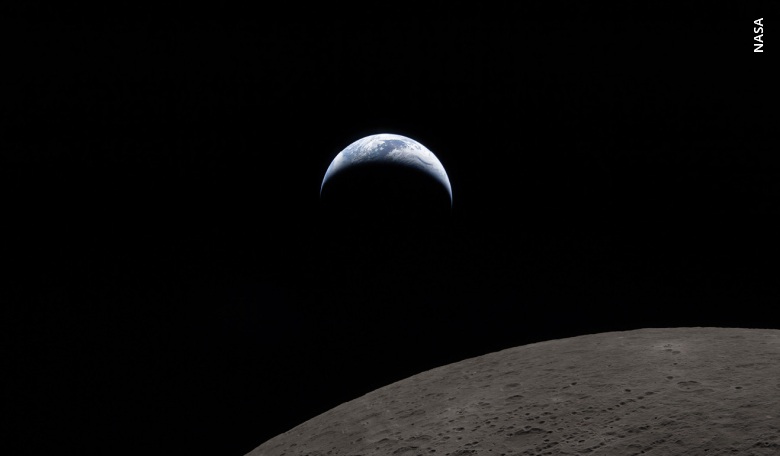
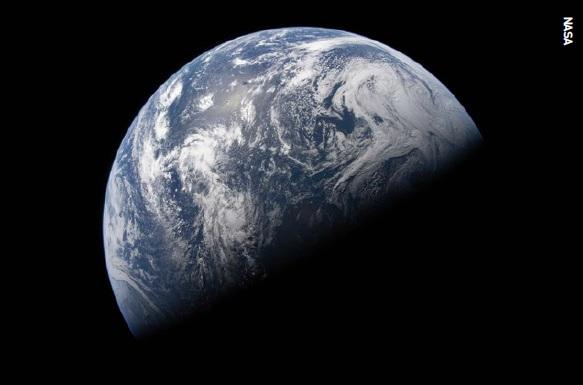 Earth illuminated against the blackness of space in a photo taken by the Artemis II crew on the second day of their mission.
Channelling Apollo
Overall, it seems that we are not necessarily in a better place than we were in the Apollo days, even taking into account the delays imparted by the tragic Apollo 1 fire and the Apollo 13 explosion. In the 1960s, thanks to Kennedy’s end-of-the-decade deadline, NASA rose to the challenge and got the job done; clearly we live in a different world.
For one thing, we don’t have the level of visibility on progress, or lack of, that we had for Apollo. NASA contractors have become used to working in ‘stealth mode’, allowed to hide behind a veil of ‘commercial confidentiality’, apparently afraid to admit that space is hard. And, as implied above, media reporters simply haven’t the knowledge or experience to ask the right questions and investigate why SpaceX and Blue Origin aren’t being more transparent about delays to their lunar landers.
The closest parallel with those halcyon days of Apollo is the fear that another nation will get there first, but US politicians awoke far too late to the possibility that China could land a man or woman on the Moon before Artemis. Their extended nap means that it may already be too late for a sprint to the finish line.
Moreover, the promised one-mission-per-annum of the Artemis programme is not enough to make us, in Elon Musk’s words, a spacefaring civilisation. Whether or not it’s enough to beat China to the Moon, there is no guarantee that Artemis will continue beyond the first landing mission. Of course, we’ve been here before with the final three missions of the Apollo programme that were cancelled for political and financial reasons.
Apart from being twins in Greek mythology, Artemis and Apollo have many common elements, but I hope that a legacy of 50-plus years confined to low Earth orbit is not among them.
Artemis II demonstrated that NASA can once again send astronauts beyond low Earth orbit. That achievement deserves recognition. Whether Artemis ultimately becomes a sustained programme of exploration, however, will depend less on engineering than on political resolve, stable funding and a willingness to learn from the successes – and failures – of the past.
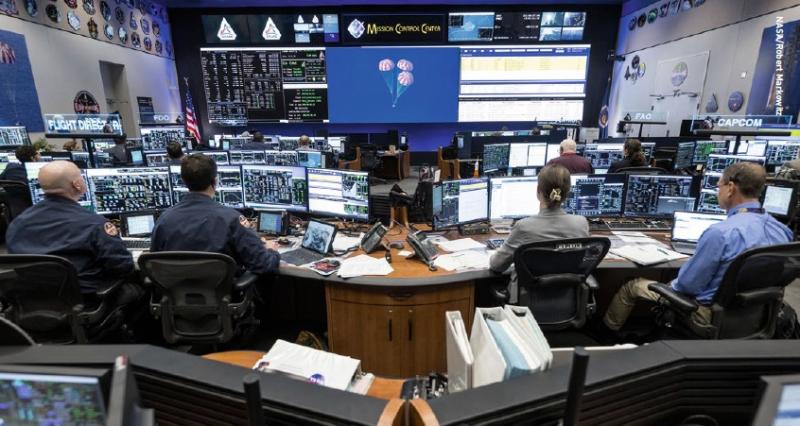 Artemis II Flight Control Team in the Mission Control Center at NASA s Johnson Space Center for the splashdown and recovery of the Artemis II crew.
About the author
Mark Williamson is an independent Space Technology Consultant and writer, and a Commissioning Editor for ROOM Space Journal. He has 40 years of experience as a satellite communications engineer and consultant to the space industry, space insurance and space education sectors. He is the author of six books, including The Cambridge Dictionary of Space Technology and Space: The Fragile Frontier, has edited three space industry magazines and written more than 600 articles and papers on space technology. He has a BSc in physics and astrophysics, a PhD in sustainable development of the space environment and is a chartered physicist and chartered engineer. In 2008, Mark developed a sub-career as a stock photographer and currently licenses images across several platforms including Getty Images and Science Photo Library.