

As tens of millions of people across the USA from Oregon to South Carolina tilted their heads skyward to observe the effects of a full solar eclipse on 21 August 2017, a young filmmaker in Montreal also watched with fascination. Inspired by the concept of the Overview Effect, his focus turned to how the Earth must appear from the other side of the eclipse, from the place where the shadow began. What would it mean for humanity’s connection to Earth to be able to invert the gaze, to see an eclipse the way a satellite does, the way the Moon itself almost does? That question was to become the founding question of The Dorothy Project, an interdisciplinary research lab and film studio operating at the intersection of immersive media, space technology, digital art and cognitive science.
I had spent my professional life behind cameras, working on film sets around the world, but space exploration and astrophysics had been my other passion since childhood. When I first encountered the concept of the Overview Effect, introduced by Frank White in his 1987 book of the same name, it turned my world upside down: the idea that astronauts returning from orbit so often describe an indelible cognitive shift, a felt understanding of Earth’s fragility and unity that words cannot quite capture.
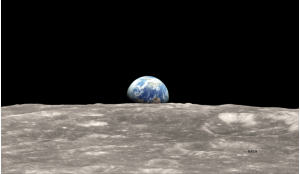
Carl Sagan described the same feeling when he asked us to look back at our planet from the outer reaches of the Solar System, in the famous Pale Blue Dot image captured by Voyager 1 from beyond Neptune. Then there is Earthrise, the famous photograph taken by William Anders, who later said that the most important thing Apollo 8 discovered was the Earth. Edgar Mitchell, returning from Apollo 14, called the experience an instant global consciousness. Sergei Krikalev, who spent more than 800 days in orbit across six missions, has described how borders disappear from space, leaving only natural features.
Most recently, the astronauts of NASA’s Artemis II mission, returning to Earth in April 2026 after the first crewed lunar flyby in over half a century, described the same sensation in interviews, almost word for word, as if certain experiences refuse to be paraphrased.
Reading the Overview Effect in 2017, I realised that this experience belonged to a vanishingly small club. Only around 700 people have crossed the Kármán line. Fewer than 30 have travelled far enough from Earth to see the whole planet at once. If the Overview Effect really is, as White argued, the most important psychological discovery our species has ever made in space, then locking it inside an expensive rocket seems an extraordinary waste of a perspective. There had to be a way to bring it down.
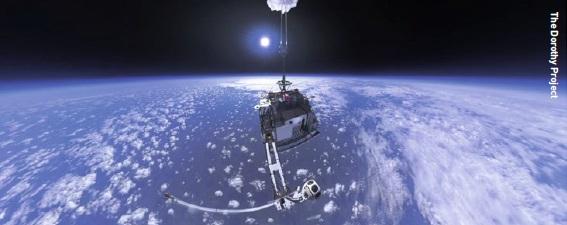 Dorothy 8 was developed in 2025 under the STRATOS stratospheric balloon programme by the Canadian and French space agencies.
The birth of the project
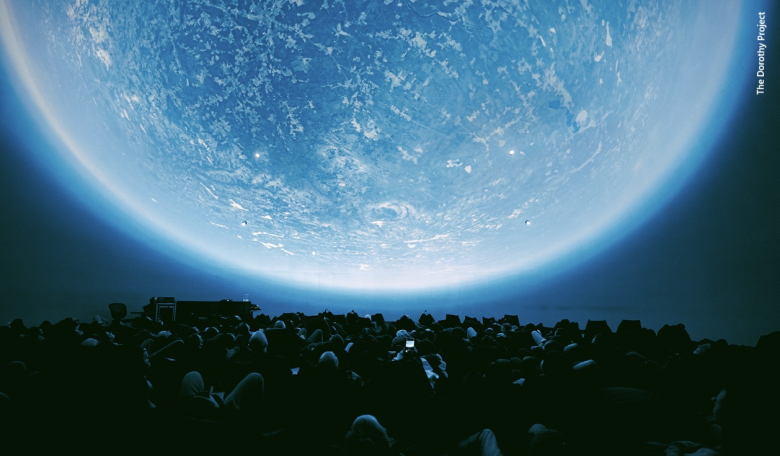
Audience members emerging from the dome have described the experience using the same vocabulary that astronauts reach for
In the months that followed, I assembled a small team of filmmakers, engineers, scientists and artists, and we began building a stratospheric module. We called the first prototype Dorothy 1, after the device thrown into the storm by the meteorologists in the 1996 film Twister, an instrument designed to record what no human can see and survive. The name was a geeky reference and a thesis statement at once. We were sending a machine where we could not go, in order to bring something back.
Montreal turned out to be an unusually well-suited place to start. The city’s overlapping ecosystems of cinema, immersive media, aerospace research, and academic science meant that when we needed a radio specialist who also understood film grammar, or an atmospheric physicist willing to spend a weekend recovering a payload from a snowy field in the Eastern Townships, we could often find them within a fifteen-minute drive. The Dorothy Project has remained, at heart, a collective of people who refuse to choose between art and engineering and have decided, instead, to do both at once.
The thesis ran like this. If you cannot put every human being on a rocket, you can still give them, through immersive experiences, a usable approximation of what astronauts see and feel. A 360-degree camera flown to 35 km of altitude does not show what the International Space Station (ISS) sees. It shows a ‘cousin’.
The horizon curves visibly, the sky overhead darkens through deep blue to violet to black, the Earth becomes, unmistakably, a body. Project that footage onto the inside of a planetarium dome, or wrap it around a viewer’s head in a virtual reality headset, and the cognitive shift becomes available, at least partially, to anyone who can spare 20 minutes. We have watched audiences come out of those screenings having shared an experience that is only produced by a certain kind of art.
For the next seven years we refined that thesis with our hands. Tracking systems grew more accurate. Cameras became lighter and more thermally stable. Trajectory simulations let us choose landing sites with greater precision and recover our payloads in fewer pieces. By the spring of 2024, after a dozen flights, the platform was ready for its real test.
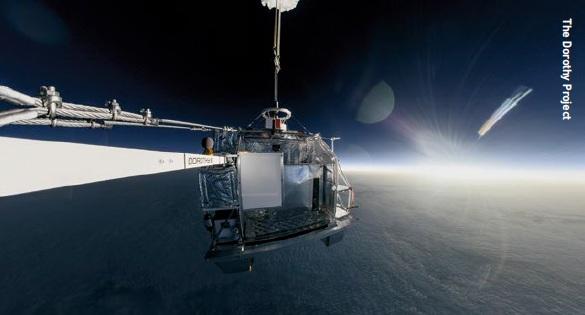 The gondola that carried Dorothy was operated by CNES. It weighed nearly 700 kg and carried around 10 scientific experiments.
Mission UMBRA
On 8 April 2024, the Moon’s shadow swept once again across North America, this time from the Pacific coast of Mexico through the United States and out over Canada. The original question, asked seven years earlier in the face of a different eclipse, was finally answerable.
We launched from southern Quebec, lifted Dorothy 7 into the path of totality, and recorded the umbra, the dark inner shadow, from above.
The footage is, in a sense, what the project had always been working toward: a circle of darkness 172 km across, sliding silently over cloud and continent at more than 4000 km an hour, while the camera floated in stillness above it. Watching it for the first time in the editing room was an unsettling experience. The shadow does not look astronomical, it looks almost biological, a great dark cell moving across the surface of a living thing.
We called the resulting 12-minute film Mission UMBRA. It exists in two versions, one for full dome planetariums and one for virtual reality headsets, and it has screened at the Society for Arts and Technology in Montreal, the Festival du Nouveau Cinéma (FNC), the Montreal Planetarium, and internationally at Dome Under in Australia, with further dates in preparation. Audience members emerging have described the experience using the same vocabulary that astronauts reach for, which is the most encouraging data point we have collected in eight years. Several have asked how soon they can go again. The film also brought us, somewhat unexpectedly, to the attention of the Canadian Space Agency (CSA).
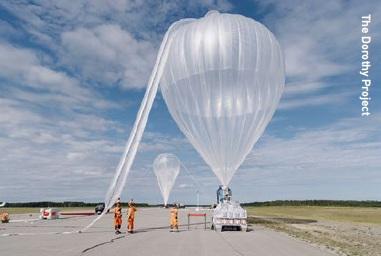 Dorothy 8 carried a modified INSTA360 Titan camera along with three additional smaller cameras, a spatial audio mic and a suite of sensors. The camera was repainted with the space-grade coating used on the ISS, which optimises thermal control in the stratosphere, allowing the camera to handle the extreme temperature difference, a swing of about 120C between the sunlit side and the shaded side.
Mission STRATOS
If everything goes to plan, the resulting imagery will be a small piece of optical history
We developed the eighth iteration of Dorothy in 2025, under the STRATOS stratospheric balloon programme, a collaboration between CSA and French space agency CNES. The goal was to transform a professional 360-degree camera and make it space ready. We covered the camera with temperature sensors, then engineered a dedicated power supply tuned to deliver an absolutely stable voltage regardless of the thermal swings the gondola would meet on the way up.
We repainted it with the same space-grade white thermal-control coating used on the ISS, designed to manage the extreme temperature delta, 120 degrees Celsius between the sunlit and shaded faces of the module. We wrote custom software to remotely control the camera, get a live view from it and adjust exposure, ISO setting, and every other setting in real time. We also had two redundant onboard computers and several independent paths to reboot the camera if anything happened.
The footage from the Dorothy 8 flights now serves two purposes. The French National Centre for Scientific Research (CNRS) will use part of the imagery in an experimental study of the upper atmosphere. The same footage will also form the visual basis of a new immersive science fiction film, the first such film, to our knowledge, ever shot in the stratosphere itself rather than reconstructed in post-production. The story will take place on a space elevator and is currently being written.
Mission TARONI
In parallel with the technical work, the project has occasionally drifted into more poetic territory. For Mission TARONI, a collaboration with Maximilian Canepa, the artistic director of Taroni, a major silk producer and one of Europe’s oldest silk houses based in Como, Italy, we sent a silk sculpture into the stratosphere. We draped an ultralight mannequin, crafted from a lifecast and weighing only 700 grams, in a Klein blue double satin chosen to echo the colour of Earth’s thin atmosphere.
The reference to artists Christo and Jeanne-Claude is deliberate; for half a century, the pair wrapped bridges, monuments, and entire stretches of coastline in fabric, suspending their everyday function in order to reveal them anew; concealment, in their work, was always a form of seeing. Wrapping a human silhouette and lifting it to the edge of space extends that gesture into a new dimension, asking what becomes visible about humanity itself when it is briefly veiled and held against the planet that made it. The collaboration also rested on shared ethics. Taroni was among the first silk houses to sign Greenpeace’s Detox Commitment in 2016, eliminating hazardous chemicals from its production chain. The resulting short video went unexpectedly viral online and has since been picked up by CNN, the BBC, and The Times.
What comes next
On 2 August 2027, we will be in Egypt for Mission APOPHIS. We will once again attempt to capture the Moon’s shadow from the stratosphere, this time with our custom 11K camera system built and tested on Mission STRATOS. To our knowledge, no one has filmed a total solar eclipse from above at that level of detail. With totality lasting 6 minutes and 23 seconds, it will be the longest total eclipse on land until 2114, and its path runs almost directly over Luxor, the ancient Thebes, where a civilization once raised temples to the Sun and called it Ra. That rare alignment is also a rare story to tell: a chance to hold modern astrophysics and ancient cosmology in the same frame, and to turn it into an immersive experience that lets an audience stand between the science of the Sun and the civilisations that built their world around it.
In 2027, with Mission TORNADO, we will document supercell thunderstorms and tornadoes from three altitudes simultaneously: on the ground, inside the storm, and above the system from the stratosphere. The centrepiece is a custom 360-degree FPV (first person view) drone designed for extreme winds, capable of flying around and into a tornado while delivering atmospheric data to scientific partners. We are building this mission with the Université du Québec à Montréal (UQAM), with the aim of involving students in the research.
The longer horizon, the one that has been on the project’s whiteboard since the beginning, is a CubeSat. We want to design and build our own small satellite, equipped with a custom 360-degree camera and place it at roughly 550 kilometres of altitude. From that vantage point, the Overview Effect is no longer an approximation, it is the thing itself. We are working toward this in partnership with the student space company at Polytechnique Montréal, PolyOrbite, with a target launch around 2030.
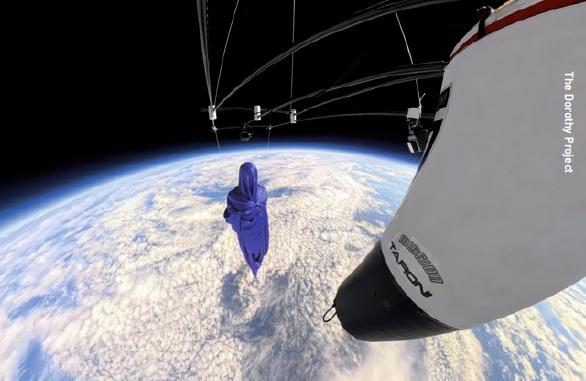 The Mission TARONI video project lifted a silk-wrapped mannequin to an altitude of 35 km to create a ‘stratospheric ballet’, exploring the ties between human creation and the natural world. The final footage used only the Earth’s natural light. The two cables holding the mannequin were removed frame by frame, but everything else in the video was as captured by the camera.
Why we do this
A still photograph can move you, an immersive experience moves through you
A fair question hovers over a project like this. Why bother building yet another stratospheric platform, another drone, another satellite, in a world that already has more imagery than it can process and more crises than it can tend to?
The honest answer is that imagery is not the same as understanding, and that the Overview Effect, as White and Sagan and the Apollo and Artemis astronauts all separately describe it, is not really an aesthetic experience, it is a structural one. It rearranges the relationship between the viewer and the object viewed. The Earth stops being the floor and the sky and starts being a place - finite, blue, and singular. Most of the great environmental decisions of the next half century will be made by people who have never been to space and never will. If even a small fraction of those people can be given an honest, well-crafted approximation of what it feels like to see Earth from outside, then the cost of a balloon and a small team in Montreal is more than justified.
The work of raising environmental awareness has been carried for decades by scientists, thinkers, and storytellers, from Rachel Carson to Carl Sagan to Frank White. The Dorothy Project sees itself as a continuation of that lineage, with one specific contribution: the use of contemporary tools, immersive cinema, virtual reality, fulldome projection, that speak natively to the generations who will inherit the planet. A still photograph can move you, an immersive experience moves through you. Body and mind are transported into the medium together; you are not looking at the Earth, you are present beside it, and that difference matters.
We have watched it happen in our screenings and the emotional response can be unlike anything a flat image produces. Earthrise, in 1968, is often credited with helping inspire the first Earth Day and the wave of environmental legislation that followed. Pale Blue Dot, captured by Voyager 1 in 1990 from six billion kilometres away, has become a touchstone of secular humility, read aloud in classrooms and at funerals. Those single images already did extraordinary work. Our wager is that immersive media, properly made, can extend that work to new audiences with a deeper register of feeling than a photograph alone can reach.
That is what The Dorothy Project is for. We borrow from cinema, from atmospheric science, from aerospace engineering, in order to do one specific thing: to keep widening the door that the astronauts pass through, until anyone who wants to walk through it can.
About the author
Mathieu Baptista is a French prosthetic makeup artist, art director, filmmaker and engineer. After earning a science degree and a bachelor’s in arts, he turned to cinema in 2007, training in Paris before joining Oscar winning Morot FX Studio in Canada and Wētā Workshop in New Zealand. Over 18 years, he has contributed to more than 60 productions, including Avatar, X-Men, The Revenant, Sicario, Rings of Power, Mother, Ghost in the Shell and Mulan. In parallel, he has designed and built stages and large-scale art installations for electronic music festivals. In 2017, mixing his passions for arts and science, he founded The Dorothy Project, and has since collaborated with the Canadian and French space agencies on stratospheric imaging missions.
Editor’s note
The Dorothy Project is looking for partners of every kind for its ODYSSEY, TORNADO and CubeSat projects: financial backers, media, technical and logistical collaborators, private companies and academic institutions. More information is at: www.thedorothyproject.ca