

As the number of confirmed exoplanets has increased, so has the number of books published on the subject of life elsewhere in the universe. This one starts with the fascinating statistic that, since the first in 1995, around one new exoplanet has been discovered “every other day since we built the first instrument sensitive enough to detect them”. And clearly this includes only planets that are relatively easy to find, so the potential number is – how can I put it – astronomical!
The author is an astrophysicist at Cornell University and, as the blurb proudly boasts, “works from Carl Sagan’s former office”. According to the preface, she spends her days “trying to figure out how to find life on alien worlds”, so we can assume we are in the hands of an expert. Indeed, she promises to “provide an insider’s view” by describing some of the most unusual exoplanets and explaining how they shed light on “one of the most enduring questions in all of science: Are we alone?”.
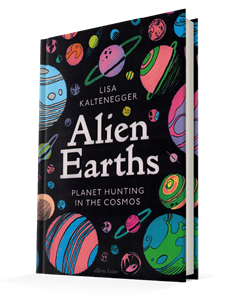
The book is pretty much devoid of imagery, but it has a useful index, a couple of short appendices and one of the prettiest covers I’ve seen! The overall style is what one could call ‘science by autobiography’ - which has become a common method of popularising science and technology - so expect references to lack of sleep, the taste of coffee and the occasional reference to the difficulties faced by women in science.
The writing style is chatty and educational and the author manages to cram in a number of important concepts (such as the Drake Equation and the Fermi Paradox) in the first chapter. And however many analogies describing the enormous extent of the universe I come across, there is always another one: this one shrinks the solar system to the size of a cookie and places the nearest star at a distance of “nearly nine thousand cookies”! Continuing an apparent food theme, we also find the author asking her students “Could this banana be an alien?”, which is an interesting method of sparking her audience’s thought processes. Indeed, we hear quite a lot about her students in this first section.
Naturally, subsequent chapters cover the requirements for habitability, definitions of life and how to search for it, but they also contain some interesting diversions such as what it’s like to work in Sagan’s office and a commentary of the misrepresentation of science and maths as “hard and boring”.
Budding young scientists will find this book inspirational. Older readers will also benefit from its clear and inclusive presentation of a continually fascinating subject. However, I am left with one crucially important question: why, given the author’s obvious interest in coffee, is there no entry in the index?