


The stars are still there. What has changed is our ability to see them. In less than a decade, thousands of satellites have been deployed into low Earth orbit, transforming what was once an intermittently disturbed sky into a permanently altered one. These spacecraft – essential to global communications, navigation, climate monitoring and security – have introduced a new, artificial brightness that did not exist at scale before 2019. Their reflective surfaces cause streaks across astronomical images, elevate diffuse skyglow and interfere with ecological and cultural relationships to darkness.
On a clear night, stand outside and look up. If you observe carefully, you’ll notice that the stars are disappearing, not because they have stopped shining, but because thousands of new satellites are flooding low Earth orbit (LEO), turning the night sky into a glowing screen. Their reflective surfaces add measurable brightness that never existed before, streaking across telescope images and rendering faint astronomical objects invisible.
In November 2022, the BlueWalker 3 satellite demonstrated the scale of this problem. With its 64 m2 phased-array antenna fully deployed, it reached an apparent magnitude of 0.4, roughly as bright as Procyon, one of the brightest stars visible from Earth.
To understand what that number means, consider how astronomers measure brightness. The magnitude scale, inherited from the Greek astronomer Hipparchus around 150 BCE, runs backwards, lower numbers indicating brighter objects. While the Sun sits at magnitude −26.7, the faintest stars visible to the naked eye hover around magnitude 6.0; the International Astronomical Union (IAU) recommends satellites remain at magnitude 7.0 or fainter, effectively invisible without a telescope.
The scale is logarithmic, meaning that small numerical differences in magnitude represent enormous differences in brightness. For example, the difference between BlueWalker 3’s magnitude 0.4 and the recommended 7.0 translates to a factor of 437, so the satellite wasn’t slightly too bright; it was 437 times too bright!
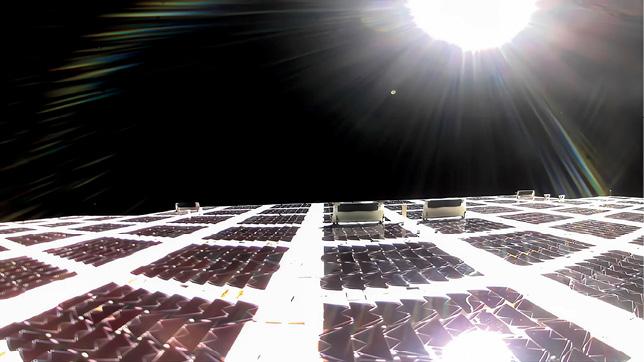 BlueWalker 3 (BW3) is a prototype satellite launched by AST SpaceMobile in 2022 to test direct-to-phone broadband from space. It features a 64m2 phased-array antenna that makes it exceptionally bright in the night sky, impacting astronomy but enabling the first 5G calls to regular smartphones from orbit.
Shared resource transformed
Artificial light at night does not just obscure distant galaxies, it disrupts the ancient rhythms that have governed terrestrial life for decades
Artificial light at night does not just obscure distant galaxies, it disrupts the ancient rhythms that have governed terrestrial life for decades. In humans, this constant illumination suppresses melatonin production and disrupts circadian rhythms, and is linked to sleep disorders, metabolic dysfunction and increased cancer risk. For wildlife, this light interferes with navigation, foraging, reproduction and predator-prey dynamics.
For example, for millions of years, sea turtle hatchlings have navigated from beach to ocean using moonlight and starlight reflected on water. When artificial brightness overpowers these cues, hatchlings crawl toward the land instead of the sea, toward roads, predators and exhaustion. In Florida alone, hundreds of thousands become disoriented annually.
With approximately 100,000 satellites projected to be launched to orbit by 2030, a shared resource that existed essentially unchanged for billions of years is being transformed within a single decade. The question isn’t whether this transformation will happen; deployment is already underway. The question is whether humanity can govern it.
Voluntary measures fail
In 2019, the Space Safety Coalition brought together major satellite operators - SpaceX, SES, Eutelsat, Intelsat and Iridium – all of which pledged voluntary practices beyond regulatory requirements. The intentions seemed genuine, but the results tell a different story.
Evidence from corporate responsibility research is unambiguous: while 78 percent of public companies disclose environmental impacts, they do so because regulations force them to. Only 6 percent of private companies disclose voluntarily. This isn’t a modest gap and it shows how commercial entities behave when enforcement is absent.
SpaceX, to its credit, has moved furthest. The company installed sun visors on its VisorSat models of Starlink and photometric studies confirmed real improvement. Characteristic magnitudes dropped from 4.7 to 6.2, which represents a roughly four-fold reduction in brightness. In addition, astronomical observatories were able to schedule their observations around satellite passes, because orbital predictions were updated multiple times a day.
However, the visors blocked the optical paths of laser inter-satellite links, so they had to go. SpaceX also cited their increased atmospheric drag. As a result, post-VisorSat satellites regressed to magnitude 5.5, with years of engineering work undone by a product decision.
When voluntary commitments conflict with business requirements, business requirements win. Every time.
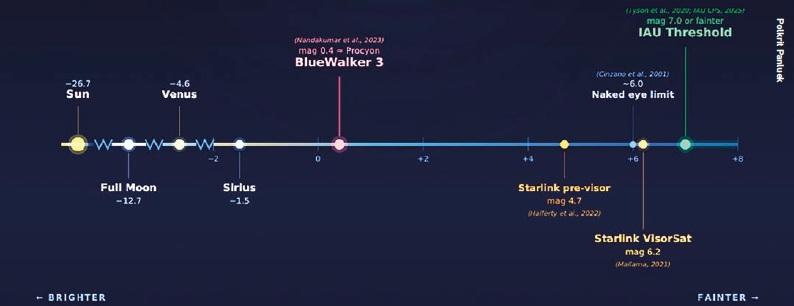 Graphic illustrating how BlueWalker 3 at 0.4 magnitude is 437 times brighter than the IAU recommended limit of magnitude 7.0.
Mitigation or redistribution?
Returning to BlueWalker 3 and its required 437-fold brightness reduction, what can current mitigation technologies deliver?
Part of the mitigation strategy are the so-called ‘dark coatings’, effectively low-reflectivity materials, that achieve the most dramatic improvement available. SpaceX’s DarkSat experiment demonstrated a brightness reduction factor of approximately 7.6 times. Applied to BlueWalker 3, this brings it from magnitude 0.4 to roughly 2.6. Impressive, but still 57 times too bright.
Sun visors deliver approximately 2.3 times reduction. Applied alone to BlueWalker 3, this reaches magnitude 1.3, still 190 times over threshold. Even combining both approaches achieves only a 17.5 times total reduction, reaching magnitude 3.5. This is still 25 times too bright and means that the satellites remain easily visible on any clear night.
The engineering trade-offs compound the problem. Dark coatings absorb more solar radiation, creating severe thermal control challenges, so SpaceX abandoned the approach despite its optical success. Worse, by raising surface temperature, dark coatings actually increased infrared emissions, meaning that while one form of interference shrank, another grew.
Only intrinsic brightness reduction, hardware modifications that reduce reflectivity regardless of viewing geometry, will address the problem universally
In Formula 1 racing, teams can bolt on new front wings or change tyre compounds within races and refine performance throughout the season. The satellite industry does not have that luxury: once a fleet design deploys at scale, it is frozen for a decade or more. There is no pit stop, no midseason development, no chance to tear down the architecture and start afresh.
It is clear that the magnitude of reduction demands fundamental design changes from the outset, not incremental patches after launch. At first sight, operational scheduling, using software to orient satellites favourably during observation windows, appears attractive. It’s cheaper than hardware and adjustable after launch, but it suffers from a fundamental ethical flaw.
When an operator manoeuvres a satellite to avoid visible passes over the Vera Rubin Observatory in Chile, for example, those passes don’t disappear. The brightness transfers to observers in South Africa, Indonesia or Australia who had no representation when the algorithm was written. The satellite becomes dimmer for stakeholders with voice and power while becoming brighter for those without.
This isn’t mitigation; it’s a redistribution of the problem. Only intrinsic brightness reduction, hardware modifications that reduce reflectivity regardless of viewing geometry, will address the problem universally. A dark coating dims the satellite whether its viewed from Beijing, Nairobi or São Paulo. Regulatory frameworks must therefore prioritise hardware solutions, because only hardware treats the night sky as genuinely belonging to everyone.
Regulation and operational reality
The EU Space Act, targeting January 2030 implementation, requires operators to establish light pollution mitigation plans, including measures such as low-reflectivity coatings and shielding.
As of the start of 2026, the proposal, still under negotiation between the European Parliament and Council, does not specify a particular magnitude threshold.
Specific technical standards are to be developed by European standardisation bodies, and the IAU’s magnitude 7.0 recommendation at LEO may inform these future standards. Crucially, the Commission chose a Regulation rather than a Directive, meaning that it applies directly across all 27 member states, avoiding fragmentation into different national interpretations. The Act embodies safety-by-design in that brightness mitigation must be built in from the initial engineering phase, not bolted on later.
Given the global interconnectedness of space companies and supply chains, the EU intends the standard to be one that space companies outside Europe may also adopt in order to supply into and work with EU companies. However, there is a gap between regulatory ambition and operational reality: the EU Space Act may establish the brightness threshold, but operators face a challenge in translating this limit into actionable engineering and business decisions. Regulators need methods to verify mitigation claims and scientists require standardised comparison frameworks, but, fundamentally, satellite companies must balance cost, timelines, performance and compliance.
What is missing is a conceptual bridge between regulatory compliance and practical spacecraft engineering, a methodological tool that translates performance requirements into design choices, budgets and schedules.
 The currently under discussion EU Space Act establishes a brightness threshold, but operators face a challenge in translating this limit into actionable engineering and business decisions.
A framework for accountability
It is suggested that a best-effect-to-cost (BEC) framework and a cost of compliance taxonomy (CCT) provide this bridge. Together they translate abstract regulatory requirements into concrete business decisions that operators, regulators and investors can all understand.
The CCT breaks compliance into three buckets: CAPEX, the upfront capital expenditure for hardware, testing and design changes; OPEX, the operating expenses for software, monitoring, reporting and staff; and the regulatory risk cost (RRC) or financial exposure from potential fines, licensing delays or enforcement actions. By making these costs explicit, the taxonomy enables operators to budget for compliance while allowing investors to assess regulatory risk exposure.
The BEC Framework ranks mitigation options based on cost per unit of effectiveness (CUE) or money spent per magnitude of brightness reduction and evaluates each measure across four dimensions:
- Technical Effectiveness: how much brightness is actually reduced
- Implementation Cost: CAPEX plus OPEX
- Operational Impact: effects on satellite performance
- Regulatory Alignment: compatibility with policy requirements.
This prevents operators from falling into the ‘good enough’ trap, where cheap partial fixes are chosen over fundamental design changes that would actually achieve compliance.
What compliance actually costs
Critically, no operator has disclosed actual mitigation costs, because the space sector has historically hidden behind corporate confidentiality
Applied to a representative 100 satellite constellation in the 250 kg class with a seven-year mission lifetime, the framework reveals what compliance may require.
Hardware visors may cost approximately £4 million and dark coatings approximately £2.5 million as one-time engineering costs; operational scheduling may cost approximately £0.35 million annually.
Combined, the layered approach achieves a magnitude 2.04 total reduction at an approximate annualised cost of £1.33 million, roughly £0.65 million per magnitude.
From a baseline of magnitude 5.0, this reaches magnitude 7.04, just barely compliant with a zero margin of error. While this may represent one to two percent of typical programme costs, these figures are conservative; costs may decrease significantly if mitigation is integrated during the initial design phase (‘safety-by-design’) rather than retrofitted.
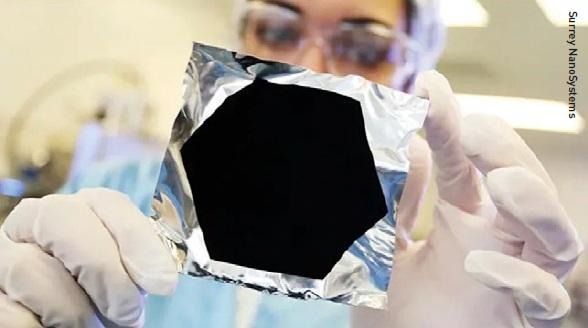 One potential solution is to make satellites that do not reflect light. This year a UK-based research team plans to launch a shoebox-sized CubeSat (Jovian-1) which will have one side covered in a special hull-darkening material that absorbs 99.965% of light that hits it. By closely tracking the dark-coated spacecraft as it orbits our planet, the team will be able to tell if the material works as predicted - and whether it can withstand the rigours of space travel. The project is a collaboration between the Universities of Surrey, Portsmouth and Southampton.
The choice
Satellite brightness isn’t ultimately a technical problem. It’s humanity’s first serious test of whether we can govern shared space resources through coordination rather than exploitation. It’s a pragmatic test of what we have come to know as ‘space sustainability’.
Success establishes precedents for everything that follows: debris mitigation, spectrum interference, planetary protection and resource extraction. Failure signals that space development will follow terrestrial patterns, privatising benefits while externalising costs until shared resources degrade beyond recovery.
The constellation designs being finalised today will determine the night sky of 2035, 2045 and 2055. These are not abstract dates; they fall within the lifetime of children alive today who have no voice in decisions shaping their experience of the cosmos.
The BEC Framework is not a perfect instrument, because no applied methodology is. It represents a deliberate simplification, designed to enable market adoption rather than await unattainable precision. But it’s a working tool that can be refined over time, and this is more valuable than a theoretically flawless model that never leaves the page.
The night sky belongs to everyone. That simple fact contains the entire challenge and opportunity of space governance. We either protect it together, or we lose it - one launch, one constellation, one boardroom decision at a time.
Editor’s note
Edited and adapted for ROOM Space Journal from the paper ‘Dimming the Shared Sky: A Cost-Effectiveness Framework for Brightness Compliance in Mega-Constellations’. For the complete technical framework, including detailed engineering specifications, measurement protocols, sensitivity analyses, international governance recommendations and the five-year phased implementation roadmap, see: sustainability.OfSpace - ‘Satellite Brightness Framework’, Polkrit Panluek’s full report.
About the authors
Polkrit Panluek is an aerospace engineering graduate from the University of Manchester, specialising in satellite system design and space sustainability. He is currently a Sustainability Research Intern at SustainabilityOf.Space through the Wayfarer Programme, where he works under the mentorship of Andrew Iwanoczko. His current research focuses on the intersection of constellation design and emerging international policy, specifically developing frameworks to quantify the cost and technical feasibility of satellite brightness mitigation. Through his work, he aims to provide space operators with the data-driven tools needed to align commercial fleet deployment with the requirements of the 2030 EU Space Act.
Andrew Iwanoczko is a London-based innovation consultant specialising in space sustainability and ESG reporting for the space sector. He is Managing Director of SustainabilityOf.Space, where he is developing the Global Space Leaderboard, and Founder & CEO of Callala Ltd, providing strategic consulting on environmental and social harms and positive impact. Andrew is a Fellow of the Royal Geographical Society (FRGS) and Fellow of the Royal Society of Arts (FRSA).