

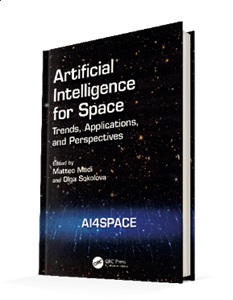
It is inevitable that every new technology or concept will, sooner or later, present a Venn-diagram-like overlap with Space and this is the case for Artificial Intelligence (AI). Indeed, according to this book, “AI is poised to revolutionize space exploration, to enable new possibilities for applications and to offer invaluable insights that can profoundly impact our life on Earth”.
The extent of this profound revolution remains to be seen, but the authors and contributors should be commended for highlighting some of the applications and identifying some of the issues involved. Following a general introduction, the main sections of this book cover trends in AI, applications, legal perspectives and future possibilities. Each chapter in this multi-author work concludes with further reading and a bibliography (effectively a reference list) and there is a brief but potentially useful index.
Although a book on the intersection between AI and Space is welcome, this is unlikely ever to be viewed as a definitive text. It lacks a coherent theme, an overview commentary or an understandable trajectory. Contributions are very specific, mostly highly technical and in some case mathematical, which makes it very difficult to discern a target audience. The blurb states that it is aimed at “space engineers, risk analysts, policy makers, technical experts and non-specialists”, but this is far too broad a remit, bordering on ‘no particular use to anybody’.
The final chapter is a case in point: it begins with what appears – in section 10.1 - to be a general commentary on the “rate of technological advancement and innovation in space”, but then deteriorates into a work of badly-written fiction. Section 10.2 opens with: “As I woke from a much needed, yet not entirely-fulfilling sleep, I was disoriented… I was here on the Moon with my parents and brother on what my Mom described as a workcation”.
In a way, this chapter summarises the book’s contribution to the AI-Space domain: much needed, but not entirely fulfilling.