

When astronauts first travelled to the Moon, their spacesuits were designed and sewn by hand. Skilled seamstresses, who learned to stitch airtight curves of Beta cloth, sewed many layers of fabric, insulation, and hardware at factory tables. Six decades later, the AxEMU (Axiom Extravehicular Mobility Unit), designed for the lunar south pole, is still a sewn garment that seamstresses assemble by hand. But today, its shape is designed using AI-driven generative tools and refined on virtual models before anyone cuts fabric. In this new workshop, algorithms build components for the astronaut’s life-support system, while human technicians determine how to wrap, reinforce and stitch those components into a suit an astronaut can live and work in.
Apollo’s first lunar spacesuits were scientific marvels of that era. They were custom made for each astronaut and sewn by expert seamstresses who learned to stitch multiple layers of synthetic fabrics into airtight, pressurised ‘skins’ capable of shielding astronauts from extreme temperatures, vacuum, solar radiation and micrometeorites.
Yet those early spacesuits were bulky and restricted mobility. Astronauts developed a characteristic hopping gait and even simple tasks, like bending to pick up a rock, turned into strenuous physical movements.
The modern AxEMU spacesuit, chosen for the Artemis lunar landing missions, is based on NASA’s earlier xEMU design. The AxEMU suit has the same goal: to keep astronauts safe and able to work on the Moon, but it is designed with the help of AI-powered generative tools. It was tested and refined in labs and facility simulations, and its many fabric layers were sewn with luxury fashion designer Prada’s expertise in clothing and textiles. These innovations show how modern spacesuit tailoring has changed.
Decisions about how to sew the suit, where to place seams and how to balance protection with comfort now come not only from skilled human hands, but also from algorithms and advanced engineering.
AxEMU’s AI component design
Decisions about how to sew the suit, where to place seams and how to balance protection with comfort now come not only from skilled human hands, but also from algorithms and advanced engineering
To design the AxEMU, engineers used genetic algorithms and Generative Adversarial Networks (GANs) to enhance topology optimisation. This approach made the metal parts of the spacesuit lighter, stronger and more efficient. The metal structures determined how the suit’s fabric layers were cut, stitched, and reinforced.
The AxEMU used full-body 3D scans and digital twins (virtual models) of astronauts to see how the suit pressed on the body and how well astronauts from small to large sizes could move in it. Then, AI systems predicted which suit patterns, joint locations and adjustable parts would fit safely. This helped designers decide how many fabric sizes to make and how the sewn pieces of the suit should be built.
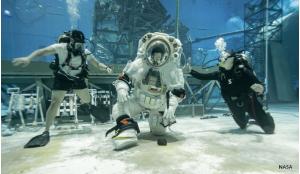
To ensure the AxEMU can withstand the mechanical, thermal and operational demands of Artemis, NASA carried out a series of rigorous tests. At the Neutral Buoyancy Laboratory at NASA’s Johnson Space Center in Houston, astronauts practiced walking and using tools in underwater conditions that simulated lunar gravity. The suit was also evaluated during reduced-gravity flights in test facilities at Johnson Space Center. Finally, thermal-vacuum chamber tests showed that the suit was reliable in extreme temperatures and low pressures similar to those on the Moon.
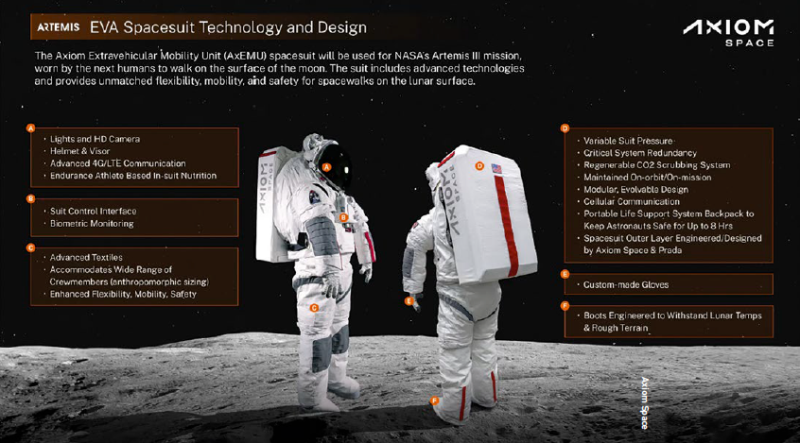
AI helped make AxEMU lighter, more flexible, and better fitted for almost all adult body sizes, and support eight-hour spacewalks. The suit integrates life-support, pressure garments, avionics and other tools to expand scientific exploration. It uses a hard upper torso while the limbs are soft and flexible. The joints can rotate and bend in the hips, knees, ankles, shoulders and wrists, allowing astronauts to kneel, squat, lunge and walk more naturally instead of hopping.
The redesigned gloves reduce fatigue and improve dexterity. This helps astronauts manipulate tools and perform fine tasks more effectively than with the earlier stiffer designs. The helmet and visor feature advanced coatings and optical treatments that reduce harsh glare, improve contrast, and protect against scratches, dust, and extreme temperatures. These improvements help astronauts see clearly on the Moon, read displays and work during long spacewalks.
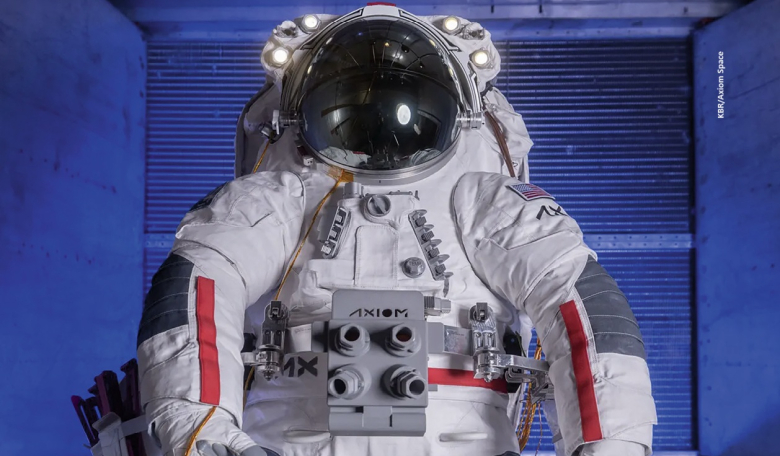
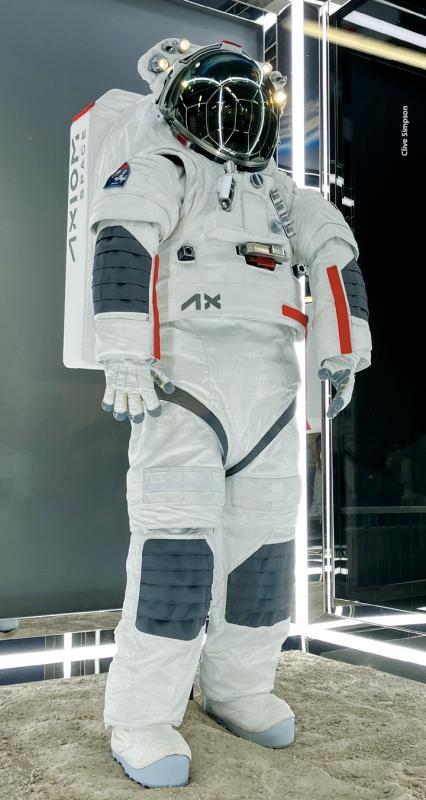 Axiom lunar EVA suit as unveiled at the IAC in Milan in 2024.
The astronaut wears Prada
NASA selected aerospace company Axiom Space to develop the next generation spacesuit. To face this challenge, Axiom Space chose the Italian fashion house Prada. Besides designing high fashion clothing, Prada also has decades of reputation as a technical expert in raw materials, innovative design and manufacturing techniques. That reputation began with functional products like travel luggage and industrial-nylon backpacks and outerwear that had to withstand abrasion, moisture and constant motion.
From the 1990s onward, Prada accumulated further expertise in performance gear through projects like the Linea Rossa range created for the Luna Rossa America’s Cup sailing team. Prada designed the clothing and gear to endure saltwater spray, high wind, UV exposure and constant movement at sea. These designs entailed stitching laminates and membranes and constructing them with techniques similar to those of sportswear and outdoor equipment.
AI helped make AxEMU lighter, more flexible and better fitted for almost all adult body sizes
The brand also produces footwear, sails, hull components and crew uniforms. Because of this background, Prada’s engineers were able to translate the AxEMU’s AI-driven hardware structures into a wearable, durable and protective spacesuit. While Axiom engineers developed the insulation, Prada focused on selecting and sourcing materials for the suit. Its seamstresses used refined seam placements and stitching methods to ensure flexibility on joints and closures. These construction methods minimise bulk and chafing, reduce the accumulation of lunar dust and reinforce high-stress fabric points, ensuring that the suit remains functional and comfortable during long extravehicular activities in harsh lunar environments.
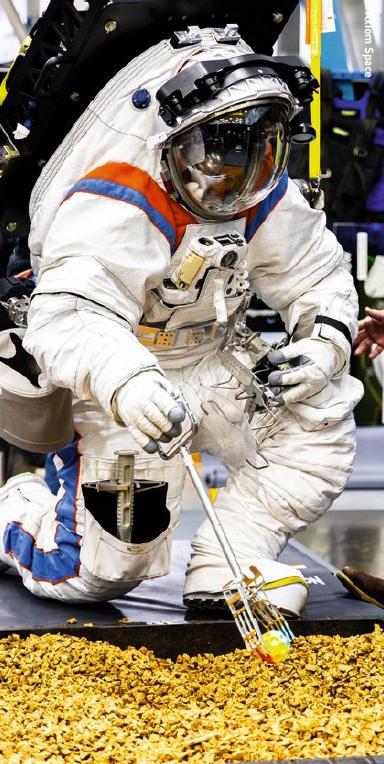 The white cover layer of the Axiom Extravehicular Mobility Unit (AxEMU) spacesuit prototype as it is tested in the Active Response Gravity Offload System (ARGOS) system at NASA’s Johnson Space Center in 2024. The person wearing it tests its use with different lunar geology tools.
Sewing the AxEMU
The AxEMU construction starts with computer-aided design tools and AI-generated patterns that map how the suit fits the astronaut’s body. These simulations show how the seams intersect, how the fabric layers drape once sewn and where adjustments are needed. Working from virtual layouts technicians and seamstresses can refine pattern shapes, modify fit and catch design errors before fabrics are cut.
The suit itself is built from four major technical layers:
- The thermal and micrometeoroid garment layer: this outer shell is made of white OrthoFabric, a blend of Gore-Tex, Kevlar and Nomex, that protects from micrometeoroid impact in space and reflects solar radiation to keep the suit from getting too hot. This layer can be replaced or repaired more easily.
- The insulation layer: Beneath the shell, six layers of aluminised Mylar insulate astronauts against extreme temperatures, minor impacts and lunar dust.
- The pressure garment bladder: this airtight inner layer holds oxygen inside the suit to keep the astronaut alive. It is made of urethane-coated nylon material.
- The restraint layer: made of Dacron polyester, this layer prevents the bladder from ballooning and keeps it in shape against the astronaut’s body.
Sewing these layers requires industrial tools and highly skilled seamstresses. Industrial walking-foot machines feed thick, slippery materials evenly, while cylinder-arm machines let seamstresses sew around rounded joints. Pattern-tacker machines add dense reinforcement stitches on webbing straps, loops and other high-stress points on the suit. Cutting is done with laser cutters, rotary blades and hot knives to get clean, accurate edges.
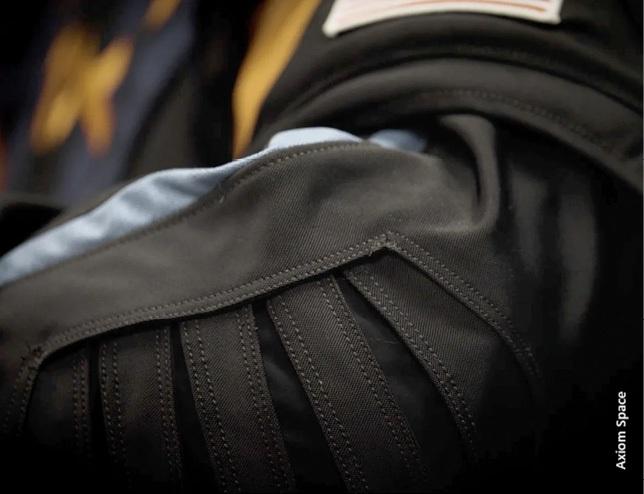 This complex sleeve design structure allows the elbow to flex in a wide range of motion.
For the airtight bladder, seamstresses switch from needles to heat-sealing and ultrasonic welding, so they don’t pierce the material and create leaks. They use various stitches depending on purpose: lockstitch for strength, zig-zag for flexibility and bar tacks for reinforcement. In tight areas, they hand-stitch pieces that machines can’t reach. They also inspect the seams with their hands to feel for tension, skipped stitches, stiff seam intersections and shifted layers of fabric. Their careful workmanship is what makes the suit move correctly and stay safe under pressure.
Collaboration of two industries
Working from virtual layouts technicians and seamstresses can refine pattern shapes, modify fit and catch design errors before fabrics are cut
The AxEMU is a major advancement over the Apollo suit which hindered motion. The new suit was redesigned with flexible joints and better fit to make working on the lunar surface easier and safer. It includes innovative life-support systems, pressure garments, a communication system, helmet displays and controls, battery power and other advanced avionics. The AxEMU demonstrates AI’s role in designing and constructing the new generation spacesuits. Engineers use AI tools to create digital twins and virtually test how a suit will fit, move, and perform. These AI applications make the suit lighter, more flexible, more comfortable and more protective.
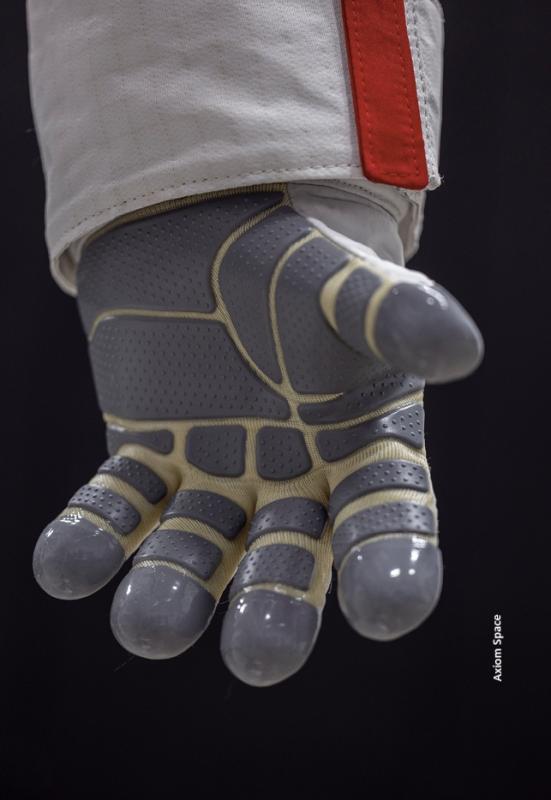 The AxEMU spacesuit includes custom gloves made in-house featuring several advancements over those currently in use. The redesigned gloves improve dexterity and reduce fatigue, helping astronauts to manipulate tools and perform fine tasks more effectively than with the earlier stiffer designs.
Despite AI’s enhancements, the spacesuit still relies on the skilful hands of seamstresses whose expert stitching techniques transform multilayered fabric panels and complex components into a safe and comfortable garment for astronauts. By combining AI tools and experienced seamstresses, Axiom Space and NASA have brought together two distinct industries that collaborate to shape the future of spacesuit design and exploration.
About the author
Harikleia Sirmans is a Librarian and NACO Cataloguer at Valdosta State University, USA, and owner of GrecianNeedle, where she produces clothing and fabric arts. She has published several sewing and fibre-related articles on the Piecework magazine website, Textile Society of America, The Medium, and All Free Sewing. She has also translated two Greek novels, and indexed four film books. She holds an MA in Library and Information Science, and a BA in English: Language and Writing, both from Valdosta State University. She also studied Pattern Cutting at the London Centre for Fashion Studies. She has won the Valdosta Awards Program Best Dressmaker award three times.