

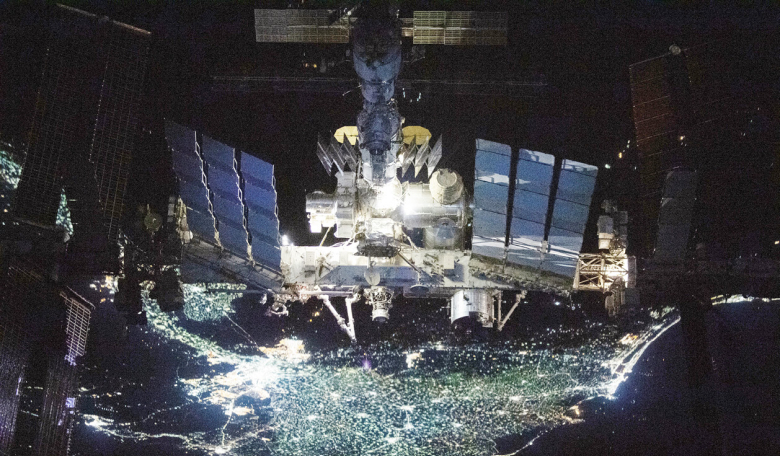
As the International Space Station nears retirement, commercial successors are racing to define the next era for low Earth orbit. At the 2026 European Space Economy Summit in Lisbon, Portugal, organised by The Economist magazine, Marshall Smith, CEO of Starlab Space, spoke to ROOM and made a robust case that Europe cannot afford to sit on the sidelines.
The mood amongst delegates in Lisbon was buoyant but quietly unsettled. Beneath the polished optimism that often characterises space conferences, a number of harder conversations threaded their way through the corridors of the European Space Economy Summit in early May. Among them, what exactly comes after the International Space Station (ISS) and, perhaps more importantly for Europe, who gets to shape what comes next?
For more than two decades, the ISS has functioned as humanity’s permanent foothold in low Earth orbit (LEO) – an extraordinary feat of engineering and international diplomacy. Today, it’s an infrastructure whose age is increasingly difficult to ignore and, depending on shifting policy timelines in Washington, could be retired in just a few years around 2030. The question is whether a meaningful successor ecosystem will exist before the ISS expires.
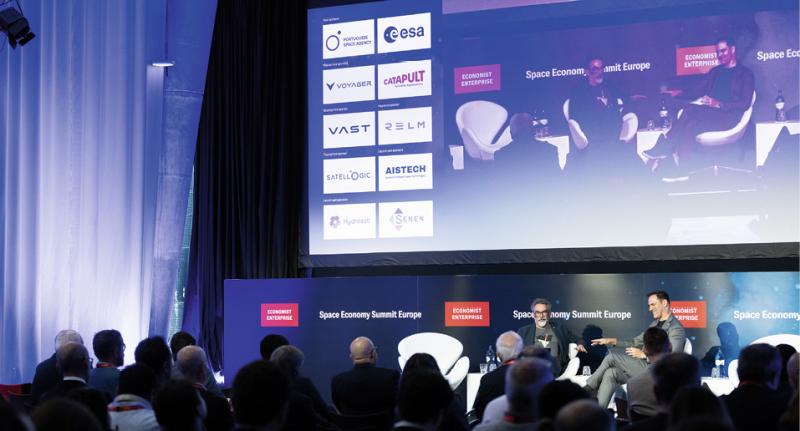 European Space Economy Summit in Lisbon, Portugal.
Few voices were more bullish in Lisbon on the transition than Marshall Smith, CEO of Starlab Space and a former NASA Chief Engineer with decades of experience in human spaceflight. If Smith projected confidence, it is partly because Starlab is positioning itself as more of a practical successor to ISS than a concept – commercially owned, internationally structured and designed, crucially, to move beyond government-funded research toward something closer to an industrial economy in orbit.
“We’ve been building sovereign nations’ space stations for 54 years,” Smith told ROOM during an interview on the sidelines of the event. “In that time, we’ve learned an awful lot about how to go build and live and operate in space.”
Accumulated knowledge, he argues, changes the risk equation. “People ask, what’s your big technical risk? Actually, you don’t have a lot of technical risk here. It’s a financial risk. It’s the market.”
A post-ISS gap would represent more than symbolic retreat, disrupting decades of scientific continuity, threatening industrial momentum and leaving strategic space to others
This is a striking statement given that commercial space stations remain aspirational projects to many observers – albeit with glossy AI created images – competing for credibility as much as customers.
Starlab, however, is attempting to distinguish itself from competitors through scale and pragmatism. Backed by a joint venture led by Voyager Technologies, Airbus, Mitsubishi Corporation and MDA Space, the company plans to launch its space station before the ISS is retired, creating a period of overlap intended to avoid a disruptive break in permanent orbital capability.
That’s important because a post-ISS gap would represent more than symbolic retreat, disrupting decades of scientific continuity, threatening industrial momentum and leaving strategic space – both literally and economically – to others, particularly China, whose Tiangong space station continues to expand in ambition and capability. For European policy – and this was much of the Summit’s focus – the stakes may be higher than many policymakers fully acknowledge.
 Starlab artist impression.
Building an orbital economy
At first glance, Starlab targets familiar territory: another modular habitat in orbit, another promise of commercialisation in space. But Smith argues that such comparisons miss a larger shift that is underway.
The ISS, he says, proved what is scientifically possible but whereas government space stations excelled at foundational science the next generation must prove commercially scalable.
Research alone does not create economic momentum. “We know that we can manufacture medicines that you can’t make on Earth,” Smith explained, pointing to growing interest in biopharmaceutical applications in microgravity. “Printing organs, making retinas, meniscus – this type of thing is just the beginning.”
If this sounds ambitious, Smith insists the commercial signals are already emerging. According to him, pharmaceutical and biotech work already represents roughly half of Starlab’s contracted interest, with semiconductor manufacturing and advanced materials accounting for much of the rest.
His business case rests on a familiar but increasingly influential proposition: microgravity is not simply useful for research, it can materially improve manufacturing itself. He points to semiconductor substrates as one example, claiming that production yields achievable in orbit may dramatically outperform terrestrial processes.
“Where you get a five percent yield on the planet in gravity, you get a 95 percent yield in space,” he said. “If you could start manufacturing this at volume, it would transform the industry.”
Such claims inevitably invite scepticism. Space has a long history of over-promising industrial revolutions that never quite arrived and in Lisbon that scepticism surfaced publicly.
Smith’s response was characteristically direct. “What we’re building is a business,” he responded. “It starts on the ground and it ends on the ground. What we do in orbit is just part of the process.”
The distinction is important because much of the space commercialisation debate has focused on space hardware – modules, launch architectures and technical specifications. Smith instead frames Starlab as an economic ecosystem, one dependent as much on terrestrial partnerships, logistics chains and industrial customers as orbital infrastructure.
“Not a dollar is actually spent in space,” he told ROOM. “It’s all spent on the ground. And it makes money on the ground.”
The comparison he repeatedly reaches for is infrastructure history: railways, aviation, telecommunications. Each began with government ownership before evolving toward commercial models supported by anchor customers. In Smith’s telling, LEO is simply following the same arc. Whether investors and governments ultimately agree remains an open question.
Europe’s orbital dilemma
Future space stations may increasingly resemble commercially operated industrial platforms, where access depends not only on political agreements but on economic participation
Beneath the technological ambition lies a more uncomfortable question and one that resonated strongly in Lisbon: if Europe fails to engage seriously with commercial LEO infrastructure, what exactly will it be left with after the ISS? The issue is no longer merely scientific participation. It is increasingly economic and strategic.
For decades, Europe has been an essential ISS partner, contributing laboratories, cargo systems and astronaut capability while benefiting from access to long-duration microgravity research, and Smith repeatedly returned to the idea that Europe risks treating post-ISS access as an optional capability rather than an industrial imperative.
The post-ISS environment is likely to be fundamentally different – instead of governments collectively owning orbital infrastructure, future space stations may increasingly resemble commercially operated industrial platforms, where access depends not only on political agreements but on economic participation.
Recently, European policymakers have been talking more openly about resilience, autonomy and sovereignty in space. The war in Ukraine, supply chain shocks and growing geopolitical fragmentation have all sharpened concerns about strategic dependence. Yet orbital infrastructure rarely features prominently in discussions outside specialist circles.
Smith believes that is changing. “We need to become commercial,” he explained during our conversation. “When we move to commercial, then we have the ability to count on those infrastructures being there to support European industry.”
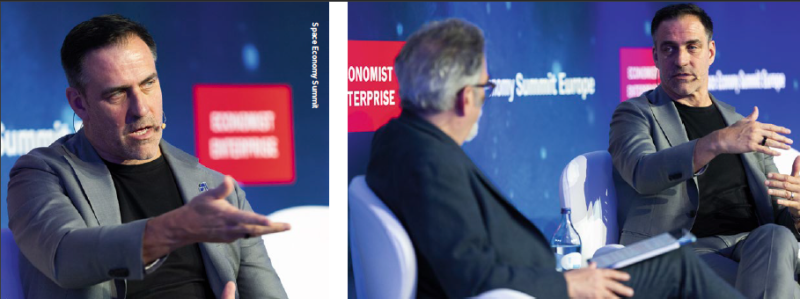 CEO of Starlab, Marshall Smith, speaking at the European Space Economy Summit.
His argument relies on the perspective that orbital infrastructure is ultimately about industrial competitiveness. If future pharmaceutical manufacturing, semiconductor production and advanced materials processing increasingly migrate to microgravity environments, Europe must decide whether it intends to be a producer, a participant – or merely a customer.
Comparisons with China surfaced repeatedly. Just as Lisbon’s delegates were discussing Europe’s industrial future, China was announcing plans to expand its Tiangong station, symbolism that was difficult to ignore.
“Tiangong is up there,” Smith told delegates. “They are making hardware, materials, doing research, building things that will go back to their economy.”
Then came a deliberately provocative challenge. “Do you want to buy your cancer drugs from a European company?” he asked. “Or do you want to buy them from China?”
Such statements inevitably oversimplify a more complex reality. No orbital pharmaceutical economy yet exists at industrial scale. Regulatory, logistical and cost barriers remain formidable. But Smith makes a valid point: orbital capability increasingly intersects with industrial policy. In other words, LEO will soon be more about supply chains than prestige.
A space station without the politics?
Starlab’s own structure reflects this changing environment. Rather than building an exclusively American space station, the company has assembled a multinational industrial partnership designed, in part, to replicate the geopolitical balance that made the ISS possible.
Airbus brings European industrial capability, Mitsubishi Corporation anchors Japanese participation, Canadian robotics specialist MDA contributes heritage in autonomous systems and robotics, and Voyager provides US leadership and financing structure.
Smith describes this as deliberate architecture. “The purpose of the joint venture is to replicate the major players in ISS,” he explained. Once Russia’s historical role in the ISS is set aside, the parallels become clear: Europe, Japan, Canada and the United States remain deeply embedded. Unlike the ISS, however, Starlab is not governed through sprawling intergovernmental agreements and diplomatic compromise. It is purely a commercial venture, a distinction carrying implications that are both attractive and uncomfortable.
Smith argues that commercial ownership offers stability. “We’re not subject to changes in direction for political reasons,” he said. “Once we’re operating there’s extremely low probability that a new administration changes the factor of Starlab.” For European institutions weary of political volatility in Washington, it’s an argument with obvious appeal.
By the same token, commercial dependency introduces its own vulnerabilities. A commercially operated space station remains answerable to investors, contracts and markets, where the risks become financial if projected demand or economic conditions shift. Smith does not shy away from that reality. Market viability, he argues, remains the defining uncertainty.
The engineering challenge, while substantial, benefits from decades of accumulated ISS experience, with Starlab relying heavily on proven technologies: solar arrays, life support systems, smoke detection, logistics infrastructure, etc – much of it derived directly from ISS heritage.
“Why reinvent the solar panel?” Smith asked rhetorically during a panel discussion. “We already know what works.”
Other lessons learned from the ISS are clearly shaping design philosophy. Don’t place maintenance-heavy systems outside a station if avoidable. Minimise EVA requirements. Use commercially available systems wherever possible. Reduce complexity before launch.
If the ISS was humanity’s proof of concept for permanent habitation in orbit, Starlab hopes to become an industrial successor – more streamlined, more modular and significantly more economically focused.
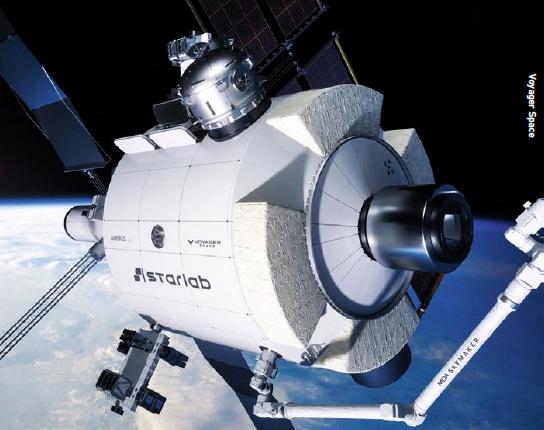 Illustration of Starlab, a commercial space station under development by a joint venture led by Voyager Space.
The overbooked station
Starlab is making a case that it can become the bridge between the government-led era of human spaceflight and something more commercially durable
Proving commercial viability may ultimately be harder than proving technical capability, however, and on that basis, perhaps Smith’s boldest claim in Lisbon was that Starlab is already oversubscribed. “We’re about close to 140 percent right now on our commercial space,” he told ROOM.
Commercial space has no shortage of confident forecasts and such figures should be scrutinised carefully. The collapse of some satellite ventures in the late 1990s, more recent turbulence in launch markets and fluctuating investor enthusiasm offer cautionary lessons, Smith insists this demand is tangible rather than speculative.
Several companies, he said, have already committed to multi-year rack leases – reserving capacity before launch in anticipation of future manufacturing campaigns. Among them is Mitsubishi Corporation, reflecting Japan’s long-standing interest in microgravity utilisation.
Such logic resembles terrestrial industrial planning, where experimental work often begins years before commercial deployment. “What’s happening is people are reserving space,” Smith explained, “because they know the capacity is going to be there.”
The distinction between experimentation and scalable production is central. The ISS offered limited rack space for scientific payloads which has been useful for proof-of-concept research but a constraint for meaningful industrial expansion.
In Smith’s view, critics who dismiss orbital manufacturing often misunderstand this difference. They look at the ISS – constrained, oversubscribed and never designed for industrial throughput – and assume future markets cannot exist. Whereas Starlab, he argues, represents a fundamentally different proposition.
One key question, however, is whether launch economics and operational costs decline quickly enough to make such ambitions commercially attractive. Space manufacturing still faces uncomfortable mathematics and regulatory approval for pharmaceutical products manufactured in microgravity. Even if production yields improve dramatically in orbit, transportation remains expensive and return logistics complex.
Markets and products
For all the confidence surrounding commercial space stations, an undercurrent of caution persisted among both delegates and speakers in Lisbon.
During one panel discussion, sharp questions surfaced around whether LEO markets are genuinely mature enough to support privately operated infrastructure, with some observers remaining unconvinced that sufficient demand exists beyond government-funded research and a relatively modest tourism sector.
When one attendee referenced doubts raised earlier in the conference – including claims that no compelling products currently exist in orbit – Smith pushed back firmly. “What we’re building is a business,” he replied. “We’ve proven these markets.”
His confidence partly stems from Voyager’s earlier work through Nanoracks, which pioneered commercial activity aboard the ISS long before talk of “commercial space stations” became fashionable.
Over the last decade, Nanoracks helped facilitate hundreds of payload missions and experiments aboard the ISS, creating early pathways between government infrastructure and private industry. Smith sees that heritage as evidence that Starlab is not beginning from scratch.
For him, the commercial case has already moved beyond theory. The next challenge is whether demand, financing and regulation mature quickly enough to sustain a permanent orbital economy at meaningful scale.
In this model, agencies such as NASA, ESA and JAXA become anchor tenants rather than operators. The model feels plausible but the uncomfortable truth is that LEO commercialisation still faces unresolved questions around regulation, economics and insurance.
The legal framework remains immature because international agreements designed around state-operated space infrastructure will almost certainly not translate cleanly into commercially governed orbital facilities.
If successful, Starlab would become a repeatable platform – adapted for different customers, orbits and industrial requirements.
“You don’t necessarily want microgravity manufacturing right next to somebody doing other kinds of research,” Smith observed.
Future orbital infrastructure may therefore fragment into specialised environments rather than replicate the single mega-platform model embodied by the ISS. For Europe, this raises an important strategic question: does it merely lease access to these ecosystems, or help shape them?
Europe’s choice
The commercial case has already moved beyond theory. The next challenge is whether demand, financing and regulation mature quickly enough
By the close of the Lisbon summit, the central question had become difficult to avoid: what happens if Europe hesitates while others move ahead?
The European space sector stands at an awkward crossroads. Public budgets remain constrained. Strategic rhetoric is rising. Meanwhile, China is moving aggressively, US commercial actors are accelerating and the retirement of the ISS inches closer.
Commercial space stations are not guaranteed to succeed and some almost certainly will fail. Timelines may slip. Business models may prove overly optimistic. Market forecasts may underperform and history offers enough cautionary tales to justify scepticism.
Yet hesitation carries risk too. If orbital manufacturing does begin to scale – if pharmaceuticals, semiconductors or advanced materials genuinely benefit from microgravity at commercially meaningful levels – the countries helping shape infrastructure now may secure disproportionate advantages later.
Smith argues that Europe still has an opportunity to participate meaningfully, but only if it commits before the transition happens without it. Starlab, he says, is already creating European industrial return through Airbus and its wider partner ecosystem. The post-ISS question, then, is no longer abstract.
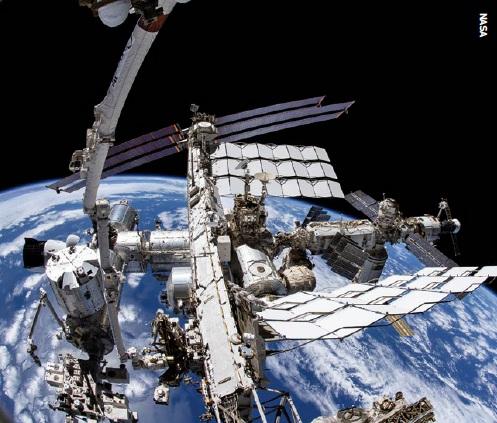 The ISS retirement clock is ticking.
The next 20 years
Smith returned repeatedly to one idea: transformation rarely looks revolutionary in the moment. The analogy he favours is the smartphone. “In 2007, your iPhone had 10 or 15 apps,” he said with a laugh. “Nowadays, you couldn’t function without your phone.”
The implication is obvious. Commercial LEO infrastructure may still appear immature, overhyped or narrowly specialised. But if the economic model works – even partially – the next decade could reshape assumptions about where products are designed, tested and manufactured. “I can’t predict what will happen,” Smith admitted. “But I can promise you it’ll be revolutionary.”
Such confidence may sound ambitious, perhaps even optimistic, given the history of commercial space promises. But the Lisbon summit offered some useful reminders: the future of low Earth orbit is no longer theoretical and the ISS retirement clock is ticking. Some successor system – commercial, governmental or hybrid – will emerge. The real question for Europe is whether it intends to help build that future or simply buy access to somebody else’s.
For now, Starlab is making a case that it can become the bridge between the government-led era of human spaceflight and something more commercially durable – a platform where orbital research becomes orbital industry, and where LEO activity evolves from destination to infrastructure. Whether that ambition survives future economics remains to be seen. But speaking in Lisbon, Marshall Smith sounded like a man convinced that the transition has already begun.