

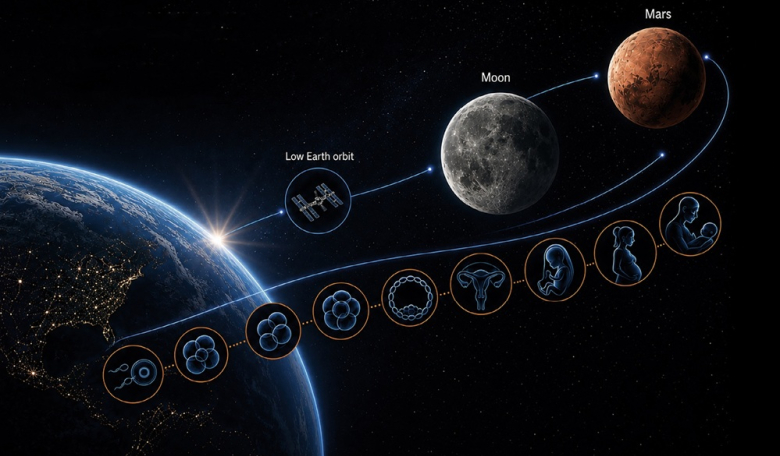
Human reproduction has become one of the most important unanswered questions in space exploration and here Cheryl Gallagher speaks to SpaceBorn United founder Dr Egbert Edelbroek following the publication of the company’s first international roadmap initiative pointing the way to a future that will see the first human born in space.
For more than 60 years, human spaceflight has been defined by a simple assumption: astronauts go into space, complete their mission and come home. But as humanity prepares to establish a permanent presence on the Moon, build commercial space stations and seriously contemplate settlements on Mars, an entirely new set of questions emerges. Not simply how we exist in space – but how as a species we survive there.
Can people safely conceive children beyond Earth? How would pregnancy develop in reduced gravity? What effect would cosmic radiation have on embryos? Who decides the ethical boundaries of such research? If humanity truly intends to become a multiplanetary species, these questions cannot remain unanswered.
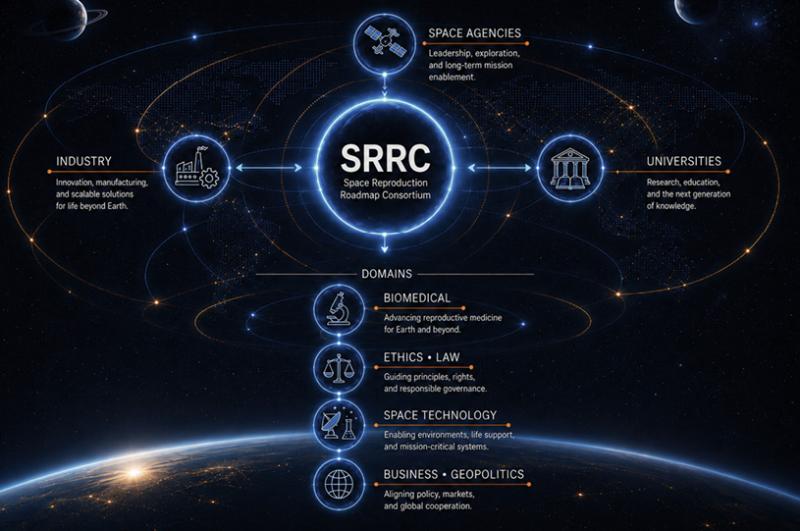 The SRRC ecosystem – how the consortium connects the fields needed for human reproduction beyond Earth.
Until recently, they were largely confined to science fiction. Today, they have become the subject of an international scientific initiative bringing together experts in reproductive medicine, developmental biology, engineering, ethics, law, governance and commercial space.
The conclusion is as striking as it is simple. The issue is no longer whether society should begin thinking seriously about human reproduction beyond Earth – it is that the discussion can no longer be postponed.
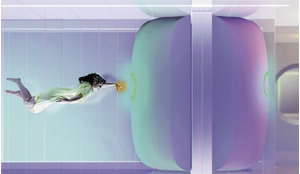
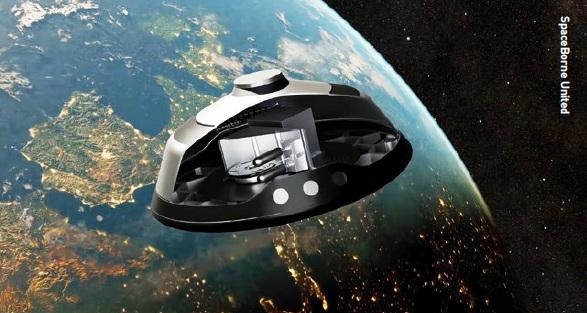 SpaceBorn United successfully tested its ARTIS (Assisted Reproductive Technology In Space) mini IVF laboratory prototype in orbit in April 2025 marking a critical step towards realising ARTIS as a fully automated IVF minilab designed to support conception and early embryonic development in micro- and partial gravity.
From curiosity to necessity
The issue is no longer whether society should begin thinking seriously about human reproduction beyond Earth – it is that the discussion can no longer be postponed
This summer the newly formed Space Reproduction Roadmap Consortium (SRRC) published its first white paper, ‘Towards a Community Roadmap for Future Human Reproduction Beyond Earth’.
Although initiated by SpaceBorn United, SRRC is designed to evolve into an independently governed consortium, ensuring stable, internationally supported long-term governance. Its white paper captures the outcomes of the inaugural SRRC Symposium, which brought together 40 experts from reproductive medicine, developmental biology, space life sciences, space technology, ethics, law, governance, entrepreneurship and policy in September 2025. The white paper marks the beginning of a coordinated international effort to advance human reproduction in space. It captures the first insights and recommendations developed by the SRRC expert community and will help guide future roadmap development.
Rather than presenting definitive answers – it is far too early for that – the document marks the beginning of what its authors hope will become a coordinated international research programme.
“Its publication represents an important transition from isolated discussions toward a coordinated international effort,” said Egbert Edelbroek, founder of SpaceBorn United and initiator of the SRRC.
“The objective is not to predict exactly how or when human reproduction beyond Earth will become possible, but to create a collaborative process through which the global community can responsibly explore the scientific, ethical, technological, and societal questions involved,” he stated
This is not a proposal to create babies in orbit tomorrow, or even in the next few years. It is an acknowledgement that the rapid progress of commercial spaceflight has outpaced our understanding of how human reproduction responds across the diverse environments of space.
Space is changing
For decades, governments had little reason to consider reproduction in space. Apollo astronauts spent days away from Earth. Space Shuttle crews stayed for a couple of weeks. Even today’s International Space Station (ISS) expeditions are relatively temporary in terms of a human lifespan.
But the landscape is changing rapidly. NASA’s Artemis programme is laying the foundations for sustained lunar operations. Private companies are developing commercial space stations. SpaceX continues to pursue its long-term vision of Mars settlement. At the same time, space tourism is expanding, the number of people travelling into space is increasing steadily and, crucially, those people are no longer all professional astronauts.
As Edelbroek observes, “If humanity is serious about living beyond Earth, these questions can no longer be avoided” - a sentence that captures the significance of the entire project because we still know remarkably little about this area. Despite decades of human spaceflight, no human conception, pregnancy or birth has ever occurred in space.
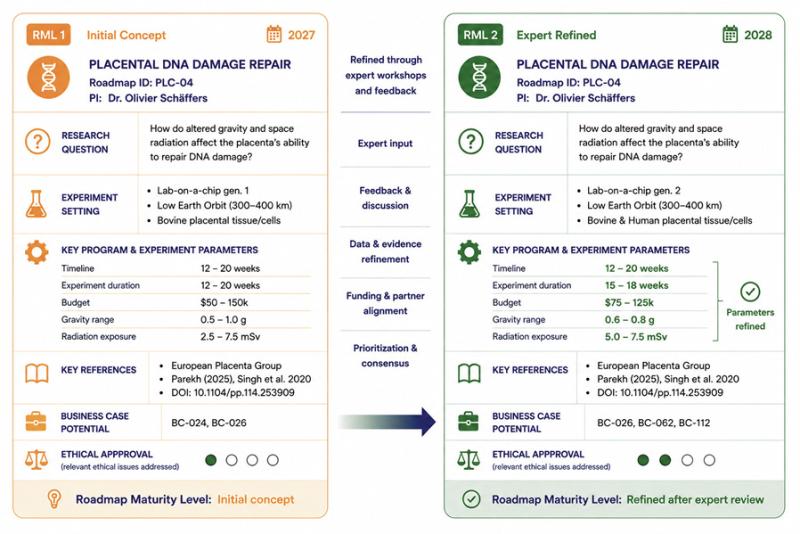 Illustrative example of an evolving roadmap building block. Research concepts are refined over multiple years through expert workshops, multidisciplinary review and feedback. The simplified cards show only a condensed preview of a final roadmap building blocks.
Not surprisingly, animal studies have demonstrated that microgravity and radiation can influence reproductive biology, but scientists still know little about how the earliest stages of human development might respond to the space environment. A number of fundamental questions are waiting to be answered.
Historically, technologies developed for space have frequently found uses far beyond their original purpose and human reproduction research may eventually follow the same path
Would fertilisation proceed normally in microgravity? Would early embryos develop successfully? How much artificial gravity would be required? Would lunar gravity prove sufficient, or would Earth-like gravity ultimately be essential?
The white paper argues that answering these questions demands a structured international research programme rather than isolated experiments built around four challenges. Rather than viewing reproduction simply as a medical issue, the consortium proposes several interconnected research themes:
- Biomedical science, investigating everything from gametes and fertilisation to embryonic development.
- Technology – future research will require highly automated in vitro fertilisation (IVF) systems, sophisticated laboratory-on-a-chip devices and perhaps artificial gravity centrifuges capable of exposing biological samples to lunar and Martian gravity conditions.
- Ethics and law.
One important contribution to this emerging research domain is SpaceBorn United’s ARTIS (Assisted Reproductive Technology in Space) programme. Initially using mouse reproductive cells, ARTIS is designed to investigate fertilisation and early embryo development in orbit before eventually progressing, subject to scientific and ethical approval, towards studies involving human reproductive cells. One of its long-term goals is to determine the minimum gravity level required for healthy embryonic development – an important question for future settlements on both the Moon and Mars.
The emphasis on assisted reproductive technologies is deliberate. IVF allows researchers to examine the earliest stages of embryonic development under carefully controlled conditions, generating scientific data long before any consideration could be given to human pregnancy in space. Perhaps nowhere across the whole gamut of human space exploration are the questions more profound.
How should human embryos be protected in space? Which nation’s laws apply aboard commercial stations? Could future genetic technologies ever be justified if they improved survival beyond Earth?
The consortium argues that a dedicated ‘Space Bioethics Code of Conduct’ should eventually underpin this work. No single nation is likely to undertake such research alone and international cooperation, commercial investment along with shared governance, may prove just as important as scientific discovery itself.
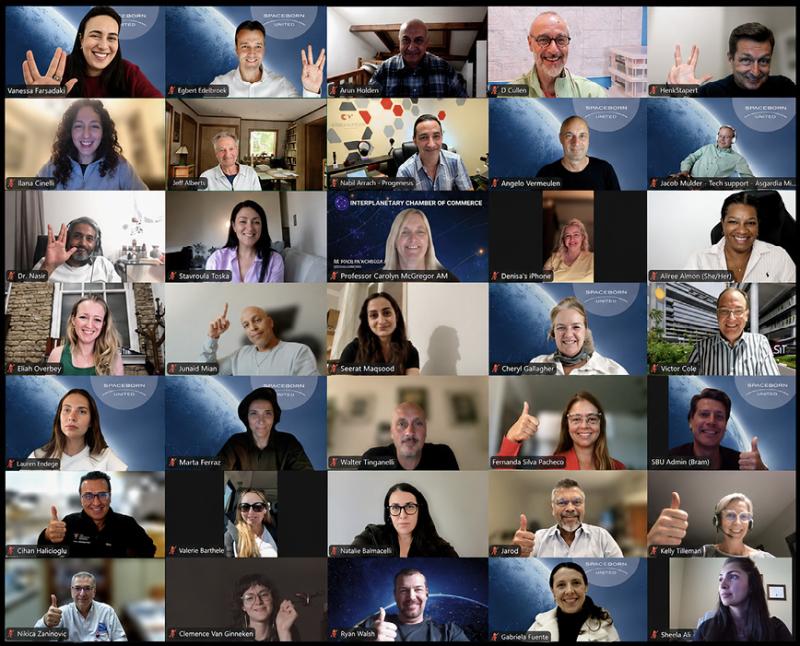 SRRC participants’ meeting in 2025.
One of the most interesting aspects of the roadmap is that it deliberately extends beyond biology, with the authors recognising that human reproduction cannot simply become another life sciences experiment. It touches law, politics, religion, culture, human rights, commercial regulation and, ultimately, public acceptance.
In some respects, the roadmap resembles the early planning that preceded today’s international cooperation on space stations, planetary protection and satellite regulation. Its purpose is not to dictate policy but to ensure that society begins discussing the implications before technology overtakes governance. But by its very nature it has to go much further.
Benefits for Earth
The consortium also argues that research driven by space exploration could generate substantial benefits much closer to home. Developing compact, highly automated fertility technologies capable of operating in the harsh conditions of space may, for example, improve IVF accessibility on Earth.
SpaceBorn believes technologies developed for use in orbit could ultimately improve IVF success rates, automate fertility treatments and enhance early embryo development on Earth – another example of space research producing benefits far beyond its original purpose.
Historically, technologies developed for space have frequently found uses far beyond their original purpose and human reproduction research may eventually follow the same path.
Microfluidic laboratory systems, advanced embryo monitoring and AI-assisted reproductive medicine all have potential terrestrial applications.
Following the white paper publication, SRRC will begin the next phase of roadmap development. This phase aims to expand scientific participation and build broader international support for the roadmap and its long-term objectives. In parallel, SRRC will engage industry stakeholders, investors, philanthropic organisations, and other contributors to help enable future roadmap execution.
Preparations are underway for a second global symposium targeted for early 2027. The event will bring together additional experts, organisations, and potential implementation partners. In parallel, SRRC is preparing local expert workshops designed to engage specific regions and stakeholder communities. This will help identify regional expertise and ensure that roadmap development reflects a broad range of cultural, ethical and societal perspectives.
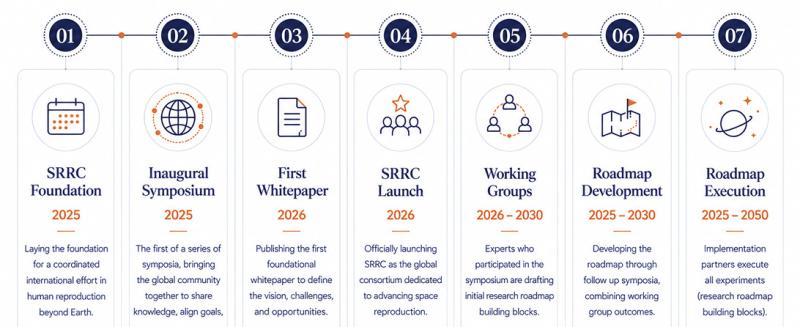 SRRC timeline.
Science fiction becomes policy
The initiative establishes a truly responsible global collaborative framework for advancing safe human reproduction beyond Earth
For decades, writers from Arthur C Clarke to Kim Stanley Robinson imagined the social consequences of humans establishing permanent settlements beyond Earth. Today those ideas are slowly migrating from speculative fiction into scientific planning.
The SRRC’s white paper does not claim to possess all the answers. Instead, it asks the international community to begin asking the right questions. As Edelbroek puts it, this work should be viewed not as the conclusion of a debate but “the beginning of a longer journey”.
The next frontier of human spaceflight may not be another launch vehicle or another destination. It may be understanding how an entirely new branch of human civilisation could one day begin.
Only two years ago, ROOM reported on SpaceBorn United’s plans to investigate embryo development in space. Today, that pioneering work has expanded into an international consortium bringing together scientists, engineers, ethicists and policymakers from around the world. The science remains in its infancy, but the conversation has matured remarkably quickly. If humanity genuinely intends to become a multiplanetary species, planning for the first child born beyond Earth must begin now.
By uniting experts across medicine, science, engineering, ethics, law and policy, while fostering partnerships and innovative collaborations between public institutions, private industry, investors and philanthropic organisations, the initiative establishes a truly responsible global collaborative framework for advancing safe human reproduction beyond Earth. In doing so, it not only supports humanity’s long-term future in space but also promises innovations in reproductive medicine and healthcare that could deliver lasting benefits for people and societies on Earth.
About the author
Cheryl Gallagher is president of Gracie G Productions, based in Austin, Texas, USA. She currently serves as Minister of Culture for Asgardia, as well as actively supporting and/or advising other space organisations, including SpaceBorn United, Space Renaissance International, Copernic Space and several other initiatives in various capacities. She is also a recognised professional artist and musician, a current member of the International Association of Astronomical Artists, the International Association of Art, and is a voting member of the Recording Academy. www.cherylgallagher.com