

Axiom Space expects the first two modules of its commercial space station to come together in orbit in 2029 as the company simultaneously advances new lunar spacesuits, sovereign astronaut missions and a distributed orbital computing network.
Speaking at the 77th International Astronautical Congress (IAC) in Antalya, Türkiye, Axiom Space CEO and President Dr Jonathan Cirtain outlined an increasingly broad infrastructure strategy extending well beyond the company’s established private astronaut missions to the International Space Station.
“To be a human space exploration company, you need astronauts, you need a spacesuit and you need a space station,” Cirtain told journalists. “And we’re working to develop all three.”
Increasingly, however, Axiom sees digital infrastructure as a fourth element, with computing and secure communications distributed across spacecraft rather than concentrated aboard its future station.
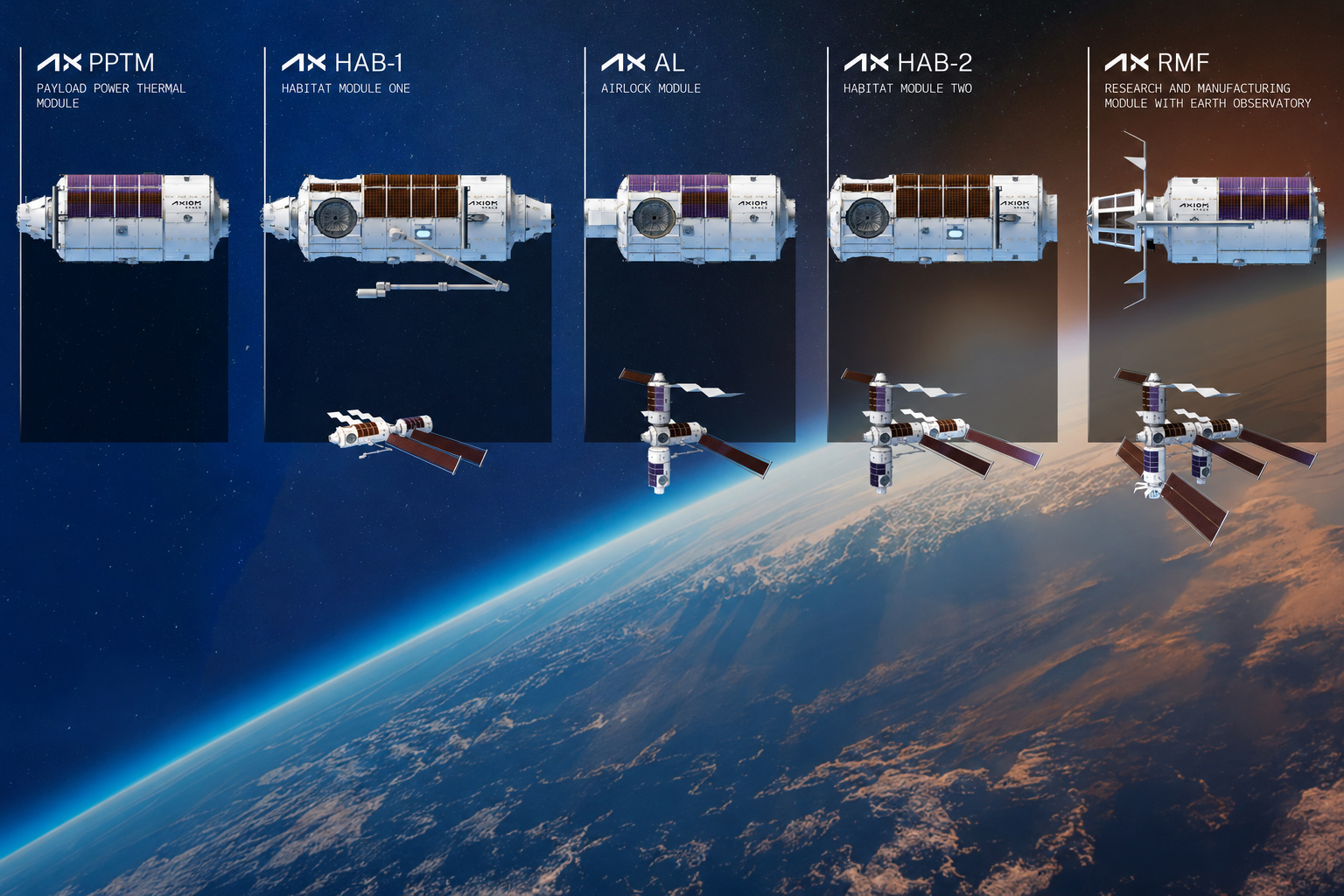
Axiom is targeting launch of the first module of Axiom Station no earlier than 2028, with a second following approximately nine months later.
The first module is undergoing final assembly at Thales Alenia Space in Turin, Italy, before transfer to Houston for integration and testing and eventually to Kennedy Space Center for launch. The second module is also preparing to undergo final assembly in Italy.
Speaking at IAC, Cirtain said Axiom was beginning assembly, integration and test activities and envisaged the first two vehicles rendezvousing in 2029, allowing station operations to begin shortly afterwards.
Once joined, the two modules are intended to form an operational free-flying station capable of supporting a crew of four.
Axiom also announced in Antalya that Redwire has been awarded a follow-on contract to supply two Roll-Out Solar Array (ROSA) wings for the second station module. Redwire is already supplying ROSA wings for the first.
The technology has extensive flight heritage, including aboard the ISS, and Axiom sees securing the arrays early as important to reducing programme risk.
“One of the longer lead items, other than making the pressure vessels themselves, are the solar arrays,” Cirtain said. “Getting that order in now really does secure us against variability in schedule in the future.”
The arrays for the first two modules are expected to provide around 40–50 kW of electrical power – a substantial resource, but one Axiom does not intend to consume by turning its station into a large orbital data centre.
Instead, the company is developing what it describes as a distributed orbital computing architecture, allowing data to be processed closer to where it is generated and workloads to move between spacecraft.
Axiom announced at IAC that two Axiom Resilient Compute (ARC) nodes are already operating in orbit aboard Kepler Communications satellites. The company has demonstrated ARC-to-ARC and ARC-to-ground communications and has also completed a ground demonstration in which a workload protected using post-quantum cryptography was successfully migrated.
The underlying problem, Cirtain said, is that spacecraft are producing increasing volumes of data which cannot always be efficiently transmitted to Earth.
Rather than relying simply on greater communications bandwidth, Axiom wants some processing and analysis to take place in orbit before selected data is returned to users.
The system is designed to orchestrate workloads across a network, potentially moving a task to another spacecraft better positioned to communicate with a ground station and thereby reducing latency. Cirtain distinguished the concept from proposals for large, power-intensive orbital AI data centres.
He said next-generation computing packages can consume several kilowatts individually, potentially competing for power required for experiments, payloads and environmental control aboard a crewed station.
“We intentionally designed our system to do most of our compute, in collaboration, through mesh constellation networks, so that the compute is done elsewhere, while we’re free to do actual work on our space stations,” he said.
Security is another major element. Post-quantum cryptography is intended to protect information against a future in which sufficiently capable quantum computers could break some of the public-key encryption systems widely used today.
Axiom says its next milestone will be an on-orbit demonstration in which data is collected, encrypted using post-quantum cryptography, processed and then transmitted to Earth – demonstrating the complete chain of custody in space.
Meanwhile, Axiom’s AxEMU next-generation spacesuit programme is moving towards qualification and its first orbital demonstration.
The suit is being developed to support NASA’s Artemis lunar exploration programme, including operations around the lunar south pole, while variants can also support extravehicular activity in microgravity.
Cirtain said Axiom expects to deliver a qualification suit later this year and a suit for an ISS demonstration mission next year.
NASA has also asked the company to examine a “sortie” configuration tailored to the requirements of Artemis IV and V. Rather than representing a fundamentally different spacesuit, Cirtain described it as an adaptation of the baseline AxEMU architecture to the particular needs of those missions.
For the planned ISS demonstration, details including duration and tasks have yet to be finalised by NASA mission planners, although Cirtain said he envisaged an astronaut wearing the AxEMU operating outside the station alongside another astronaut using the existing Extravehicular Mobility Unit.
The company has been tasked with producing a suit capable of accommodating 98 percent of the human population, with individual adjustments concentrated largely around elements such as gloves and arm dimensions.
Axiom has so far completed four private astronaut missions to the ISS, involving astronauts from a growing number of nations and more than 160 research activities. NASA has selected the company for a fifth mission, Ax-5, targeted for no earlier than January 2027 and expected to spend up to 14 days docked to the ISS.
But Cirtain said discussions with governments increasingly concern something more ambitious than short-duration flights.
“What we’re seeing is a lot of demand for longer duration missions,” he said, adding that countries were interested in missions extending considerably beyond the two-week model used for current private astronaut flights.
Axiom believes the certainty provided by its station development schedule now allows countries to begin building funding programmes, astronaut pipelines and scientific payload portfolios ahead of commercial station operations.
Jared Stout, Axiom Space Chief Strategy Officer, told the roundtable that astronaut flights can act as catalysts for wider national space ecosystems.
“The science really is the why. The humans are the how,” he said, arguing that astronaut programmes can stimulate domestic scientific communities and industrial capabilities.
Türkiye provides an example. Alper Gezeravcı became the country’s first astronaut aboard Axiom Mission 3 in January 2024, while Turkish organisations are now developing payloads and capabilities for future human and robotic missions.
Axiom sees similar momentum emerging elsewhere, including India, Hungary and other countries seeking greater involvement in human spaceflight.
Taken together, the programmes outlined in Antalya reveal a company attempting to move beyond its initial identity as a provider of commercial astronaut flights.
By the end of the decade, Axiom wants astronauts flying to its own station, wearing spacesuits it has developed and using an orbital infrastructure in which communications and computing are distributed securely across spacecraft.
The individual elements remain at different stages of maturity, but the timetable is beginning to converge around 2028-29 – the period when Axiom expects the first pieces of its post-ISS vision to become operational.