

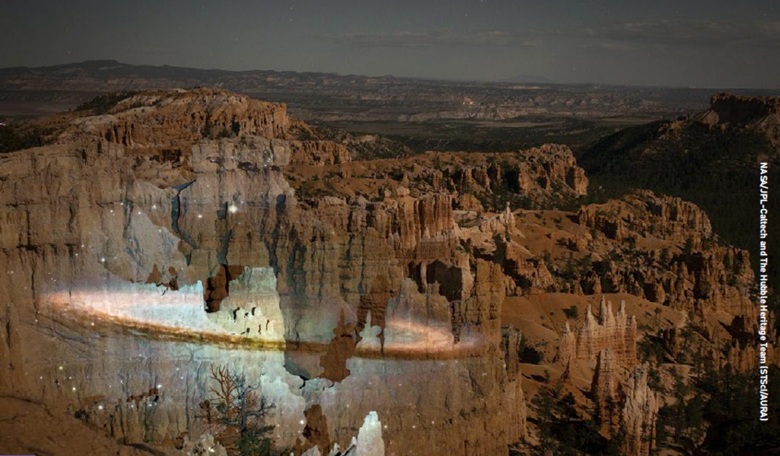
Photographic artist Mark Chen’s work explores the mysterious coexistence of the universe, Earth and people and the conceptual link between the geological age of landscapes and distances of galaxies. For his latest series, Pilgrimage of Light, Mark travelled to hard-to-reach wilderness locations to project galactic images, altering landscapes while he photographed them.
When we look at far away galaxies, or when we lay our hands on ancient rocks, we are sensing distant pasts. The light of the Sombrero Galaxy, for example, travels for 35 million years before it reaches Earth. In the same duration, the hoodoos (irregular rock columns that natives likened to people) at Bryce Canyon were formed. At the end of this eternity in the human timescale, you and I happen to be alive to experience them.
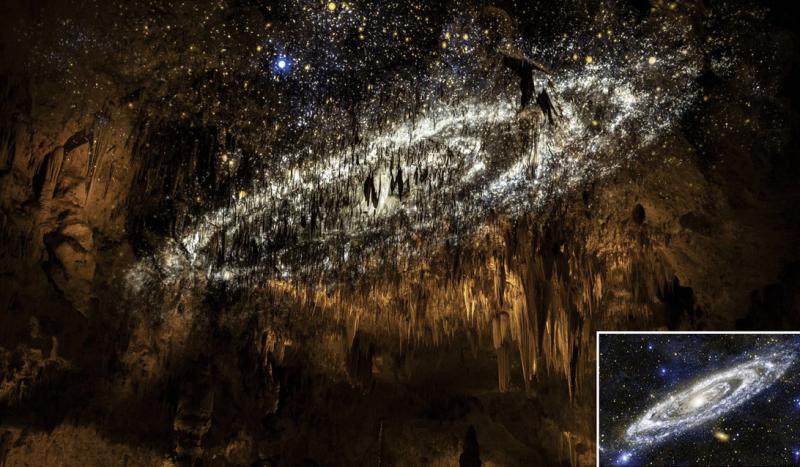 Hubble’s intricate image of the Andromeda galaxy (NASA/JPL-Caltech) was transjected in Carlsbad Caverns, New Mexico, which were forming when the light from the galaxy began travelling 2.5 million years ago.
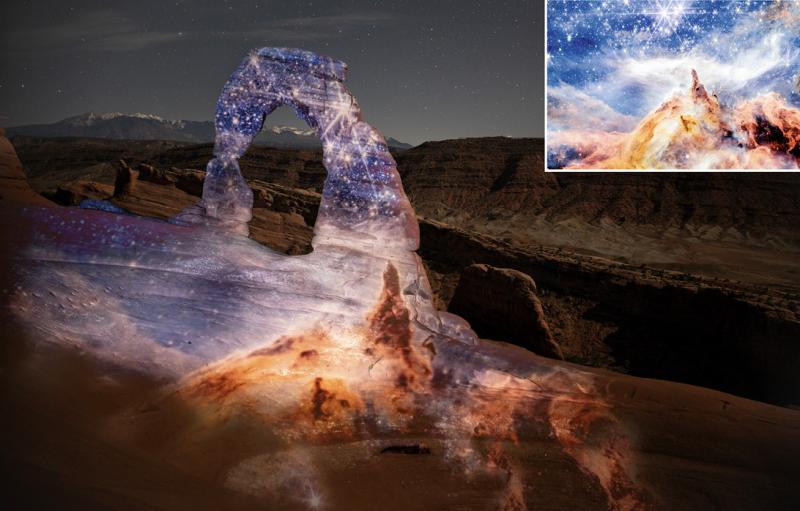 Delicate Arch at Arches National Park, Utah, was formed in a relatively brief period in geologic timescales. James Webb Space Telescope’s image of NGC 63 57 (NASA/ESA/CSA/STScI) shows the nebula’s look 5000 years ago. How did ‘Delicate’ look then?
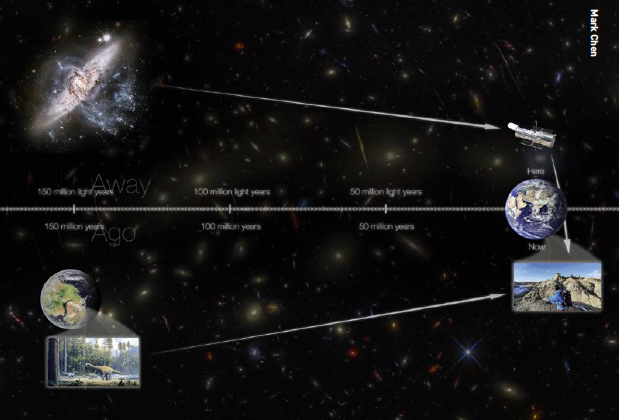 The ‘visual artist statement’ for Pilgrimage of Light. In this example, a galaxy at 150 million light years away emitted its light that would reach us today when dinosaurs roamed Earth. Now, Hubble Space Telescope takes its image for us to see during our brief existence. I research and find a geologic location whose age matches the duration of 150 million years. A pilgrimage is made there and a ‘transjection’ of the galaxy is delivered to the landscape while I take the photo.
I’m an artist who’s passionate about science. Pilgrimage of Light, an art project that explores natural wonders, is the closest I could get to being a scientist. I visualise the abovementioned space-time analogy by juxtaposing the galactic and the terrestrial through onsite projection.
This novel process required the invention of a unique projector I called the ‘transjector’. With it I travelled to US national parks and wilderness, and using the transjector and NASA/ESA image archives, I transjected the stars onto the terrain while photographing.
Based on preparatory research, I matched the duration of the celestial light’s journey and the geological formation’s age to produce a body of work.
“But, why and how did you come up with this peculiar idea?” is the most frequently asked question in every presentation I give.
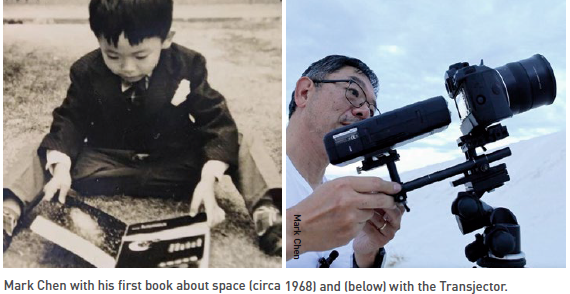
I can pinpoint the moment I became hooked on the stars. The event was a book fair in Taipei, Taiwan in 1968. I spotted a hard-paged photo book. The first page was a photo of a galaxy and the second the Gemini space capsule. The book became mine and a childhood passion was ignited. This, however, did not bring about an easy or direct career path. Circumstantial and personal factors meant that a life in astronomy remained an unfulfilled dream.
Fast-forward through a few decades of colourful careers, and I was a practicing visual artist with a Master of Fine Arts degree. Meanwhile the Hubble Space Telescope had produced images beyond that little boy’s wildest dreams, and the James Webb Space Telescope promised to bring about surprises. The astrophile in me was reawakened and demanded that the visual artist did something about it. Pilgrimage of Light was born.
Over four years since its inception, Pilgrimage of Light has grown to 40 pieces, has been shown internationally in museums, galleries and festivals, and was published by National Geographic in its March 2025 issue. The core concept of the space-time analogy has expanded to formal harmony, and geological counterparts.
The whole wide world of geological wonders and the ever-growing archive of celestial images continue to beckon me. While I make strides in the wilderness, my crafts have evolved. Pilgrimage of Light is a labour of love that needs support.
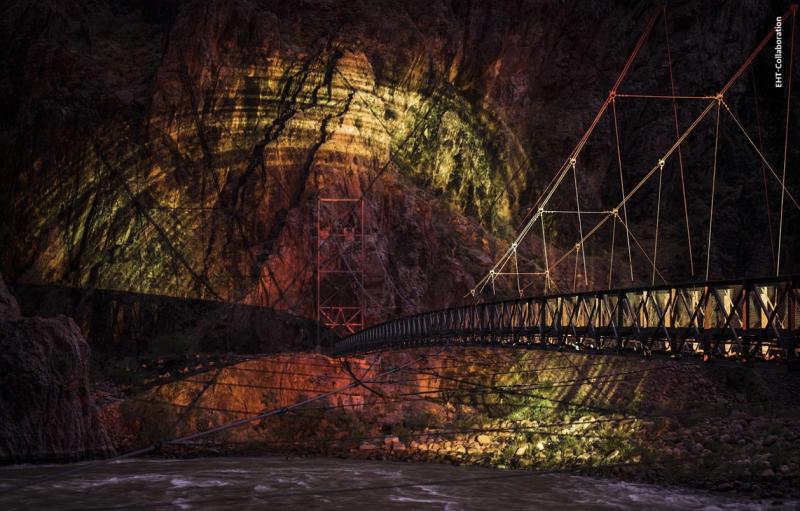 Black Hole Sagittarius A* and Bright Angel Bridge, Colorado. At the centre of our Milky Way galaxy is a massive black hole Sagittarius A*. Event Horizon Telescope captured its photo, which is the second black hole ever being observed. Under my transjection, Bright Angel Bridge resembles the jet that shoots out from a black hole while symbolising a bridge into the unsolved mystery. Produced under residency at Grand Canyon Conservancy.
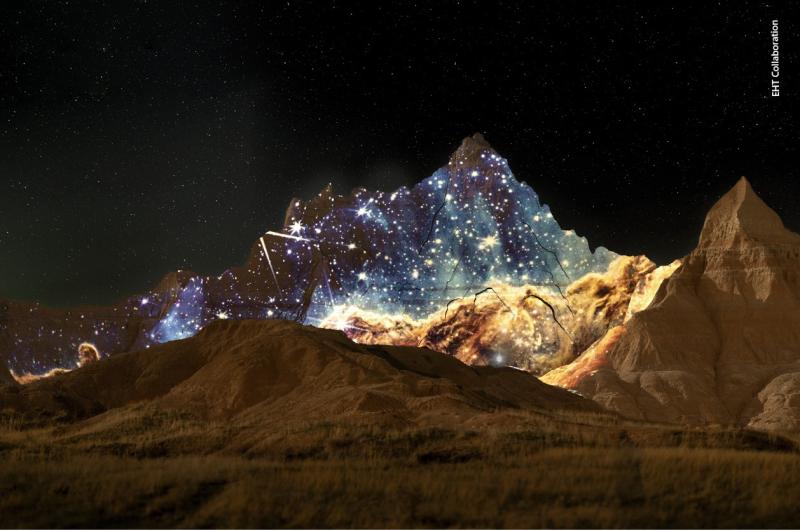 There’re no ‘cliffs’ in the outerspace, but radiations from the nearby newborn stars eroded Carina Nebula (NASA/ESA/CSA/STScI) into shapes that resemble cliffs at Badlands National Park, where elements did the erosion. I paired them for the weathering they share.
About the author
Mark Chen is a photographic artist, educator and author. He invents and repurposes tools as he pushes media boundaries, devising new processes and designing logistics that make possible the executions of his concepts. The production of the Pilgrimage of Light series received a boost from his residency at Grand Canyon National Park in 2023 and 2024. Chen’s recent engagements include artist in residence at Angel Island Immigration Station Foundation, Music@Menlo, California, exhibitions at Wright Gallery, Texas A&M University, Hong Kong Art Week, International Art and Science Museum, Texas, and a feature article Where Space and Time Merge, in National Geographic, March 2025. He has taught at the University of Houston, Rice University and Houston Center for Photography, among other institutions. He has also published eight books, including Photography, A 21st Century Practice (Rutledge 2020). To contact him, please visit www.markchenphotography.com