

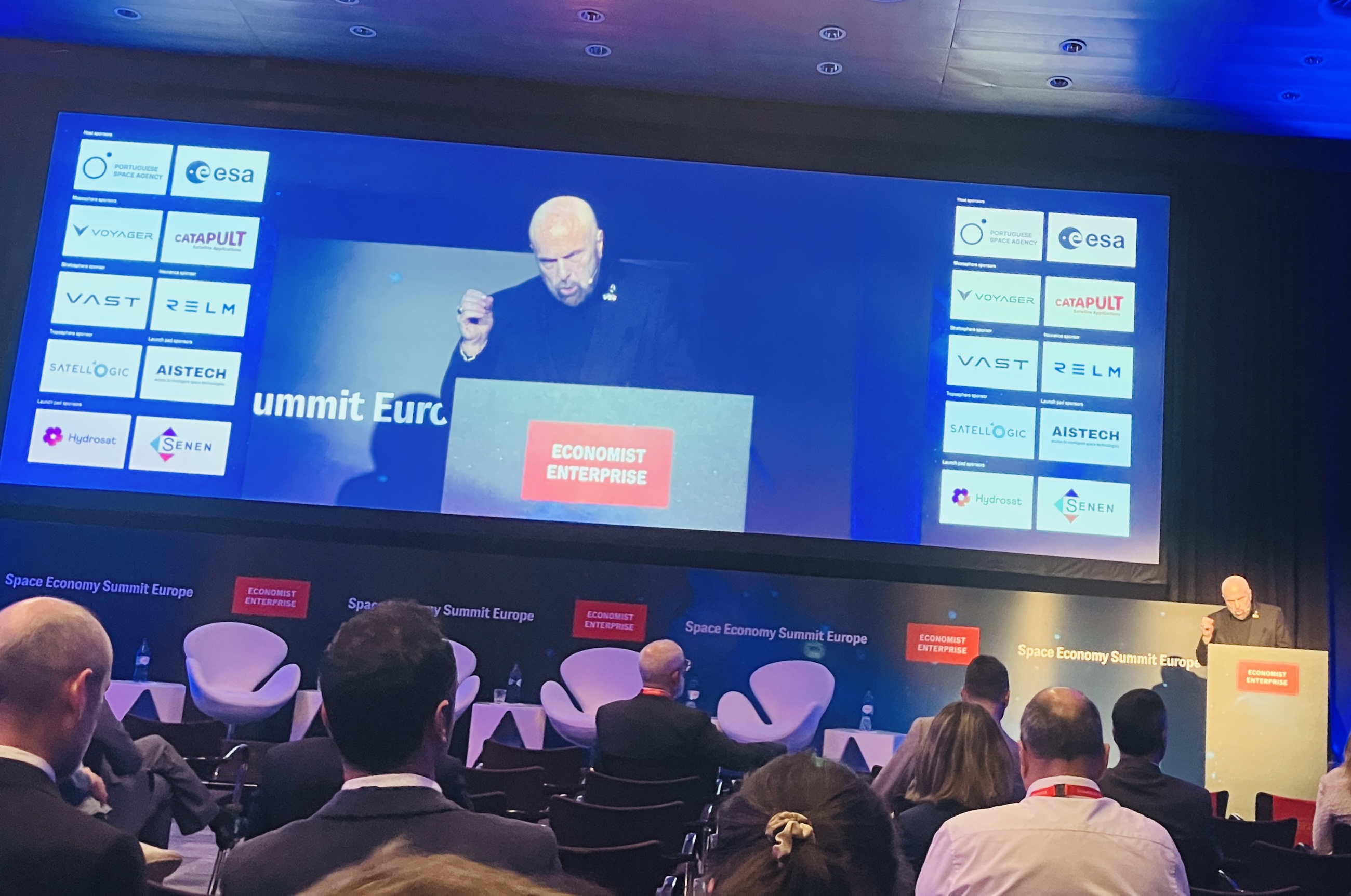
Lisbon, Portugal – As the first day of the European Space Economy Summit drew to a close, the tone shifted from policy detail to something more provocative.
Addressing an audience of several hundred delegates, space industry veteran Rick Tumlinson from the United States delivered a keynote that was part historical reflection, part rallying cry – and part warning to Europe.
Speaking in a city he described as “one of the greatest in history”, Tumlinson invoked Lisbon’s maritime legacy – home of Prince Henry the Navigator – to argue that Europe now faces a similar moment of decision, not across the Atlantic but into space.
Tumlinson’s central argument was stark – humanity’s expansion into the Solar System is inevitable but Europe’s role in that future is not.
“Civilisations that open frontiers change history,” he told delegates. “Those that stay safe in the harbour become footnotes in somebody else’s.”
Space, he suggested, is not a domain for conquest but for opportunity – “new worlds of possibility” encompassing economies, science and culture. Yet he challenged Europe directly saying that, for all its technical excellence, the continent has too often positioned itself as a supporting actor.
Referencing programmes such as Rosetta, Gaia and Copernicus, he acknowledged Europe’s engineering achievements. But critique followed.
“Europe provides the engineering,” he said, “while somebody else stands on the bridge.”
Tumlinson spoke with the authority of someone who has spent decades on the fringes of what is now mainstream. A co-founder of the Space Frontier Foundation and an early advocate of commercial spaceflight, he was among those pushing the ideas of private launch, commercial space stations and reusable rockets long before they became mainstream.
He described the early days of the “NewSpace” movement as a period when such thinking was dismissed as unrealistic or even absurd.
“Heretical ideas only become revolutions if people are willing to look foolish for a long time,” he added.
Today, companies like SpaceX, Blue Origin and Rocket Lab have normalised what was once radical a transformation Tumlinson stressed that was the result of decades of persistence, failure and iteration.
If Tumlinson’s tone was admiring toward Europe’s capabilities, it was less kind about its systems.
According to him, the issue is not talent or technology, but culture and structure: excessive caution, entrenched bureaucracy and a procurement model shaped by political compromise, particularly the principle of “geographical return”, which distributes contracts across member states.
“The problem is not European ambition,” he stated. “It’s that ambition is processed through systems designed to reduce risk and avoid embarrassment.”
His prescription was blunt: open up competition, prioritise excellence over geography and create genuine opportunities for startups to compete and fail.
“Do not fund geography. Fund excellence,” he said.
Central to his argument was the need for Europe to embrace a more commercial approach – one in which institutions act as customers rather than designers of systems.
He urged agencies such as the European Space Agency and the European Union to procure services – transport, logistics, payload delivery – rather than hardware, echoing models pioneered in the United States.
“If government buys paperwork, companies will build paperwork,” he added. “If governments buy services, entrepreneurs will build industries.”
Such a shift, he argued, would unlock a broader ecosystem of innovation, enabling startups to scale and compete globally.
Perhaps the most striking element of the talk was Tumlinson’s call for what he termed a European “declaration of space independence”.
This was not a rejection of partnerships with NASA or others, but a move toward strategic autonomy.
Europe, he argued, needs its own roadmap to the Moon, Mars and beyond “not as a footnote to Artemis, but as Europe’s own plan.”
Moderator Oliver Morton, editor at The Economist, raised the issue of political contradictions within today’s space sector, referencing the influence and controversies surrounding figures like Elon Musk.
Tumlinson did not sidestep the question, acknowledging his long-standing relationship with Musk but expressing unease with aspects of the current political climate in the United States.
“I watched him go down the hole,” he said, describing the situation as “incredibly sad”.
More broadly, he described an unresolved tension: how history will judge individuals whose technological contributions are intertwined with contentious political positions.
“I don’t know how those things balance,” he admitted. “But it does bother me deeply.”
Tumlinson closed by returning to his opening metaphor. Just as Lisbon once stood at the edge of an unknown ocean, Europe now faces a new frontier – one that demands risk, ambition and a willingness to embrace uncertainty.
“The Solar System will not wait,” he said.
Whether Europe chooses caution or courage, he suggested, will determine whether it helps shape the future or watches it unfold from the sidelines.