

Despite the huge advances in our understanding of the universe since the start of the Space Age, there are many observations that we still struggle to explain convincingly. Here, the author proposes an alternative model for our understanding of the ‘jets’ observed emanating from pulsars and spiral galaxies… and some serious implications for our own galaxy.
In An Introduction to Modern Astrophysics (Cambridge University Press, 2017), Bradley Carroll describes our efforts to develop effective models of pulsar emission as “an exercise in frustration because almost every observation is subject to more than one interpretation”.
In the same reference work, the density wave model that seeks to explain the arms in spiral galaxies also receives a less-than-ringing endorsement: “a complete understanding of density waves has not yet been fully realized”.
It is possible that further research will resolve some of puzzles associated with these two classes of object, but perhaps our modelling difficulties stem from an error in the fundamental assumptions about their physical configuration.
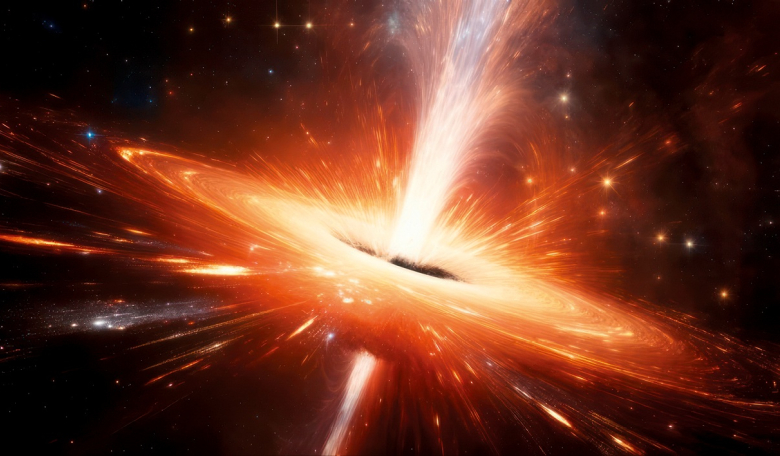
 Artistic impression of black hole accretion disk and jet eruption in deep space.
Current paradigms
The cores of pulsars and spiral galaxies, although of significantly different masses, are generally assumed to consist of a single central object.
In the case of pulsars, the prevailing model is that of a rapidly rotating neutron star that emits a lighthouse-like beam of radio waves which allows it to be detected as it intersects with radio telescopes on Earth. It is this pulsing signal that led to the name pulsar, for ‘pulsing star’. Pulsars are thought to emit an accelerated ‘jet’ of charged particles, at an angle to the axis of rotation, that leads to the radio emission which we observe. The angle between the spin axis and the emission cone is an assumed feature of the model.
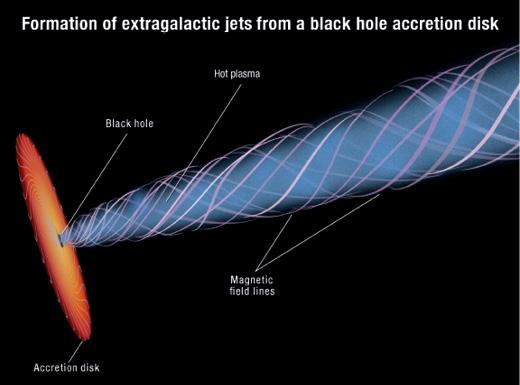
The central object in a spiral galaxy is, conventionally, a super-massive black hole surrounded by an accretion disk. These exotic objects are assumed to be the origin of the jets that are seen to emanate in a perpendicular direction to the plane of many galaxies (i.e. along the axis of rotation).
In both cases - for pulsars and for spiral galaxies - the associated jets are assumed to be constrained by strong magnetic fields.
As an aside, it is worth noting that the black holes in spiral galaxies are not thought to have a role in the creation of the spiral arms, which are attributed to spiral density waves in the disk of the galaxy. Although results from the James Webb Space Telescope (JWST) may force a revision, spiral galaxies are theorised to result from gravitational accretion processes involving pre-existing stars, and their rapid rotation is assumed to be caused by ‘tidal interactions’ with other galaxies.
Limitations of the current paradigms
Pulsar models assume that the emission cone is offset from the spin axis of the central body but fail to offer a particularly convincing physical explanation of why this should be so
Pulsar models assume that the emission cone is offset from the spin axis of the central body, but fail to offer a particularly convincing physical explanation of why this should be so. Some pulsars display a temporal ‘drift’ in their radio pulse pattern, and others can manifest significant changes to their pulse profile; these facts also present challenges for the standard model, as there is no very obvious reason why the emission should vary in these systematic ways.
Spiral galaxies are now being observed by JWST apparently close – in terms of time - to the Big Bang. At these epochs, they should not have had time to form via gravitational collapse, while their significant angular momentum is not well explained by ‘tidal interactions’. Their spiral arms are attributed to ‘spiral density waves’, but some spiral arms are observed to be ‘trailing’ while others are ‘leading’ (figure 1), and there are even examples of spiral galaxies that possess both! Why is this?
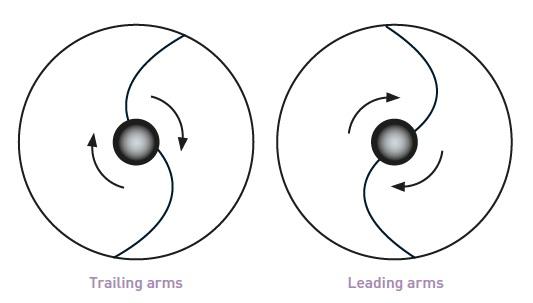 (Figure 1) Spiral galaxies are now, apparently, being observed by JWST temporally close to the Big Bang, at epochs when they should not have had time to form via gravitational collapse, and their significant angular momentum is not well explained by ‘tidal interactions’. Their spiral arms are attributed to ‘spiral density waves’ – but some spiral arms are observed to be ‘trailing’ and some are ‘leading’, and there are even examples of spiral galaxies that possess both!
The density-wave mechanism does not appear to account naturally for the symmetry seen in most spirals, or indeed for the central bars observed in many of these galaxies. Some spiral galaxies have just two spiral arms, but others have several, and the reasons for this are also rather unclear.
The energy source and acceleration mechanism for the spiral galaxy jets is also unclear, especially given the polar axes on which they are emitted, and the fact that they are supposed to be escaping at significant fractions of the speed of light from highly gravitationally attractive objects.
An alternative paradigm
Given these limitations, perhaps there is merit in considering a central configuration for both pulsars and spiral galaxies that more readily accounts for the structures observed (though obviously at very different size scales).
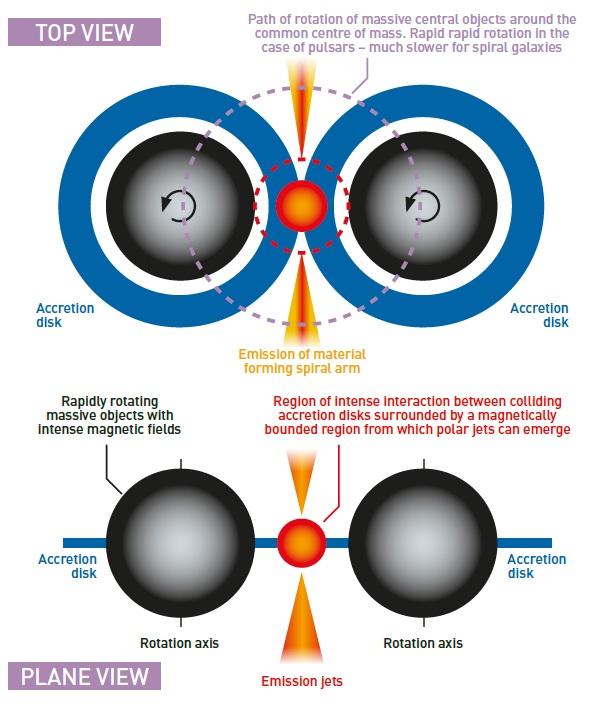 (Figure 2) In this concept, the region where the two accretion disks intersect resembles a massive particle collider, with particles being slammed together at enormous velocities, leading to an enormous release of energy from the central region.
It is suggested that the central regions of both pulsars and spiral galaxies are occupied by two rapidly rotating compact objects with co-aligned spin axes, potentially held apart (from gravitational collapse and merger) by large, similarly-oriented (and hence repulsive) magnetic fields – see figure 2.
The central objects - neutron stars or black holes - are surrounded by gravitationally constrained accretion disks (standard features in the models of such objects), which are thought to be responsible for their strong magnetic fields.
The density-wave mechanism does not appear to account naturally for the symmetry seen in most spirals, or indeed for the central bars observed in many of these galaxies
In this alternative concept, the region where the two accretion disks intersect resembles a massive particle collider, with particles being slammed together at enormous velocities, which leads to a vast release of energy from the central region.
Emission in a ‘disk’ perpendicular to the plane of the system (constrained by the magnetic fields of the two central bodies) can explain the ‘jets’ that emerge from active galaxies, and some of these energetic particles will intersect with the plane of the galaxy, playing a role in the creation of bars and spiral arms. A similar mechanism may explain the so-called Fermi Bubbles in our own galaxy – see figure 3.
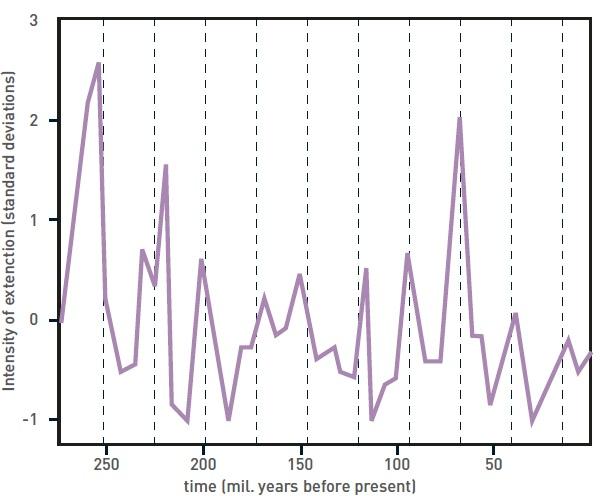 (Figure 3) Some authors have suggested that a periodicity of about 26 million years can be discerned in the sequence of mass extinctions.
Discussion
The first question that needs to be addressed with this general model is whether the idea of two central objects is credible.
For the much smaller-scale pulsar concept, it might be recalled that between 70 and 85 percent of all stars are in binary systems, so the idea that two evolved stellar-mass objects (neutron stars in the pulsar case) could be involved seems plausible.
For the much larger galaxy-scale configuration, there is evidence of black holes in binary systems from gravitational wave studies, and previous work on black hole systems seems to provide observational confirmation of the Doppler-shifted emission lines that might be expected from such a system.
It is suggested, however, that this model has significantly more explanatory power.
In the case of pulsars, the rapid rotation of the two neutron stars around each other periodically reveals and exposes this central region, leading to the pulses that are observed. In figure 2, the central interaction region is shown as a circle, but in reality the geometry of the interaction region and the magnetic fields is likely to create a region with more structure than a simple sphere, and this could account for the observed changes to the pulse shape as the system precesses.
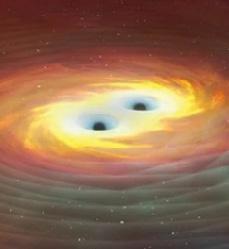 For the much larger galaxy-scale configuration, there is evidence of black holes in binary systems from gravitational wave studies.
‘Precession’ here relates to the concept that the central axis of the entire binary system may rotate relative to the line of sight to the Earth, such that, if the interaction region has a non-spherical structure, the shape of the pulses received would be expected to vary as it rotates. This precession could also explain the pulse-timing drift that is observed for some pulsars.
In the case of spiral galaxies, much slower precession leads to a rotating ‘disk’ of emission (perpendicular to the line between the black holes), some of which is in the plane of the galaxy. The theory is that this would lead to a ‘pressure’ which could trigger the formation of the spiral arms. This appears to provide a very natural explanation of the ‘pressure waves’ that are observed, and an obvious source of the symmetry observed in most spiral galaxies.
If this is true, the radiation environment in the vicinity of the Earth might be expected to increase periodically, and this could be injurious to life on the planet
Noting that galaxies with multiple mass concentrations near their cores are well known, this approach can also be invoked to explain galaxies with more than two spiral arms – by adding further black hole pairs.
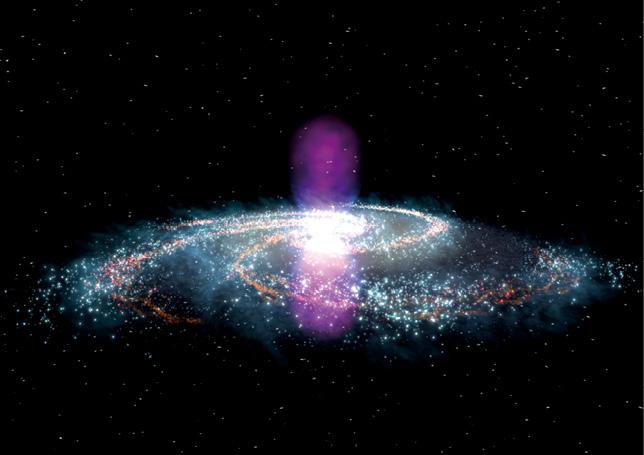 Fermi Bubbles.
As a result of variable gravitational interactions, the precession of the pair of black holes around the central interaction region could either be slightly slower or slightly faster than the general rotation of the galaxy. This seems to provide a very straight-forward explanation of trailing or leading spiral arms.
Implications
We believe we live in a spiral galaxy – in or near one of the spiral arms.
The new hypothesis presented here proposes that such spiral structures are created by an intense beam of radiation emanating from the central regions of the galaxy which is slowly ‘swept around’ by the precession of a pair of central black holes.
If this is true, the radiation environment in the vicinity of the Earth might be expected to increase periodically, and this could be injurious to life on the planet.
There are suggestions that there is a 26-million-year periodicity in the extinction record. Is it possible that this is also a consequence of this theory?
About the author
Dr Stuart Eves runs a space consultancy company (SJE Space), having previously spent 16 years with the UK Ministry of Defence and 14 years with Surrey Satellite Technology Limited (SSTL). During his time with the MoD, Stuart initiated the TopSat programme, which established a new world record for ‘resolution per mass of satellite’. He has recently published Space Traffic Control, a book which describes the measures needed to maintain the space environment and protect satellites from both natural hazards and man-made threats such as space debris. Stuart has an MSc in Astrophysics, a PhD in satellite constellation design, and has been a fellow of both the Royal Astronomical Society and the British Interplanetary Society for more than 25 years.