

More than half a century after the Apollo 11 lunar landing, humanity stands on the threshold of returning to the Moon. Yet amid the renewed excitement and spectacle surrounding Artemis, commercial launch systems and lunar ambitions, an uncomfortable question lingers: did Apollo actually teach us how to become a spacefaring civilisation? In this timely article, Mark Stewart argues that the true legacy of Apollo was not flags and footprints, but the first fragile framework for a permanent human presence beyond Earth.
“I think a future flight should include a poet, a priest and a philosopher... we might get a much better idea of what we saw.”
Apollo 11 astronaut Michael Collins
Towards the end of Apocalypse Now, as Francis Ford Coppola’s 1979 hallucinatory war epic drifts deeper into psychological collapse, there is a brief exchange about landing on the Moon. Dennis Hopper’s wired, half-mad photographer attempts to explain the process to Martin Sheen’s Captain Willard with a stream of fractured logic about mathematics, fractions and trajectories. The explanation makes almost no sense. Marlon Brando’s Colonel Kurtz dismisses it with visible irritation.
The scene lasts barely a minute, yet it captures something oddly truthful about the Apollo era. Not the engineering itself – the astonishing precision of it all – but the psychological atmosphere surrounding it. The Moon landings often feel, even now, less like history than a fever dream produced by an industrial civilisation operating at the absolute edge of its technical and emotional limits.
Coppola’s film and the Apollo programme emerged from the same America: a nation capable of almost unimaginable technological ambition while simultaneously drifting toward political, cultural and psychological fracture. Both projects were colossal systems held together by fragile human beings under unbearable pressure. During the filming of Apocalypse Now, Coppola suffered what he later described as a nervous breakdown. Martin Sheen had a heart attack at thirty-six. The production threatened repeatedly to collapse under the weight of its own scale and ambition.
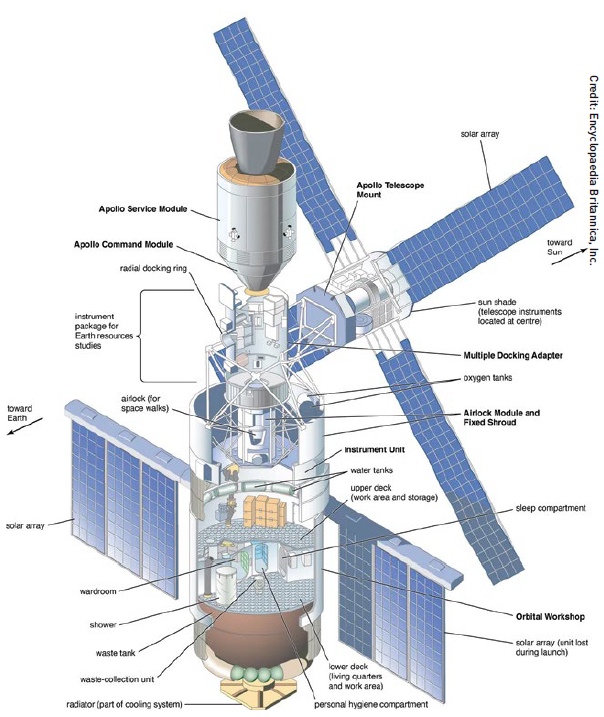 Graphic of US space station Skylab (occupied 1973–74), shown with docked Apollo Command and Service Module. The orbital laboratory, assembled from leftover Apollo components, was the first US space station.
Apollo possessed similar tensions beneath its polished exterior.
Behind the televised heroism stood exhausted engineers, overextended families, fatal accidents and a level of organisational stress that bordered on the inhuman. The triumphal imagery of Saturn V rockets concealed a machine civilisation running dangerously hot. And yet it worked. Which raises the deeper question lurking beneath Hopper’s rambling monologue: how do you actually land on the Moon?
Interconnectedness
The obvious answers are physics, mathematics, propulsion systems, computers and highly trained astronauts. But Apollo also depended upon something less tangible – infrastructure, systems thinking and networks of support extending far beyond the spacecraft itself. The Lunar Module (LM) did not descend from the heavens alone like some gleaming chariot from mythology. It was merely one component within a vast interconnected architecture.
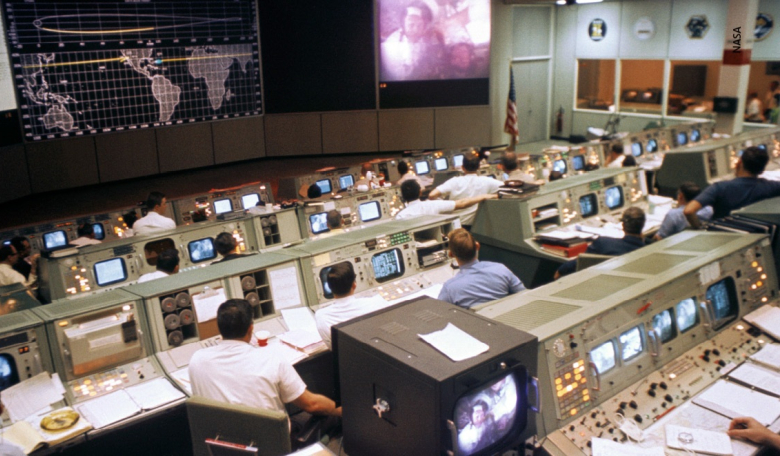
Perhaps appropriately, the first LM used in crewed flight testing carried the callsign Spider, which now feels strangely prophetic. Because the LM only functioned as part of a web: the Apollo Command and Service Module orbiting above it, Mission Control in Houston, tracking stations spread across the globe and the intricate choreography of rendezvous operations linking each stage of the mission together. Apollo succeeded not because NASA built a single heroic machine, but because it created an entire operational ecosystem capable of sustaining human activity beyond Earth.
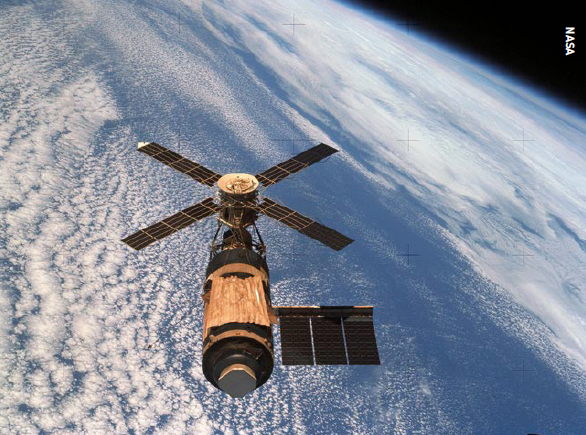 An overhead view of the Skylab space station in low Earth orbit as photographed from the Skylab 4 Command and Service Modules (CSM) on 8 February 1974 during the final fly-around by the CSM before returning home.
Such a distinction matters because space exploration is often remembered incorrectly. Public memory reduces Apollo to footprints, flags and singular moments of spectacle. Yet the real breakthrough lay elsewhere – in modularity, logistics and infrastructure. Apollo was not merely a mission architecture. It was the beginning of a systems architecture for a spacefaring civilisation.
Even its afterlife demonstrated this. When the Moon landings ended with Apollo 17 in 1972, NASA found itself with surplus hardware, surplus expertise and surplus momentum. The result became Skylab – an orbital laboratory assembled from leftover Apollo components and launched almost as an afterthought.
The Lunar Module did not descend from the heavens alone like some gleaming chariot from mythology
But Skylab represented something more important than recycling. It hinted at the future Apollo never fully reached.
The paradox of the Moon landings is that they achieved the impossible before building the infrastructure necessary to sustain it. Apollo could visit another world but not remain there. It could perform exploration but had no permanence. It was a programme of immense kinetic energy without long-term continuity and once the political urgency of the Cold War faded, the machinery lost direction.
In retrospect, the great unfinished project of the Space Age was never the Moon landing itself. It was the construction of the orbital and cislunar infrastructure that should have followed.
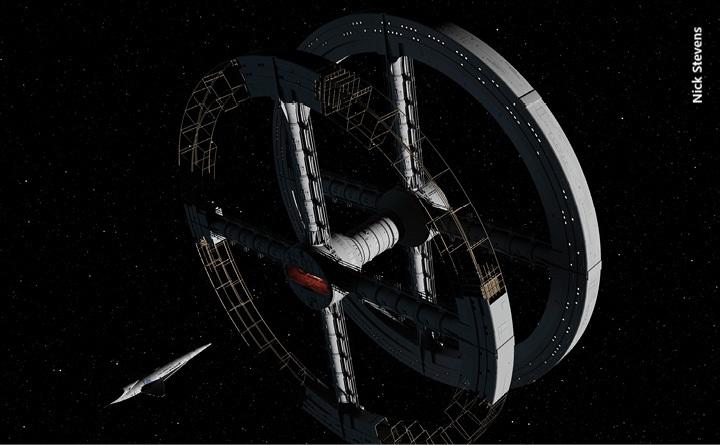 In 2001: A Space Odyssey, Stanley Kubrick and Arthur C Clarke imagined enormous, wheeled orbital stations serving as gateways between worlds. The film’s most realistic insight was not artificial intelligence or videophones, but logistics.
Infrastructure
How, after all, do you maintain a permanent presence on the Moon without space stations, fuel depots, transfer vehicles and industrial supply chains? How do you create a functioning Earth-Moon economy without ports, logistics and maintenance hubs?
Maritime empires did not expand across the oceans through ships alone. They required dockyards, fuelling stations, navigation networks and trade routes. Infrastructure always precedes settlement, and the great science fiction writers and visionaries of the 20th century understood this long before policymakers did.
In 2001: A Space Odyssey, Stanley Kubrick and Arthur C Clarke imagined enormous, wheeled orbital stations serving as gateways between worlds. The film’s most realistic insight was not artificial intelligence or videophones, but logistics.
Kubrick understood that a civilisation capable of reaching the Moon routinely would require systems of permanence rather than isolated acts of heroism. The great wheel station in 2001 is not presented as extraordinary. It is presented as infrastructure.
This distinction runs through much of the best speculative fiction of the twentieth century. Gerard K. O’Neill imagined giant orbital habitats not as fantasy architecture but as the natural extension of industrial civilisation into space. Arthur C Clarke’s orbital elevators and transfer stations were ultimately about continuity and access.
Even the paintings that accompanied Wernher von Braun’s famous Collier’s magazine articles in the 1950s depicted not lone astronauts planting flags, but functioning systems: wheels, docks, ferries, habitats and orbital construction yards humming with activity. In other words, the future once imagined itself as permanent.
Somewhere along the way, that confidence faltered. The decades after Apollo increasingly reduced human spaceflight to symbolic gestures and short-duration missions circling endlessly above the Earth.
The International Space Station (ISS) became one of humanity’s greatest engineering achievements and one of its strangest paradoxes: a permanently inhabited outpost that nonetheless leads nowhere beyond itself. For more than two decades astronauts have lived continuously in orbit while remaining psychologically and politically tethered to Earth. It proved we could survive in space but it never fully answered why we were there. And yet the old dreams persist stubbornly beneath the surface.
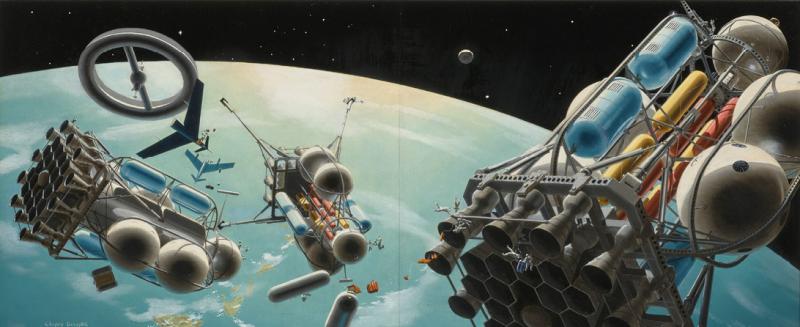 ‘Assembly of the Moonships 1,075 miles above the Hawaiian islands’ by Chesley Bonestell, published with Wernher von Braun’s article, ‘Man on the Moon: The Journey’, Collier’s, 18 October 1952. The paintings that accompanied von Braun’s famous Collier’s magazine articles in the 1950s depicted functioning systems: wheels, docks, ferries, habitats and orbital construction yards humming with activity, forecasting permanence in space.
Taking the long view
The paradox of the Moon landings is that they achieved the impossible before building the infrastructure necessary to sustain it
NASA’s Artemis programme, the proposed Lunar Gateway station, commercial orbital habitats and the emergence of fully reusable launch systems all suggest that spaceflight may finally be returning to the infrastructural logic glimpsed during Apollo’s aftermath.
For the first time in decades, the discussion is no longer simply about missions. It is about supply chains, propellant transfer, in-situ resource utilisation and industrial capability.
These are not glamorous concepts. No child dreams of becoming a cryogenic fuel transfer specialist. But civilisations are not built from glamour alone.
To this day, Roman roads remain more significant than Roman triumphs, and Victorian telegraph cables transformed the world more profoundly than most Victorian wars. Infrastructure is civilisation made physical.
SpaceX’s Starship perhaps illustrates this shift most clearly. Public attention naturally gravitates toward the spectacle of gigantic rockets exploding over Texas coastlines, but the deeper ambition behind the programme is infrastructural.
A fully reusable transportation system changes the economics of access to orbit in the same way container shipping transformed maritime trade. The significance lies not in a single launch, but in repetition, cadence and scale.
That may ultimately determine whether the current era becomes a genuine opening of the frontier or merely another cycle of spectacle followed by retreat.
Apollo succeeded magnificently as theatre. It succeeded politically as a Cold War demonstration. It succeeded technologically beyond almost anyone’s expectations. But as a long-term civilisational project, Apollo remained incomplete. The astronauts departed. The launch pads fell silent. The infrastructure necessary for permanence never fully arrived.
Perhaps that is why the Moon landings still possess such a haunting quality. They resemble fragments from an abandoned future – visions of a civilisation briefly glimpsing what it might become before turning away.
Now, more than half a century later, humanity appears to be approaching the same threshold once again.
This time the challenge may not be reaching the Moon. We already know how to do that. The challenge is deciding whether we truly intend to stay beyond Earth at all. Whether space is merely a target for episodic adventure, or the beginning of a permanent extension of human civilisation outward into the Solar System. Because, in any objective final analysis, the Moon is not merely a destination. It’s the first port of call in humanity’s journey to the future.
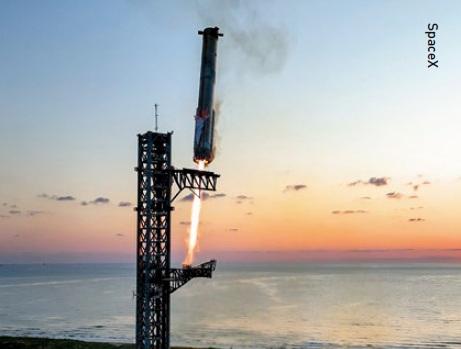 The primary purpose of SpaceX’s Starship is not exploration but infrastructure.
About the author
Mark Stewart is the Editor of Odyssey – the arts and culture magazine of the British Interplanetary Society. He writes with a social and environmental conscience, hoping to redress the balance in favour of Mother Nature. His other passion is star gazing and writing about space – its history and cultural impact. His website The Metaphor Equation can be found at: markdestewart.wixsite.com