

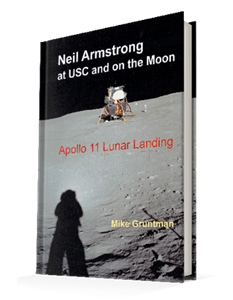
Neil Armstrong became the first man to set foot on the Moon in 1969 and books on the tremendous effort behind this ostensibly simple action have been published ever since. Most, however, have concentrated either on the mission details or the political context of the Apollo programme; this one is different in interlacing a small part of Armstrong’s personal story with the technology that placed him in the history books.
The author is a professor of astronautics at the University of Southern California (the USC in the title), which awarded Armstrong a Master’s degree in 1970 - and this is the ‘hook’ for the book. It turns out that Armstrong began his studies in the late 1950s, but somehow ‘life got in the way’ and he hadn’t managed to complete his thesis when NASA called. As the author wittily reports, “ ‘one small step’ toward the degree remained to be made”. It was Neil’s hour-long seminar at USC on 22 January 1970 that completed the degree requirements; its title was, perhaps not surprisingly, “Apollo 11 Lunar Landing Mission: Landing Techniques”. Gruntman speculates that the ‘requirements’ were “creatively established” for the occasion…and I’m sure he’s right!
Beginning and ending with aspects of this story, the book fills in the technical details of the mission in the intervening chapters, covering the mission design and operation of the key hardware elements. The text is crisp and well-written, providing just the right balance of context and detail.
I particularly liked the focus on some of the technical aspects often missed by less knowledgeable authors: for example, the fact that Armstrong’s landing was so well-controlled and ‘soft’ that the shock absorbers in the landing legs failed to compress as far as expected, leading to that famous jump down to the surface from an apparently too-short ladder.
The book is well illustrated with black-and-white photos and enhanced by an 8-page bibliography and a nine-page index. Coverage is necessarily brief, given the low page count, but it will tick all the boxes for anyone wishing to understand what Apollo was about. It may be 56 years since Armstrong made his famous little jump, but there is much for today’s engineers engaged in the return to the Moon to learn from Apollo.