

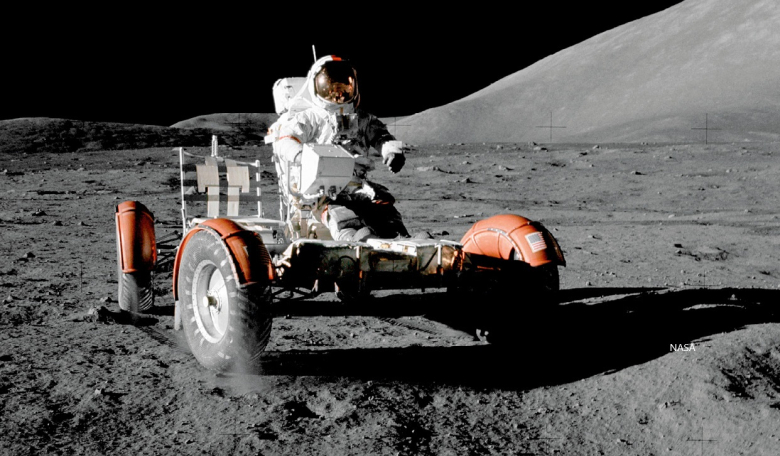
The Lego Group has become known for producing large, space-related construction kits for adults, which have included the Apollo Saturn V rocket and the Lunar Module. In this article, Mark Williamson considers the addition of a crucial piece of kit on later Apollo missions – the Lunar Roving Vehicle – and reviews the Lego version.
At a time when many people drive electric vehicles (EVs) of one marque or another, it may come as a surprise that there are three 1971-model Boeing EVs parked on the surface of the Moon. They were made, under contract to NASA, for its J-series Apollo missions – 15, 16 and 17 – which explored different regions of the Moon in 1971 and 1972.
In some ways, the Lunar Roving Vehicle (LRV) would seem familiar to modern drivers: it had two seats and four wheels and was powered by onboard batteries; however, the seats were more like deckchairs (to save weight), the wheels were made of piano wire and the silver-zinc batteries were non-rechargeable. Moreover, there was no cabin, its top speed (demonstrated on a downhill run) was 18 kph and it was bristling with cameras, payloads and communications antennas – so not your regular EV!
It was, however, according to astronaut Gene Cernan following his use of LRV-3 on the Apollo 17 mission, “the finest machine I ever had the pleasure to drive”.
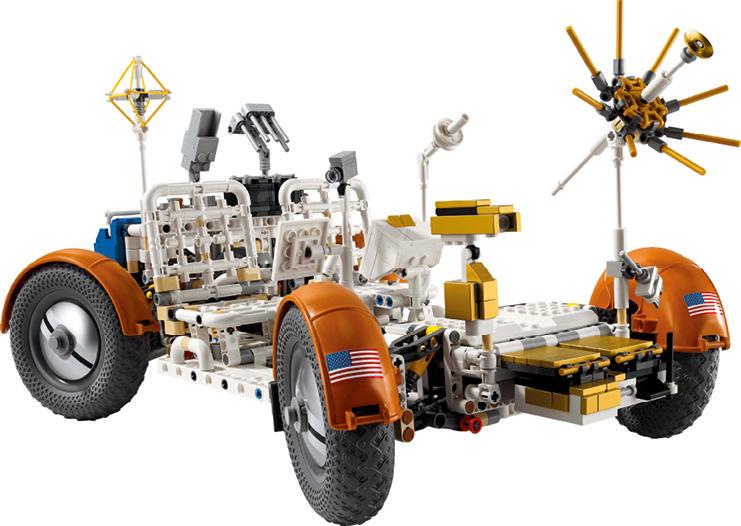 The Lego LRV fully assembled.
Lego model
The LRV was deceptively simple in appearance but, in reality, was a complex piece of engineering. According to a Boeing information sheet of 1981, the company considered it a specialised “spacecraft on wheels”, designed to function in the vacuum and wide temperature extremes of space on the rugged and difficult terrain of the lunar surface.
The real LRVs were 3.1 m long with a 2.3 m wheelbase, 1.8 m wide and had a ground clearance of 0.35 m. The 0.8 m-long forward and rear chassis sections supported the wheels and equipment platforms, while the 1.5m centre chassis housed the so-called Crew Station. The Lego version is about 40 cm long and 24 cm wide - effectively a 1/7.75 scale model - and provides a good facsimile of the real LRV (given the obvious limitations of Lego bricks!).
At a time when many people drive electric vehicles (EVs) of one marque or another, it may come as a surprise that there are three 1971-model Boeing EVs parked on the surface of the Moon
The model is based on the Apollo 17 variant (LRV-3) and has 1913 separate pieces. As with all these ‘sets’ (as Lego likes to call them), it comes with a glossy, full-colour instruction manual, in this case comprising no less than 350 pages. The booklet credits Lego Technic’s Olav Kroigaard as the designer of this version of the LRV, and he and his team have done a wonderful job. Following the several hours of ‘concentrated effort’ required for its construction, even the most discerning Apollophile would be impressed.
The three-section chassis structure (referred to above) is quite faithfully reproduced, in that its forward and rear sections can be folded onto the centre chassis once certain subsystems have been removed. Owners thus have the choice to display the model in its operational, lunar-surface configuration or with the forward chassis, lunar communications relay unit and aft pallet assembly mounted on separate stands.
In fact, the basic vehicle is complete about halfway through the instruction book, while the second half covers the antennas, batteries, science experiments, sample collection tools and those arguably superfluous display stands. The tool collection includes a drill kit, scoop and brush and a removable rock sample caddy. There is even a model interpretation of a famous rock, known as Big Muley (at 11.7 kg the largest lunar sample), which was collected on the Apollo 16 mission.
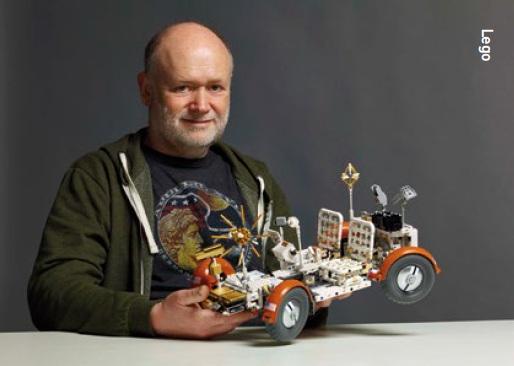 Lego Technic designer Olav Kroigaard with his labour of love.
Stowage and deployment
The folding function referenced above was a fairly obvious necessity given the limited volume available on the Lunar Module (LM) and within the fairing of the Saturn V rocket itself. The rover was stowed, therefore, with the wheels flat against the folded chassis pack, in a quadrant of the LM’s descent stage to the right-hand side of the ladder. Integral springs ensured that the vehicle unfolded and that its wheels deployed and locked into their proper positions. Deployment was possible with the LM tilted at any angle up to 14.5 degrees and although deployment time was intended to be 15 minutes, with the LM almost level this could be reduced to about five. The operation itself was semi-automated so that a single astronaut could deploy, activate, check and operate the vehicle quickly and easily.
The design of this fold-up car was impressive enough as an example of high-cost, high-reliability spacecraft engineering - the total LRV project cost had risen to $38 million by the end of the programme – but it was a surprise to see this so well reproduced in a Lego model. It would have been so much easier to settle for a fixed chassis with fixed seats and batteries, and simply-sprung wheels, but the designer obviously fancied a challenge.
Once the payload, antenna and battery subsystems have been removed, some 20 separate operations are required to fold down the seats, footrests and control console, release the wheels and fold everything up. It’s a good job the last few pages of the manual include arrowed diagrams as a reminder!
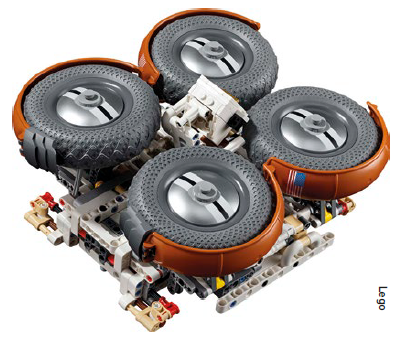 LRV model folded for stowage in the LM (just like the real thing!). Note the control console at centre.
Suspension and steering
Some 20 separate operations are required to fold down the seats, footrests and control console, release the wheels and fold everything up
Those who have seen the films of an Apollo LRV bouncing across the lunar surface, in what astronaut Dave Scott called a “rocking-rolling ride”, will understand the flexibility of the LRV’s suspension system, necessary because of the naturally rough surface. The Lego LRV reproduces this flexibility with a tremendously dynamic suspension system.
Moreover, just like the real thing, the model incorporates four-wheel steering using linkages from the astronauts’ T-shaped steering controller (centrally-mounted so that either man could steer). The Lego control stick allows the vehicle to be steered quite easily and, again like the real LRV, identical front and rear systems are independent and capable of being disconnected to revert to two-wheel steering.
This attention to authenticity is impressive in a model engineering sense, but is likely to have limited ‘play value’, as I can’t see many adults pushing the model round the living room floor for long. I have to say, however, that even my wife was impressed with a demonstration of the model’s manoeuvrability!
Return to the Moon
It is well over half a century since the last vehicle (LRV-3) was driven on the Moon, but if NASA’s Artemis programme is successful we could see another ‘Moon car’ on the lunar surface in the next decade. On the other hand, it has long-occurred to me that there are already three second-hand models sitting there, in need of a recharge but more than likely in serviceable condition.
In fact, following the Apollo 15 mission, NASA received several offers, mainly from American used car companies, to buy LRV-1: the offers ranged from $100 to $1000 (the low bids probably reflecting the difficulty in returning the vehicle to Earth!). According to Boeing, “NASA artfully dodged the issue in a typical bureaucratic maneuver” in that offers were shuffled between NASA centres and HQ “until the would-be purchasers gave up”.
Under the largely inert conditions of the lunar environment, the LRVs and other Apollo hardware could theoretically remain untouched and unchanged for centuries. But if mankind is to bestow a fitting tribute on the first vehicles driven ‘off-world’, it could do no better than incorporate the Apollo Lunar Roving Vehicle in the first lunar museum. Time, as ever, will tell.
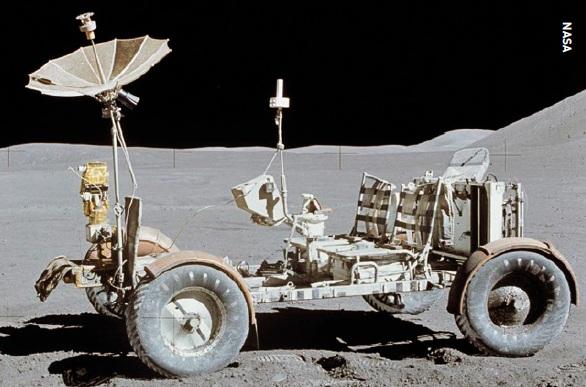 The real Apollo 15 lunar rover, one of three still parked on the Moon.
Note on pricing
Prices depend on regional markets and suppliers, but Lego’s recommended retail price (RRP) for the NASA Apollo Lunar Roving Vehicle was originally £189.99 in the UK (later reduced to £132.99), $219.99 in the US and €149.99 throughout the Eurozone.
Editor’s note:ROOM published articles by Mark Williamson on “Lego’s replica space programme” in Issue 24, Summer 2020, and “Lego tribute to NASA’s SLS and Artemis” in Issue 36, Spring 2025.
About the author
Mark Williamson is an independent Space Technology Consultant and writer, and a Commissioning Editor for ROOM Space Journal. He has 40 years of experience as a satellite communications engineer and consultant to the space industry, space insurance and space education sectors. He is the author of six books, including The Cambridge Dictionary of Space Technology and Space: The Fragile Frontier, has edited three space industry magazines and written more than 600 articles and papers on space technology. A more detailed account of the engineering design of the Lunar Roving Vehicle can be found in his book Spacecraft Technology: The Early Years, published in 2006 by the IEE (now Institution of Engineering & Technology, IET). He has a BSc in physics and astrophysics and a PhD in sustainable development of the space environment, and is a chartered physicist and chartered engineer.