

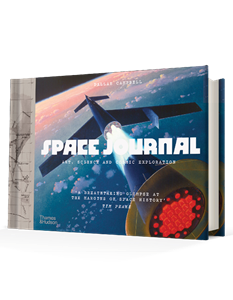
As a collector of space-related books (and author of a few), I realise the challenge of originality: how does an author find a different subject, a quirky angle or a saleable solution in a world that reckons books are dead anyway? Despite its arguably pedestrian title, Space Journal fully meets that challenge.
The book is as difficult to pigeonhole as its author, Dallas Campbell, ubiquitous TV presenter, trade-show host, actor, writer and unmitigated space fan. Possibly reflecting his sub-career as an actor, the six divisions of the book are termed ‘Acts’ and, presumably channelling a classical education, their titles are in Latin! Luckily, since I failed my Latin O-Level, he provides a free translation to items such as “Staring into Space”, “The Search for Life” and “Wanderers in Time”.
In essence, this is a book about a highly selective group of people who ‘lit the fuse’ for space exploration and development. Thus we find Jules Verne and Chesley Bonestell as “space dreamers”, Wernher von Braun and “The Chief Designer” as rocket engineers and Laika, Freeman Dyson and Oliver Postgate in supporting roles. As Campbell admits in his introduction, “There’ll no doubt be names that you can’t believe I’ve omitted”, while some he’s included “may make you scratch your head”; but it’s his choice and he never said it was an encyclopaedia.
Actually, I found the content and style to be refreshing. The author’s choice may appear quirky and slightly random, but the book has a chapter plan and, within this plan, Campbell allows himself to freestyle his way through the space cornucopia. In fact, he terms it a “stroll along the foreshore of this most exciting of endeavours”.
In practice, his approach allows him to feature a wide variety of subjects and imagery within the book’s attractive landscape format: space art, magazine covers, postage stamps, flowcharts, woollen dolls, newspaper cuttings, Brooke Bond Tea cards, blueprints, film stills…and of course the usual (and not so usual) photos and diagrams!
The writing style is engaging, positive and authoritative, almost relentless in its inclusion of facts, anecdotes and historical information. While the author is free with his opinions - in a presentation mode that avoids the limitations of proof-by-reference - one is caught up in his enthusiasm for the subject and never feels lectured at or patronised. So, what’s wrong with it? Where is the reviewer’s balancing statement to indicate fairness in criticism? Er… I’ll have to get back to you on that!