

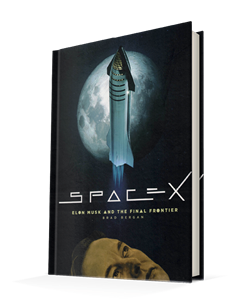
Love him or loathe him as an individual, no-one can deny that Elon Musk is a force for change in the space industry. Indeed, as historians of the 22nd century look back at the beginning of the 21st, one would expect at least part of their analysis to pivot on the emergence of SpaceX. It is strange, therefore, that the market is not swamped with books on the company and its charismatic leader.
This book appears to be aimed at the general reader with an interest in space and is written by a business journalist and editor with an interest in space. The distinction between such a writer and a ‘space insider’ has both positive and negative aspects: while it offers a welcome objective view of our industry, its momentum is slowed by the author’s apparent need for historical context.
Following a short thesis on Fukuyama’s declared “end of history” after the Cold War, a potted history of the space race and a review of Space Shuttle accidents, the author finally introduces SpaceX. Even then, however, his chapter leads with Robert Zubrin’s call to settle Mars and references the Shuttle, DC-X and VentureStar. Then we come to a chapter on “The Space Barons”, featuring Jef Bezos and Richard Branson, almost as if the author is delaying the start of the gig with a bunch of ‘support acts’. I find his scattergun approach to space history frustrating.
Once the main act hits the stage, however, the book becomes more interesting. Chapter 5, which begins on page 88, is titled “SpaceX Takes Center Stage in Space Race 2.0”, thus referencing the author’s other space book, “Space Race 2.0”; it’s mainly about Starship and the Super Heavy (as previous chapters have already slipped in aspects of the Falcon series). The following chapter covers “the Moon, Mars, and Beyond” and, before you know it, we’re into a short, final chapter on “SpaceX After Musk”.
The latter is something I have pondered on myself lately, so I was interested to see what the author thought, but after quoting Musk on the likelihood of his death “before we go to Mars”, the chapter lost focus and wandered off into space debris, litigation and a proposed probe to Uranus.
This is an extremely well-illustrated book, with lots of glossy colour images (many of which I’d never seen before); it also has a predominantly names-based index. As such, it should be of interest to the educated lay reader, but anyone with a desire to learn more about the man in the title and his role in exploring and developing space will be disappointed.