

Europe is investing billions of euros in sovereign space infrastructure but industry leaders are warning that satellites alone will not be enough to secure long-term strategic autonomy.
They argue that Europe must also accelerate the deployment of optical (laser) communications if its future space networks are to remain competitive with foreign systems such as Space-X's Starlink, which already uses laser inter-satellite links to provide faster, more secure data transfer than conventional radio-frequency communications.
The comments come as the European Commission prioritises European operators for direct-to-device spectrum allocation, work continues on the planned IRIS² sovereign satellite constellation and Germany outlines a €35 billion investment in defence space capabilities.
According to Laurynas Mačiulis, CEO of European laser communications company Astrolight, the next challenge is ensuring that the communications layer evolves alongside the satellites themselves.
"If Starlink remains the only widely available commercial space network using optical communications, European operators will inevitably turn to it for superior speeds and data security," he said. "Optical data transfer is no longer a next-generation technology for specialised missions; it is becoming a strategic and commercial necessity."
Unlike traditional radio-frequency systems, optical communications transmit data using tightly focused laser beams, offering data rates up to 100 times higher while making transmissions significantly more difficult to detect, jam or intercept. The technology can also reduce dependence on increasingly congested radio-frequency spectrum.
The warning comes as demand for satellite connectivity continues to rise. Market analyst Novaspace forecasts global demand will grow by more than eleven-fold between 2024 and 2034, placing increasing pressure on conventional satellite downlinks.
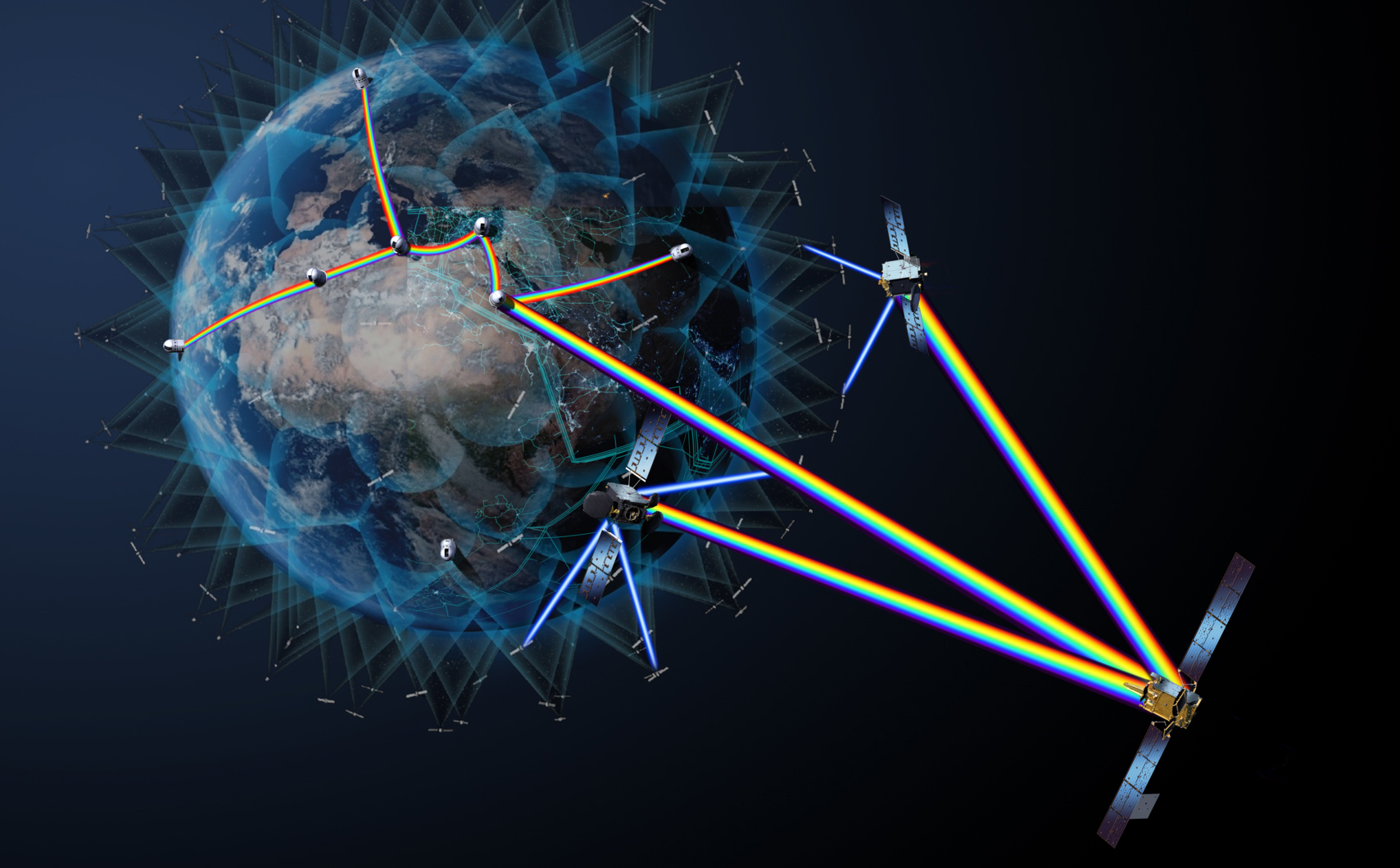
Europe has already committed to incorporating optical technologies into several major programmes. The IRIS² secure connectivity constellation is expected to employ optical inter-satellite links, while ESA's HydRON initiative is intended to demonstrate a multi-orbit optical transport network.
However, Astrolight believes programme-level capability alone will not be sufficient. Dalius Petrulionis, the company's Chief Technology Officer, said Europe also needs to establish the wider industrial ecosystem required to support large-scale deployment, including optical inter-satellite links, optical ground stations and user terminals.
"IRIS² and HydRON are important steps, but for optical communication to become a resilient communications backbone, Europe must also build the industrial and commercial layer around them," he said. "This infrastructure will enable secure, real-time data transfer that supports defence, emergency response and higher-value commercial services."
A recent report by the Centre for European Policy Studies similarly concluded that Europe possesses strong technical capabilities but continues to face challenges in scaling its space industry sufficiently to compete internationally in areas including satellite manufacturing and secure communications.
Astrolight, founded in 2019, develops optical communication terminals for space-to-space, space-to-ground, maritime and terrestrial applications, and is involved in several European Space Agency programmes as well as NATO's Defence Innovation Accelerator for the North Atlantic (DIANA).
# #
Photo: Depiction of ESA's HydRON initiative which is intended to demonstrate a multi-orbit optical transport network. (ESA)