

Over the past decade, launch costs have fallen rapidly and more payloads are heading to space than ever before. But there’s one resource that is not getting cheaper or more abundant: crew time. Could robots be the answer?
Space has the scarcest labour environment known to man: fewer than 700 astronauts have ever been trained and, as of 2024, NASA had fewer than 50 active astronauts. Once astronauts are trained and embark on their first mission, it costs US$130,000 an hour for an astronaut to do work in space.
With the launch of new satellite mega-constellations and commercial mspace stations, there is now more demand for science in orbit than ever before, and numerous future habitats are planned. The need for extra hands in space is huge and the next great bottleneck for advancements in the final frontier isn’t launches; it’s labour.
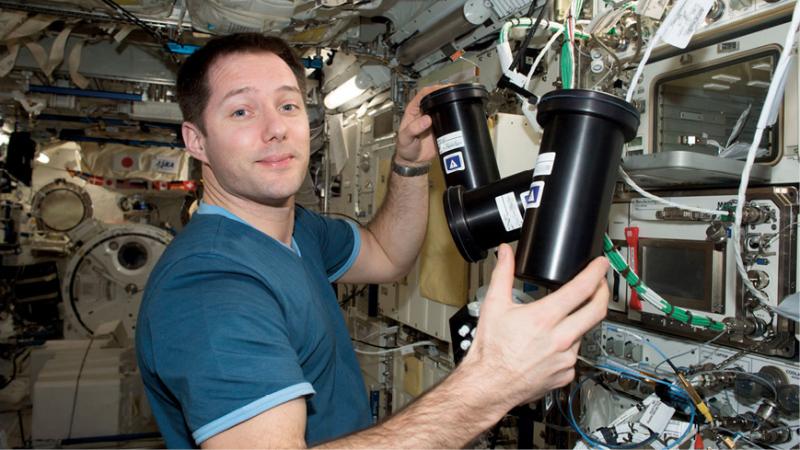 NASA astronaut Thomas Pesquet removing the Protein Crystallization Facility hardware from the incubator on the ISS for US biopharmaceutical company, Merck’s research experiments in December 2019.
Crew-time bottleneck
With so much work and so few hands, astronauts’ time is scheduled right down to five-minute intervals
The International Space Station’s (ISS) primary function is to act as an orbiting laboratory. For years, research groups, government agencies and commercial companies have relied on the ISS for crucial microgravity research. Over 20 years of this research has yielded groundbreaking discoveries that impact our life on Earth – better semiconductors, fibre-optics and medicines are among the discoveries we can thank the ISS for. For example, Keytruda, a cancer therapeutic refined in space, has saved countless lives and made almost $30 billion in revenue for US biopharmaceutical company Merck in 2024.
The ISS relies on the very few active astronauts to carry out this experimentation and manufacturing, as well as handling all the logistics and maintenance that keep them alive. With so much work and so few hands, astronauts’ time is scheduled right down to five-minute intervals, with everything accounted for. Still, demand crushes capacity and experiment proposals and maintenance backlogs pile up faster than they can be scheduled. This results in a wait-list of years for a single ISS experiment.
Scientific investigations number in the hundreds per year, with more than 400 carried out in 2024 alone. All of these experiments involve astronaut time, whether its pipetting, swabbing or even just installing cartridges, and all must be carried out delicately. The average experiment takes three to four hours of astronaut time to complete.
Every 45-60 days, a resupply mission delivers up to 3.5 tonnes of cargo to the station and crewmembers are diverted to logistics, cargo unpacking and supporting newly arrived crew. These spikes in workload draw crew away from potentially life-saving experimentation, which results in a reduction in experiment productivity. As a result, astronaut free time has now become a limiting factor for on-station science. As cargo vehicles launch at a higher rate with greater payload capacities than ever, the human crews cannot keep up. There simply aren’t enough astronaut hours to go around.
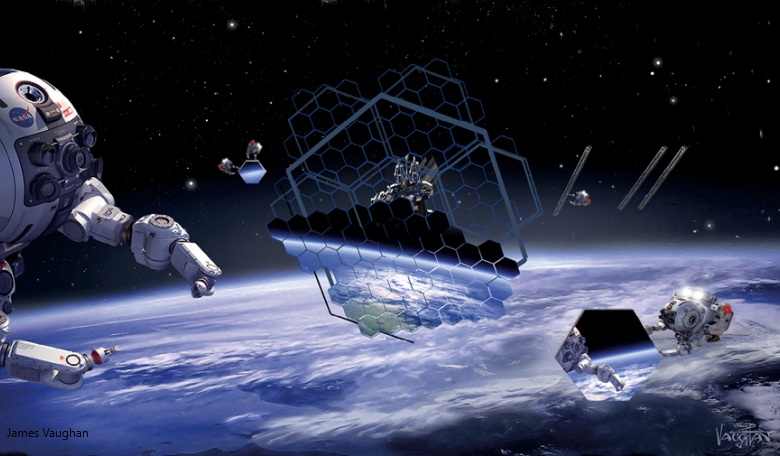
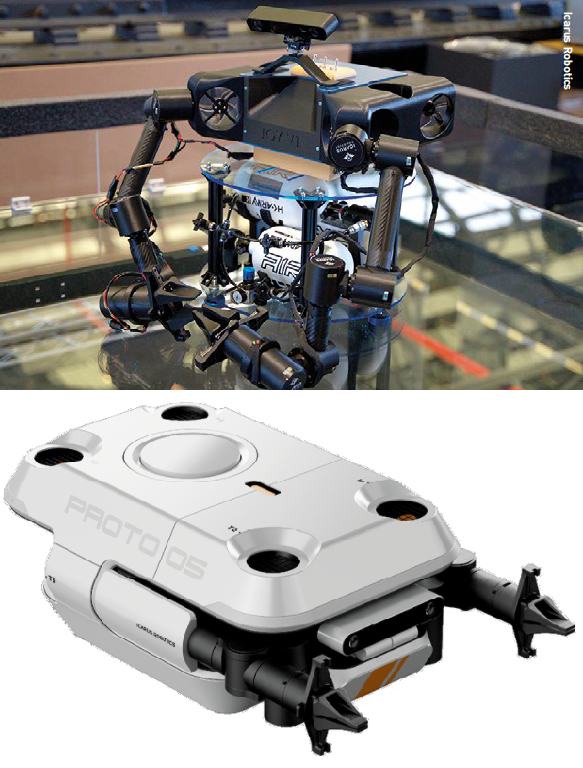 Icarus Robotics is creating free-flying dextrous robots.
For the next decade, NASA is betting on a new era of privately owned and operated space stations to carry forward America’s presence in orbit and stimulate the growth of commercial activities in microgravity. The rise of this new Commercial Low Earth Orbit Destination programme (CLD) has made the astronaut labour problem more topical than ever.
As cargo vehicles launch at a higher rate with greater payload capacities than ever, the human crews cannot keep up
The ISS will be de-orbited due to its age and annual upkeep cost, which exceeds $1.1 billion. In its place, a fleet of commercial stations from Axiom Space, Starlab, Vast and Blue Origin aims to sustain both scientific discovery and a continuous American heartbeat in space. The first of these commercial space stations is set to launch later in 2026.
NASA’s updated Space Act Agreement (SAA) accelerates funding and deployment, enabling a rapid path to space for new scientific payloads. However, this agreement only requires short-duration crewed missions of around 30 days, only a few times a year during the initial phase. This means for most of their early lives, these stations will be largely uncrewed. With no end in sight for rising experiment demand, shorter-duration crewed missions mean even fewer hours to carry out the scientific research critical to humans on Earth.
Orbital labour
Outside of science and stations, new tasks demanding labour in orbit are on the horizon. Tasks such as satellite servicing, spacecraft refuelling, in-orbit inspection, debris removal and in-orbit construction will be essential. Many of these jobs will not be one-time missions but will instead require regular upkeep and steady attention.
Momentum is ramping up around NASA’s Moon to Mars initiatives, and the United States is moving faster than ever to stay ahead of China and other peers and adversaries. All of these factors create pressure to launch more missions and add more capabilities on short timelines, adding to the need for more labour in orbit.
The economics of human spaceflight, however, is still prohibitive, the health risks relatively unknown and the danger unprecedented. As a result, orbital labour has to scale in new ways that don’t depend on sending more humans into space. At least for now.
An important issue is that humans are not a scalable workforce for space. Every astronaut requires years of bespoke training, specialised launch vehicles and spacecraft, and extensive life support and ground control infrastructures. Even small increases in crew capacity for an in-space habitat drastically multiply the cost of habitats, consumables and life support systems.
Until now, NASA has subsidised this cost for most of the American space industry, but as the US shifts to private stations that subsidy is ending. At the same time, NASA’s model of short, 30-day crewed missions means that astronaut time is now even more limited and expensive than ever.
Even if astronaut time in space was free, we don’t really understand the health implications of long-duration spaceflight missions on the human body yet. The longest space mission - of just over a year - was carried out in the 1990s. Now, 30 years later, we have yet to see much of an improvement in our understanding. We have heard it directly from the astronauts upon their return: bone structure changing, muscles atrophying, hearts and eyes modified!
Space remains fundamentally hostile to human life and it may take decades before we learn how to safely sustain people there for extended periods. But the demand for labour in orbit isn’t waiting; research, manufacturing and infrastructure projects in microgravity are multiplying. The demand for labour requires an exponentially increasing workforce, but that workforce isn’t human – it’s robotic.
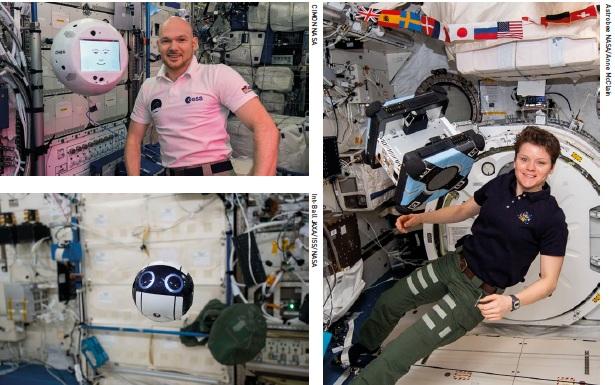 Icarus Robotics’ design stands on the shoulders of space robots of the past, namely Astrobee, CIMON and INT ball. Left: ESA astronaut Alexander Gerst with CIMON, an artificial intelligence helper aboard the ISS. Centre: The Int-Ball drone is activated on the Space Station in July 2017. Right: NASA astronaut Anne McClain with Astrobee robot ‘Bumble’ Three Astrobee free-flying robots Bumble, Honey and Queen were launched to the ISS in 2019.
Rise of the robots
Space and robotics have gone hand in hand; the two have been symbiotically paired through science fiction movies and literature from I, Robot to Blade Runner
Space and robotics have gone hand in hand; the two have been symbiotically paired through science fiction movies and literature from I, Robot to Blade Runner. The reality is more complicated and harder to solve.
Long signal delays that prevent remote control, non-scalable control methods, and the absence of robust, cost-effective hardware have held the field back until now. Even communicating with the ISS, just 250 miles above the surface, introduced delays of over 1.5 seconds, enough to make precise teleoperation unworkable.
Recently, however, we have seen a number of advances in terrestrial robotics, driven by the rise of humanoid robots in long-distance teleoperation, and it is now possible to remotely operate robots better than ever.
The rollout of optical, laser-based communication networks in low Earth orbit, namely Starlink, has reduced latency to mere tens of milliseconds. Historically, an RF signal would be transmitted from the ground to the faraway geostationary orbit (GEO) and back to LEO.
Meanwhile, for the first time, we see the robustness of robot learning or ‘embodied artificial intelligence’. Robots can now learn from human demonstrations, improving their ability to perform complex, variable tasks without constant supervision.
With the technology more ready than ever, the economic necessity for a cheaper labour source in space makes a strong case. Paying an operator $100,000 a year is nothing compared to the tens of millions it would cost to sustain an astronaut to do the same work. Now, with pressure from the Moon to Mars directive, Artemis and national competition, the mission frequency is accelerating. For the first time, robots are capable enough, the need urgent enough and the economics compelling enough to make robotic labour in space inevitable.
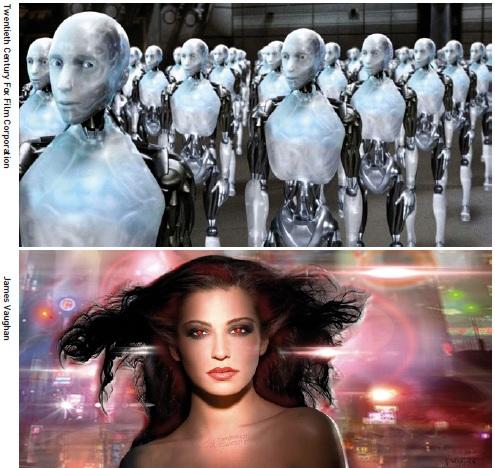 Space and robotics have always gone hand in hand – the two have been symbiotically paired through science fiction movies and literature from I, Robot to Blade Runner.
New approach
Icarus Robotics is taking a fundamentally different approach to space robotics. When I founded the company with Ethan Barajas, who started his career at NASA developing autonomous plant growth systems for the ISS, we set out to do something ambitious: modernise space robotics and bring terrestrial advancements to the final frontier of space.
Legacy systems in space robotics are narrow in scope and pre-programmed for specific missions with code that must be rewritten for every new task. We’re building general-purpose robots powered by embodied AI. The concept is straightforward: skilled human operators on Earth remotely control robots in space to perform real work, while simultaneously collecting training data. That data then trains the robot’s AI ‘brain’, enabling greater autonomy over time.
This mirrors the same breakthroughs we now see in terrestrial robotics. Every company, from Tesla with Optimus to Figure and 1X, is pursuing embodied AI through human-in-the-loop training. We will be the first to bring these advancements to orbit, with short, fast design cycles unlike the multi-year timelines that have become notorious in aerospace. The result is an intelligent robot in a single form factor that can generalise and scale across many tasks, rather than having to be rebuilt each time.
Icarus is building a free-flying dexterous robot which uses fan propulsion to fly through a station, essentially a drone for microgravity environments. The robot has two arms, allowing operators to actively control the robot to do grasping and manipulation tasks while the propulsion system provides stability. It also has a comprehensive sensing suite of vision, depth and proximity sensors” as the robot may use different exact sensor types in some cases, than previously listed. This provides the operator with eyes, ears and other new senses in space, giving them a rich and immersive experience.
Our design stands on the shoulders of space robots of the past, namely Astrobee, CIMON, and INT ball. While these robots were also free-flyers, their main aim was to act as companions and mobile sensing units. Our robot combines these core qualities with manipulation capabilities, allowing it to also carry out physical labour.
By offloading repetitive and dangerous work to intelligent, adaptable robots, we make space operations safer, faster and more sustainable
We’re building and testing daily at our headquarters in New York’s Navy Yard, using custom test rigs and advanced simulation environments, culminating in our first campaign to the ISS in 2027 for full-scale testing, in partnership with Voyager.
Space has a labour problem. Every other part of the industry - launch, payload, data - has scaled, but labour hasn’t. The embodied AI revolution offers a way forward. By bringing the same human-in-the-loop training methods that have transformed terrestrial robotics into orbit, we can finally create scalable labour for space.
Our goal isn’t to replace astronauts, but to extend what’s possible. By offloading repetitive and dangerous work to intelligent, adaptable robots, we make space operations safer, faster and more sustainable. More robots in space means more humans in space. This is a chance to work on embodied AI at the final frontier, with technology that will define humanity’s expansion beyond Earth.
About the author
Jamie Palmer, Co-Founder and CTO of Icarus Robotics (https://www.icarusrobotics.com/), earned his Master’s in Robotics from Columbia University on a full scholarship, researching intelligent, dexterous manipulation in the Robotic Manipulation and Mobility Laboratory. He developed and deployed autonomous hospital robots during the pandemic and worked as a dyno test engineer for the Mercedes-AMG Petronas Formula One team.