

It is human nature to define boundaries, from property to nations, even the boundary to space itself, but this becomes difficult at an astronomical scale. Almost a century ago, in 1930, Pluto was thought to mark the edge of the solar system, but definitions change with time. In this article, the authors present a theory that the Milky Way’s gravity, including its dark matter, redraws the Sun’s frontier. Moreover, it allows the Solar Lagrange points L1 and L2 to form ‘portals’ that funnel interstellar visitors into the system, possibly capturing them for future study.
If you ask planetary astronomers where the solar system ends, they will say well past the planets, well past the bright band of the Kuiper Belt where Pluto resides, and still further to a shadowy realm called the Oort Cloud. There, a trillion or so icy cometary bodies are thought to orbit at the limits of the Sun’s gravity, about 1.5 light years away. This is so far away that passing stars can tug at those objects just enough to start them on a journey, taking a million years or more, to the inner solar system.
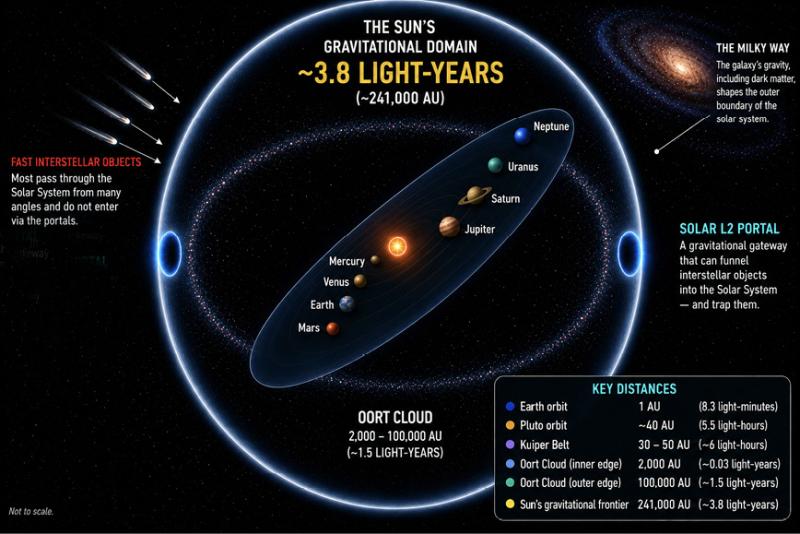 Redfining the edge of the Solar System the Sun s gravitational frontier extends far beyond the Oort Cloud and comes with portals.
On average, this occurs at about one Oort Cloud comet a year. It’s a compelling picture of a solar gravitational kingdom fading into the vastness of interstellar space. But gravity does not stop at a border the way a nation’s territory does. The Sun’s pull weakens smoothly with distance, and in principle extends forever. So, what do scientists really mean when we talk about the extent of the solar system?
Instead of asking where the Sun’s gravity becomes negligible, perhaps the better question is where it becomes non-dominant - or where the Milky Way’s overall gravitational field competes strongly enough to reshape the Sun’s sphere of control. When you treat the galaxy not as a distant backdrop but as an active player, and when you include the extra gravitational heft of dark matter, the answer to our question changes.
The solar system’s gravitational frontier extends to nearly 3.8 light-years from the Sun, roughly 241,000 astronomical units (AU), a distance that brings the ‘edge’ of the solar system to within the same scale as the separation between neighbouring stars. And, perhaps most intriguingly, that frontier comes with two special regions or ‘portals’ through which interstellar objects can enter and, under the right conditions, become permanently captured.
The result is not a new stationary boundary. It is a dynamical boundary, a set of locations and velocities that determines whether an object remains bound to the Sun indefinitely or eventually wanders back into interstellar space on its own journey around the galactic centre.
Interstellar visitors
The solar system’s gravitational frontier extends to nearly 3.8 light-years from the Sun
All stars are born in nebulae, in clusters like our own birth cluster, which may have spawned between 2000 and 20,000 stars about 4.6 billion years ago. Our solar system formed from a rotating disk of gas and dust. In the inner regions, where sunlight and heat were intense, rocky material accumulated into the terrestrial planets: Mercury, Venus, Earth and Mars. Further out, volatiles could condense, helping giant cores grow quickly and capture thick envelopes of gas. The result was our set of gas and ice giants: Jupiter, Saturn, Uranus and Neptune, each with a sprawling architecture of moons, rings and resonant orbital patterns.
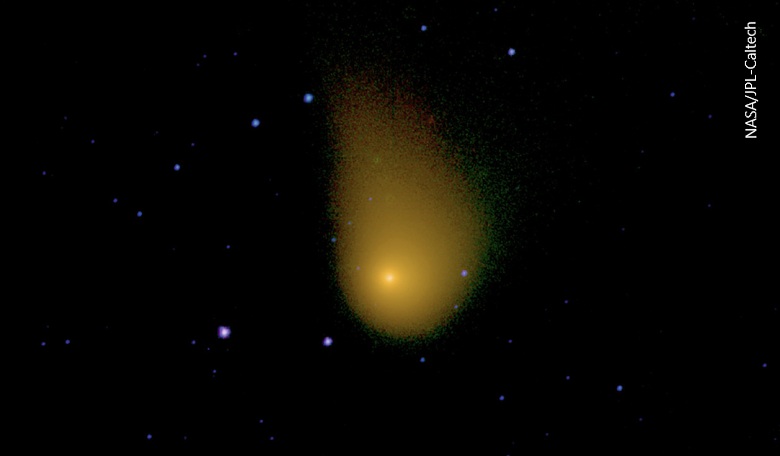
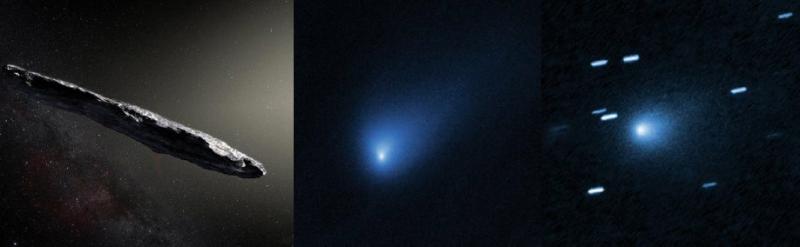 Interstellar visitors such as 1I/’Oumuamua, 2I/Borisov and 3I/ATLAS (left to right) demonstrate that material from other planetary systems regularly passes through our own. Photo credits: 1I/’Oumuamua: ESO/M. Kornmesser; 2I/Borisov and 3I/ATLAS: NASA/ESA /Jewitt (UCLA)
As solar systems come into being, their host stars in the cluster are gravitationally attracted to each other and perform a sort of ‘dance’ as they move past each other. But a fraction of the original disk material around each star never makes it into planets. These leftovers persist as small bodies: asteroids, comets and the countless tiny dust fragments. These small bodies are more than debris; they are time capsules, chemical laboratories and sometimes hazards. But when they leave their solar system origin and move out into interstellar space, they also act as messengers.
In the last several years, planetary astronomers have obtained the ability to observe objects that were formed around other stars, ejected into the galaxy and propelled through interstellar space to become visitors to our solar system. The implication is simple and profound: the solar system is not an isolated island. It moves in a cosmic sea of wandering material. That knowledge raises a natural question. When interstellar objects pass through our region of space, could they become trapped? And if so, under what conditions does the Sun’s trapping power begin and end?
Where is the edge?
The most familiar candidate for the solar system’s furthest boundary is the Oort Cloud, a hypothesised population of icy bodies that probably extends from tens of thousands of AU to around 100,000 AU, roughly 1.5 light-years from the Sun. In many depictions, it forms a vast spherical shell, the source of long-period comets.
Whether the Oort Cloud is truly spherical, how far it extends, and how many bodies it contains remains unanswered - we infer its existence mainly from highly eccentric comet orbits - but as a conceptual boundary it has an intuitive appeal. Beyond that region, the Sun’s grip is weak enough that passing stars and the Milky Way’s tidal field can dramatically reshape orbits. In other words, it is where the solar system begins to look less like a self-contained planetary system and more like a region of space shared, and sometimes contested, by many passing gravitational objects.
Yet even if the Oort Cloud marks an important reservoir, it does not necessarily mark the Sun’s maximum gravitational domain. To explore that domain, we must bring in a classical idea from celestial mechanics referred to as Lagrange points.
The solar system begins to look less like a self-contained planetary system and more like a region of space shared, and sometimes contested, by many passing gravitational objects
Imagine two massive objects, say the Earth and the Sun, locked in their mutual gravitational orbits. Now imagine a third object with negligible mass: a spacecraft. In the rotating frame that turns with the Earth around the Sun, there are special locations where the gravitational pulls balance. These are the Lagrange points, five in total, labelled L1 through L5. Three of them (L1, L2, L3) lie along the line connecting the two masses: L1 between Earth and Sun, L2 beyond Earth on the line away from the Sun and L3 on the far side of the Sun. Two more (L4 and L5) form equilateral triangles with the two masses and can host the stable, so-called Trojan orbits.
These points are not just mathematical curiosities. They have become prime real estate for space science. Satellites near Sun-Earth L1 monitor the solar wind and provide early warnings of space weather that affects Earth’s magnetosphere. Astrophysics observatories such as the James Webb Space Telescope (JWST), orbit near Sun-Earth L2, enjoy a thermally stable environment, shielded from infrared radiation from the Sun and the Earth with a clear view of deep space.
Solar Lagrange points
The key point here is that the Lagrange points represent the geometry of gravitational control in a rotating two-body system, so if we want to understand the Sun’s gravitational reach inside the Milky Way, we can ask an analogous question. Where are our Sun’s Lagrange points? The answer is that Solar-L1 is in the direction toward the galactic centre, where the Sun’s pull and the galaxy’s pull create a saddle point, and Solar-L2 is in the opposite direction, where the same balance occurs on the far side.
Our Sun is not stationary; it orbits the centre of the Milky Way at roughly 248 km per second, completing one galactic year in about 225 million Earth years. The gravitational field that keeps the Sun in orbit comes from the galaxy’s mass, both visible or baryonic matter (stars, gas, dust) and the much larger unseen component known as dark matter. As an initial effort to make this calculation, we can treat all the baryonic mass enclosed within the Sun’s galactic orbit as if it came from a single effective point mass located at the galactic centre and add our latest model of the Milky Way’s dark matter.
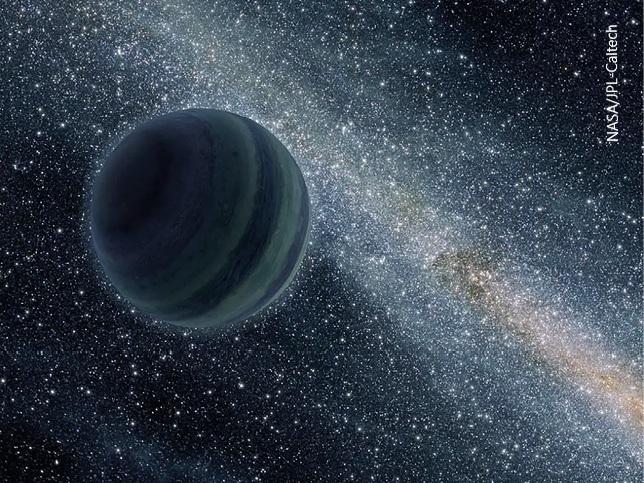 Artist’s concept showing a Jupiter-like planet alone in the dark of space, floating freely without a parent star. Rogue planets, ejected from their parent stars, may drift through interstellar space for billions of years. Under the right conditions, some could theoretically become permanently captured by the Sun.
The result yields both points which lie at approximately 3.81 light-years from the Sun, or about 241,000 AU. That’s further than the traditionally discussed Oort Cloud distances, by more than a factor of two, and is comparable to the scale of the solar neighbourhood itself. Here’s where dark matter becomes more than a cosmological footnote. If you perform the same estimate using only the Milky Way’s baryonic mass, you get a much larger solar domain, around 12 light-years across. The reason is straightforward: more galactic mass means a stronger competing gravitational field, which shrinks the Sun’s region of control. In this sense, dark matter doesn’t just shape galaxies on vast scales, it changes the size of the Sun’s effective gravitational territory.
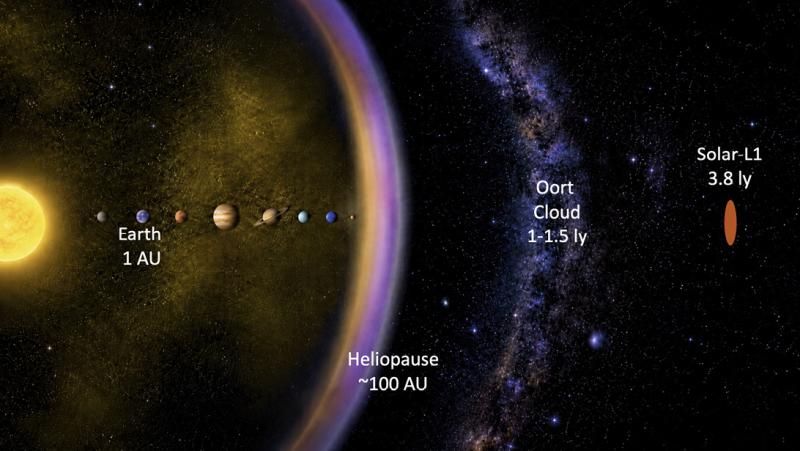 Key objects in the solar system are shown on a logarithmic scale illustrating the huge distances that are controlled by the Sun’s gravity.
Portals at the edge
The Lagrange points represent the geometry of gravitational control in a rotating two-body system
According to the mathematics behind Lagrange points, narrow dynamic channels or passages can form to connect ‘outside’ space to the region around the secondary body. The existence of such channels near the Sun-Earth’s L1 and L2 points helps explain how engineers can exploit these dynamic paths when designing complex interplanetary trajectories for missions with surprisingly low fuel costs.
For the Sun–Galaxy system, the geometry is on a much larger scale, but the logic is similar. If an interstellar object approaches the Sun’s domain at the right energy and direction, it can pass through a channel near Solar-L1 or L2, entering what is called the Sun’s Hill region which is our operational definition of the solar system’s outer gravitational domain. In physical terms, the opening associated with these distant Lagrange-point regions has a characteristic scale of about 7,880 AU in the simplified estimate, which is immense compared to planetary distances, yet very small compared to the 3.8 light-year radius itself.
It is helpful to visualise the situation by imagining a sphere around the Sun almost four light-years in radius. At two opposite points on that sphere, one facing the galactic centre and the other facing away, are these narrow dynamical portals. An object drifting through interstellar space can cross into the Sun’s territory through these portals, much the way a spacecraft can drift into a region around L1 or L2 in the Sun-Earth system. But entering the territory is not the same as staying there forever.
Solar-L1 and L2 create an opportunity for a particular capture pathway referred to as permanent weak capture, which combines two ideas. First, the object becomes weakly captured in the technical sense that its Keplerian energy with respect to the Sun becomes negative, meaning that the Sun can, in principle, hold it. Second, the capture is permanent in a strict dynamical sense: the object never escapes back to interstellar space and never collides with the Sun. These conditions occur by moving slowly through the portal toward the Sun where the object will become permanently captured for all time.
Capture cross section
Our Sun is not stationary; it orbits the centre of the Milky Way at roughly 248 km per second, completing one galactic year in about 225 million Earth years
It is important to understand that the Solar-L1 or L2 portal is not a single point, but a region referred to as a capture cross section. In our simplified analysis, the geometry of the channel opening can be approximated as an ellipse or rectangular window whose area depends on how much out-of-plane motion is allowed. Using conservative assumptions, the effective cross-sectional area is calculated to be about 5 × 10⁷ AU²; with more generous out-of-plane allowances, the area can be closer to 5 × 10⁸ AU².
These are enormous areas in human terms, though again small compared to the vast sphere of radius 3.8 light-years. But here is the mathematical subtlety: not every point in that cross section corresponds to permanent weak capture. The permanently capturing trajectories form a fractal subset. In other words, the net is large, but the threads are fine. What, then, determines whether a passing interstellar object threads the needle?
In our model, the key is the object’s velocity relative to the Sun at the boundary. To pass through the channel and remain in the capture region, the object must be moving relatively slowly, in the order of tens of metres per second in the range analysed. This is a demanding condition. Many interstellar objects sweep through the solar system at speeds of kilometres per second, fast enough to remain unbound.
But interstellar space is vast, and the distribution of velocities is broad. There may exist a population of slow-moving objects in the Sun’s neighbourhood, including free-floating bodies that drift with velocities not so different from the Sun’s own motion through the galaxy. If such objects are common enough, then the solar system’s portals become more than a mathematical curiosity. They become a potential pathway by which the Sun can accumulate interstellar material over cosmic time.
Interstellar visitors
The very recent discovery of interstellar objects passing through our solar system on hyperbolic trajectories has opened an entirely new window onto the material and processes shaping planetary systems across the galaxy. The objects in question are known as 1I/Oumuamua, detected in 2017, 2I/Borisov in 2019 and 3I/ATLAS in 2025.
These objects act like comets, which is why they were observed at all, and reveal a surprising diversity among bodies that have been created in distant stellar environments and set adrift into interstellar space by some unknown mechanisms. Together, these visitors provide the first direct evidence that fragments from other solar systems routinely pass through our own, each carrying chemical, structural and dynamical clues about their origins.
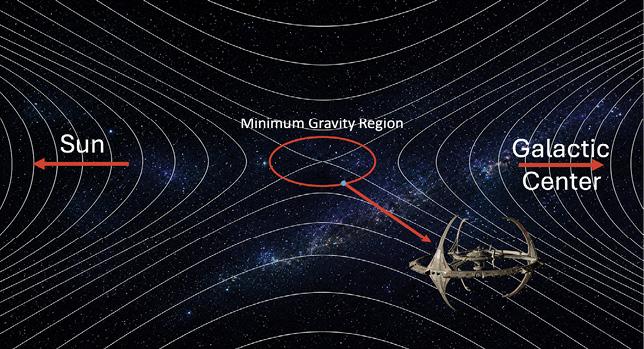 A gravity map of the Lagrange point Solar-L1 showing the minimum gravity region that allows interstellar objects to drift into the solar system and be captured by the Sun. Perhaps in the distant future this portal could also be used as a region in deep space where advanced extraterrestrial beings, from neighbouring star systems, would gather on a Solar-L1 orbiting space station.
If interstellar comets and asteroids pass through our solar system regularly, some fraction may approach the Solar System’s portal cross section at low enough relative speed to have a chance, however small, of being involved in the permanent weak capture process. Perhaps the most dramatic possibility involves rogue planets: planetary-mass bodies that roam interstellar space unbound to any star. The existence of such objects is a natural consequence of planet formation.
Young planetary systems are chaotic arenas where gravitational encounters can eject planets entirely, while stellar flybys in dense birth clusters can strip planets from their hosts. Even later in a star’s life, as it evolves into giant or dwarf stages, can send planets outward. Our own solar system’s history probably included major reshuffling among the giant planets, and some models suggest that an additional giant planet could have been ejected early on.
An object drifting through interstellar space can cross into the Sun’s territory through these portals, much the way a spacecraft can drift into a region around L1 or L2 in the Sun-Earth system
A rogue planet passing through the inner solar system would not be subtle. Its gravity could perturb planetary orbits, potentially leaving signatures detectable in long-term orbital records. That makes the prospect of a captured rogue planet scientifically tantalising and perhaps a little unsettling.
An order-of-magnitude probability estimate for permanently capturing a rogue planet through the Solar-L1/L2 portals can be calculated, with the largest uncertainty being the distribution of rogue planets near the Sun and, especially, the probability that such an object has a sufficiently low relative velocity. Under plausible assumptions, the probability for permanent weak capture per candidate object can fall in a range roughly from 10-9 to 10-6 times a velocity-factor term, reflecting how sensitive capture is to the unknown velocity distribution. Even if those numbers seem small, they are not zero and time is the great amplifier. Over hundreds of millions of years, or even billions of years, the solar system has had many opportunities to encounter wandering objects.
Rethinking our Solar System
What should we do with this picture of a 3.8-light-year solar capture domain? First, it reframes a classic question. The Oort Cloud remains an important structure, the likely source of long-period comets and a dynamical archive of early solar system history. But it sits comfortably inside a larger region where the Sun’s gravitational control is still meaningful when viewed against the background of the Milky Way galaxy. If the Sun’s effective Hill-like boundary lies near 3.8 light years, then the solar system’s gravitational reach extends well beyond our traditional reservoir of comets.
Second, it highlights the Milky Way as an active sculptor of the solar system’s outermost dynamics. Within 40 AU of the Sun, the dominant perturbations come from our planets. But far beyond the Oort Cloud, the galactic tidal field competes with solar gravity in ways that can open channels and shape capture and escape routes. In our simplified model, the galaxy does not just stir the outskirts, it helps define the very geometry of the Sun’s gravitational domain.
These visitors provide the first direct evidence that fragments from other solar systems routinely pass through our own
Third, it suggests a mechanism, at least in principle, for the solar system to accumulate interstellar objects over time. This accumulation would not be a steady, easy process but may have been significant at times when the solar system traversed dusty molecular clouds on its journey around the galactic centre. The portals are real features of the dynamical system and the capture cross section is not negligible in size, a combination that can matter in a universe where interstellar traffic is continuous, even if mostly unseen from our vantage point.
Finally, the result underscores a broader theme in modern planetary science, in that boundaries are often not where we first imagine them to be. The ‘edge’ of the atmosphere is not a sharp line; the heliosphere’s termination shock is not a simple sphere. The solar system’s gravitational frontier may be similarly nuanced as a region defined not by a sharp boundary but by a complex dance among forces, energies and trajectories.
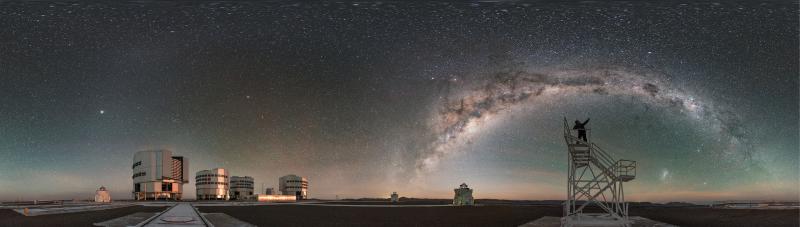 A striking panoramic shot of ESO’s Very Large Telescope in Paranal, in the Atacama Desert in Chile, taken in 2016. The stargazer visible to the right of the frame, pointing to the beautiful arc of the Milky Way curving overhead, is ESO Photo Ambassador, Babak Tafreshi. The constituent telescopes of the VLT can be seen scattered across the left of the frame.
A frontier to explore
Today, the concept of interstellar travel is being explored but our spacecraft won’t reach 3.8 light-years anytime soon. Even the fastest probes ever launched would require tens of thousands of years to travel that far. Yet we can explore this frontier in other ways.
With the James Webb Space Telescope, we can search for interstellar objects passing through the solar system and measure their velocities and trajectories. We can improve our census of rogue planets in the solar neighbourhood, constraining how many there are and how they move, and we can ask new observational questions. Could some very rare long-period comets have interstellar origins? Might captured interstellar bodies carry isotopic signatures distinct from solar system material and participate in bringing life-bearing materials?
In our simplified model, the galaxy does not just stir the outskirts, it helps define the very geometry of the Sun’s gravitational domain
Interstellar travel requires a mastery of gravity, which an advanced extraterrestrial civilisation might use to tour the galaxy, using portals created at Lagrange points for leverage. Remaining at these locations, they could observe the life within a stellar system with essentially no energy expenditure. So perhaps we should be looking for large space stations at stellar L1 and L2 locations as a techno-signature of advanced intelligent life?
Whether or not this is science fiction, these locations allow us to treat our solar system as a participant in the larger ecology of the Milky Way. The Sun’s domain is not a closed system, not merely the realm of our native planets and comets. It is a region whose shape is greatly affected by dark matter and whose boundary contains portals through which the galaxy can deliver new material. And it offers another important location to explore.
About the authors
Dr James Green is the founder of Space Science Endeavors. Having gained a PhD in Physics from the University of Iowa in 1979, he worked at Marshall Space Flight Center, Goddard Space Flight Center and NASA Headquarters before retiring in December 2022. During his 42-year career at NASA, Jim was the Agency’s Chief Scientist and longest serving director of the Planetary Science Division.
Dr Ed Belbruno received his PhD in mathematics from the NYU Courant Institute in 1981. He worked as an assistant professor of mathematics at Boston University until 1985, then moved to NASA’s JPL for Mission Design, where his work led to the first use of chaos for low energy trajectories to the Moon and beyond, with the rescue of Japan’s Hiten spacecraft, in 1991. He is a professor of mathematics at Yeshiva University, senior research associate at Princeton University, Astrophysical Sciences Department, and Visiting Member of the Institute for Advanced Study, Mathematics Department.