


Understanding sustainability requires examining not only what we do in orbit, but the assumptions we carry into orbit. How we conceptualise the space environment influences what we regulate, what we overlook, and whose interests are protected. This article examines how these impressions shape governance, environmental responsibility and the emerging role of startups in the space economy, and argues that meaningful sustainability depends on confronting these guiding assumptions head on.
The global space sector is evolving faster than the frameworks we use to understand it. Satellite constellations scale by the thousands, cislunar ambitions accelerate and commercial players increasingly define the character of orbit. Yet the language we use to describe this moment still leans on familiar tropes of exploration and innovation, as if today’s decisions were only technical milestones rather than political choices. The way we imagine space today will determine how we govern it tomorrow.
A more fundamental truth sits beneath the surface. If we take Earth’s existing power dynamics and extractive habits into orbit, we will rebuild their inequalities in space. The result will be a familiar pattern: concentrated benefit, distributed risk and environmental degradation that undermines long-term sustainability. This possibility is already visible in the structure of licensing decisions, debris distribution and access to orbital resources.
 The frontier narrative portrays space as territory waiting to be opened, and those who arrive first as pioneers charting a natural path forward with little regulation and a belief that innovation should outpace governance. This approach can normalise “first arrival equals first rights,” echoing patterns that historically concentrated power and marginalised latecomers.
How we imagine space shapes how we govern it
Before diving into policy, it is useful to acknowledge how diverse our interpretations of space actually are. Some actors treat space as infrastructure, important for communications or defence. Others imagine it as an environment that must be protected. Many still see it as a frontier of opportunity where limitations should be minimal. These mindsets quietly shape priorities and define what counts as responsible behaviour.
These different views explain why sustainability remains contested. Operators who view space primarily as a functional zone tend to see debris as an operational risk rather than a symptom of an extractive system. Companies that imagine space as a frontier often treat rapid deployment as proof of legitimacy. Conversely, those who see orbit as a shared environment begin from an entirely different ethical baseline.
Recognising these contrasting worldviews is essential because they guide policy as much as data does. Sustainability in space is not only a technical challenge but also a cultural one, rooted in the stories we tell and the values we project upward.
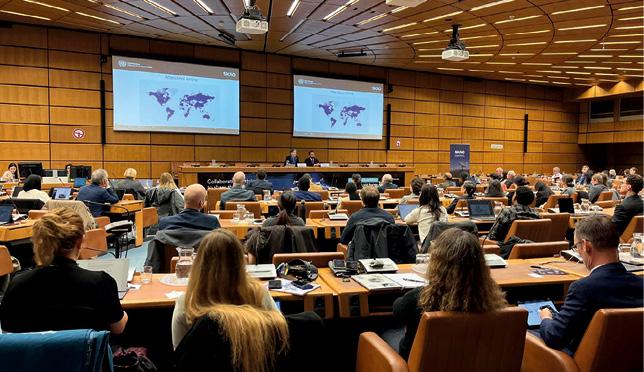 Some 200 participants from 86 countries attended the Workshop on Dark and Quiet Skies for Science and Society in Vienna hosted by the Square Kilometre Array Observatory/United Nations Office of Outer Space Affairs (SKAO/UNOOSA) in December 2025. Concerns about the space environment continue to be addressed by COPUOS and it was agreed to include “Dark and quiet skies, astronomy and large constellations: addressing emerging issues and challenges” on its provisional agenda for sessions up to 2029.
Governance in an unequal space age
Space governance reflects long-standing global inequalities. The foundational treaties were shaped at a time when only a few nations could operate in space, and their influence still permeates today’s institutions. The United Nations Committee on the Peaceful Uses of Outer Space (COPUOS) provides essential legitimacy, but its consensus model makes rapid adaptation difficult. This tension becomes clear when emerging issues collide with outdated structures.
Recent debates illustrate the complexity. Several African and Latin American delegations have raised concerns in COPUOS about uneven exposure to debris risks and the limited ability of developing nations to influence decisions that shape the future orbital environment. Licensing decisions for mega-constellations often reshape the shared low Earth orbit (LEO) environment with limited meaningful influence from many affected states, even though formal coordination channels exist through the International Telecommunication Union (ITU).
Meanwhile, the US Federal Communications Commission’s revised deorbit rules, the European Space Agency’s Zero Debris efforts, and the proposed European Union Space Act, a formal EU regulation introduced in June 2025 to harmonise safety, resilience and sustainability requirements, represent meaningful steps toward modern regulation. ESA’s Zero Debris efforts include an internal policy framework for debris-neutral missions. They also involve a voluntary multi-stakeholder Zero Debris Charter that continues to gain new signatories.
The way we imagine space today will determine how we govern it tomorrow
Taken together, these European and international initiatives illustrate a broader shift toward embedding environmental responsibility into operational practice. The five-year deorbit requirement remains a significant regulatory step, although major operators continue to push for adjustments to the rule.
These developments reflect an increasing willingness to internalise environmental responsibility in national and regional frameworks. Yet even these initiatives must coexist with strong commercial incentives and geopolitical competition. National rules alone cannot solve issues whose consequences are global.
Real progress will likely emerge from a layered approach: stronger national enforcement, coordinated international guidelines and industry-aligned incentives. This approach recognises the practical limits of each mechanism while acknowledging the interdependence of all actors. Sustainability will not be achieved through ideal structures, but through realistic ones that distribute responsibility more evenly.
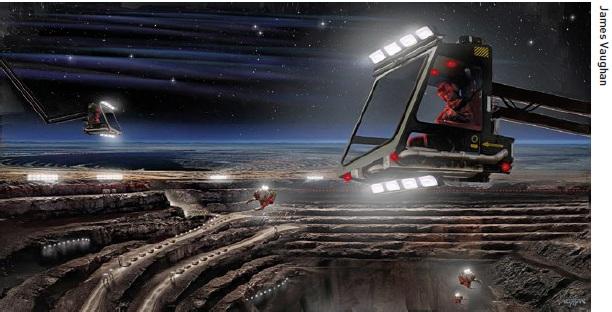
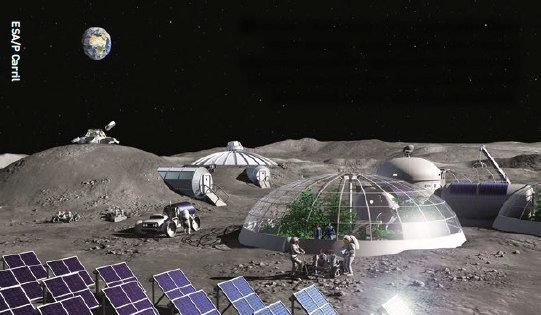 Artist’s impression of a sustainable Moon base concept. Sustainability here means balancing scientific opportunity, commercial interest and long-term preservation before detrimental norms become entrenched.
Frontier narrative and its consequences
To understand how behaviour takes shape, we must also examine the narratives that frame space. The frontier metaphor remains deeply influential. It portrays space as territory waiting to be opened, and those who arrive first as pioneers charting a natural path forward. While it energises public imagination, it also brings unintended consequences.
This mindset can normalise the “first arrival equals first rights,” principle, echoing patterns that historically concentrated power and marginalised latecomers. It frames regulatory caution as obstruction and encourages a belief that innovation should outpace governance. When applied to resource extraction or settlement concepts, it can make inequality appear like an unavoidable side effect of progress.
Without a shift in narrative, repetition of Earth’s inequalities becomes almost inevitable. By contrast, framing space as heritage, infrastructure or environment invites more collective approaches and broadens the range of governance models we consider legitimate. The narrative we choose influences not only public expectation but the ethical boundaries of future policy.
 Japanese startup Pale Blue produces a range of systems that use water as a propellant. It uses patented electron cyclotron resonance (ECR) technology to generate water plasma, which is the power source for its satellite thrusters.
Space as an environment, not an empty abstraction
Recognition of orbit as a genuine environment has grown significantly in the past decade. Congestion in LEO, increased concerns about the cascade effect and interference with astronomy have made it clear that the orbital domain behaves less like an infinite backdrop and more like a finite ecological system. These concerns continue to be raised in the ongoing Dark and Quiet Skies processes at COPUOS, but voluntary mitigation efforts by operators remain uneven. Operators now face mounting pressure to incorporate debris mitigation and responsible end-of-life practices as standard design elements.
This environmental shift is also intertwined with questions of fairness. Environmental risks in orbit rarely affect all actors equally. Smaller nations with limited satellite fleets may face proportionally greater harm from collision debris or lost access to radio frequencies. The distribution of risk mirrors inequalities on Earth, complicating the notion that space is a neutral arena.
Beyond LEO, similar questions are emerging around cislunar space and planetary surfaces. The Moon is no longer an abstract destination. It is a rapidly evolving operational domain that requires proactive stewardship to avoid irreversible patterns. Sustainability here means balancing scientific opportunity, commercial interest and long-term preservation before detrimental norms become entrenched.
Environmental awareness in space is therefore not only about protection. It is about ensuring that the benefits of the space environment remain accessible to all, not just to those who can absorb the costs of degradation.
A closer look at startups and the NewSpace ecosystem
The rise of NewSpace companies is often celebrated as a democratising force, but insider experience shows a more complex reality. Startups bring creativity and disruptive potential yet operate within tight funding cycles and demanding investor expectations. Teams often face real design tensions: cost versus responsibility, speed versus stewardship, investor timelines versus technical robustness.
Real progress will likely emerge from a layered approach: stronger national enforcement, coordinated international guidelines and industry-aligned incentives
Yet startups also introduce something the space sector has long lacked: new voices, new expectations, and new cultural assumptions about what responsible behaviour should look like. Their presence diversifies who gets to shape the norms of the orbital environment and helps balance a domain that has historically been defined by a small number of powerful actors. When sustainability is embedded from day one, not as a feature added later but as part of a company’s identity, startups can set new baselines for ethical practice that larger incumbents may eventually follow. This potential is not guaranteed, but it is real. Governance frameworks that reward long-term stewardship can amplify these contributions and prevent early-stage pressures from undermining them.
Many early-stage companies prioritise survival and rapid innovation over long-term debris mitigation. Launch opportunities are often chosen based on affordability rather than environmental impact. Public contracts can also shape incentives, pushing companies toward national strategic goals rather than global sustainability. Some public programmes now include explicit sustainability language, although implementation varies widely and national priorities often remain dominant.
Without supportive governance, startups may unintentionally reproduce unsustainable terrestrial patterns. Yet they also possess genuine advantages. They can implement sustainability-by-design from the outset, and some already prioritise low-mass architectures, autonomous collision avoidance and transparent operational data.
Startups can be part of the solution, but only if regulatory and financial frameworks reward responsible innovation. Sustainability must be aligned with commercial logic, not positioned as a luxury that early-stage companies cannot afford.
Inclusive governance without illusions
Inclusivity is often framed as an aspiration, but in space governance it is preventative. Without broader participation, governance will replicate existing inequalities by default. This is not idealism. It is structural reality.
A practical path forward includes expanding transparency requirements, harmonising licensing expectations, strengthening environmental obligations and increasing capacity-building support for emerging space nations. It also involves ensuring Global South perspectives remain central in negotiations around spectrum, debris mitigation and resource activities.
None of this requires reinventing the entire system. It only requires acknowledging that sustainable governance must reflect the diversity of those who depend on space infrastructure. Interdependence is already built into orbital mechanics. Governance must adapt to that fact.
Choosing the frameworks for our future in space
The space sector is approaching a decisive moment. Activity is accelerating, dependence on orbital infrastructure is deepening and commercial ambitions are expanding. Sustainability will not emerge from a single treaty or technological breakthrough. It will emerge from a gradual shift in how we interpret our obligations and understand our shared vulnerabilities.
A responsible future depends on broadening the imaginations that shape our governance decisions. It requires aligning business incentives with long-term stewardship and ensuring that environmental responsibility becomes part of routine mission design. Above all, it requires recognising that what we carry into space will define the architecture of our shared future.
The question is not how far we expand into space, but whether we can expand our imagination enough to avoid rebuilding Earth’s inequalities beyond the atmosphere.
 Munich-based startup The Exploration Company is dedicated to building accessible, sustainable and cooperative space worlds by serving the needs of space stations around the Earth and Moon. Their modular, reusable spaceships, named Nyx, can be refuelled in orbit, use green propellants, and have an open-source operating system.
About the author
Mehrsa Shirzadian is a space sustainability researcher and science communication specialist focused on the ethical, social and governance dimensions of the NewSpace era. She holds a Master’s degree in International Media and works at the intersection of space technology, public discourse, and environmental responsibility. Her work examines how narratives commercial practices and governance frameworks shape equity and long-term sustainability in orbital and cislunar environments. She is also actively involved in the space industry, bridging analytical research with applied innovation.